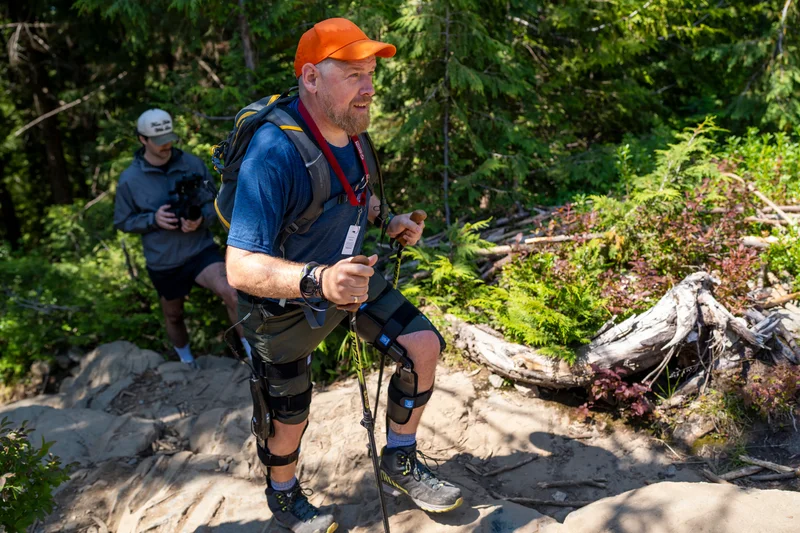
It’s 10:30 a.m. on a warm day in mid-July, and Jamie McAnsh is sitting soaked in sweat on a log bench off to the side of the Grouse Grind trail on Vancouver’s North Shore. He’s about halfway up the 2.5-kilometre mountain trail, which includes 2,830 stairs, and he’s taking a moment to reflect.
“Stairs have always been something I shy away from because they’ve always been hard,” he says. Then, pointing to the orthosis device on his legs, he adds, “This doesn’t make it necessarily easy, but it does make it possible.”
Possible is the point for Mr. McAnsh.
In his early 30s, the Brit was working as a sales executive for a motorcycle company in Wales, satisfying his love of the machines. He was also an avid runner, with an affinity for the outdoors. By all accounts, Mr. McAnsh led a relatively normal, active life.
Then, on Jan. 6, 2014, he suffered a neurological spasm overnight that caused nerve damage to his spine and sensory nerves in his lower body. He became partly paralyzed from the waist down.
Mr. McAnsh was later diagnosed with bilateral lower-limb complex regional pain syndrome, a rare, incurable neurological condition that led to him taking 16,000 milligrams of pain medication daily at one point. The pain was so intense it shut his body down.
Mr. McAnsh’s condition is degenerative, and he will never fully recover. He used a wheelchair at first, and then later he transitioned to forearm crutches. But he became determined to climb back up – quite literally – and encourage others to do the same.
In 2022, he spent 11 days trekking to Everest Base Camp on crutches. Shortly thereafter, he set his sights on a new challenge: Mount Kilimanjaro. But in anticipation of climbing sections where he would need to use his arms to scale rock, Mr. McAnsh began searching for yet another mobility aid solution.
That’s when he discovered a KAFO, or a knee-ankle-foot orthosis device, made by a French company, Thuasne. It was perfect. Their system, which looks like a leg brace with a hinge at the knee and a shoe insert, gave him a sense of independence that he didn’t have on crutches or in a wheelchair, helping him relearn how to walk normally again.
So, he made his pitch to them. “I basically just said, ‘Look, I’m climbing Kilimanjaro, and I want to do it in those structures, and I want to work with you,’” Mr. McAnsh said.
This was in June, 2024. Eight weeks later, he was climbing Kilimanjaro using the KAFO, proving to himself and others that the limits of what’s possible with this technology are beyond what he or the company previously imagined.
“I want everybody to be able to do what they want to do, and if that’s taking a dog walk or playing with the kids, or whatever it is, then I want them to be able to feel that because I know what it’s like to have that taken away from you,” he said. “And when you’re able-bodied, you don’t appreciate it until you don’t have it.”
Fast-forward two years and Mr. McAnsh has hardly slowed down. Today, he’s preparing to climb Mount Everest in 2028, and has several summits along the way to prove his own fitness, as well as the KAFO technology’s readiness.
His first test: North Vancouver’s Grouse Mountain. It’s a fitting locale, since the orthosis Mr. McAnsh wants to wear to summit Everest won’t be the same one that he wore to climb Kilimanjaro in 2024. This time, he’s relying on Canadian technology, in part, to take him to the top.
Mr. McAnsh met Vancouver-based company Bionic Power through Thuasne after the two businesses collaborated to create the SpryStep Agilik KAFO – a medical device offering help with everyday mobility for patients with weakness in their legs.
Bionic Power’s contribution, the Agilik, represents years of continuous research and development to create a device that attaches to the custom orthosis at the knee joint. It contains a motor and a gearbox and applies torque at the joint as programmed by a physician using real-time gait analysis from the sensors embedded in the rest of the orthosis. It builds on Thuasne’s previous KAFO models, technology-wise, with its increased power and specificity to a user’s needs.
Altogether, the SpryStep Agilik is a lightweight, modern alternative to the bulky, full-body exoskeleton-like devices of the past, making Bionic Power one of a suite of companies contributing to the normalization of this type of technology within society.
There are straps around Mr. McAnsh’s waist, thighs and just below his knees as he scales the first few steps of the Grouse Grind. Sweat pools in the areas where the device fits snugly to his skin and clothes.
As part of the orthosis device Mr. McAnsh relies on to get around every day, he wears a battery pack that rests on his lower back. The device’s carbon-fibre structure and soft straps mean Mr. McAnsh can almost forget he’s wearing it, and given how much it reduces the pain he deals with on a daily basis, it’s worth it regardless.
The Agilik collects data about his gait and movements, displayed in an app. The whole orthosis can be controlled either through the app or buttons on the side of the knee joint, where the motors sit. It’s designed to help people with a range of gait impairments, which commonly occur with conditions such as cerebral palsy and spina bifida, or after a stroke. It helps with knee flexion and extension, providing resistance and assistance, and relies upon multiple sensors, including those embedded in a shoe insert, to detect a user’s movements.
Altogether, the cost of the device varies greatly from patient to patient. For example, in the United States, reimbursement can range from US$30,000 to US$40,000, but that includes a suite of care and fitting around the orthosis – not just the device itself. In some countries, such as the U.S., Germany and Australia, the device can be fully reimbursed through health insurance, said Gualtiero Guadagni, chief executive officer of Bionic Power.
However, in Canada, there’s no streamlined pathway toward reimbursement for the Agilik, Mr. Guadagni said. “It’s our backyard, it’s our device. We are a Canadian company, and simply, the Canadian system doesn’t make it easy for any patient to get it,” he said.
Mr. McAnsh is lucky in the sense that he’s able to use the device through a sponsorship deal with Bionic Power and Thuasne. It has become a lifeline for him, allowing him to move around more or less as an able-bodied person would.
For Mr. McAnsh, performing epic feats such as climbing Everest has become his way of spreading the word about what’s possible with the right technology.
“My story is not unique. There are people that just sit on their ass, and they sit at home in this imprisonment of their own self-devaluation and go, ‘My life’s over,’ when actually it’s not,” he said.
“But they don’t even know that this kit exists. That’s the point. It’s getting them to know that this kit exists because that will give them hope.”
At Bionic Power’s Vancouver office, it’s the day before Mr. McAnsh is set to tackle the Grouse Grind, and he’s seated across the table from Mr. Guadagni, who’s scrolling on his phone.
He’s looking at Mr. McAnsh’s Instagram account, trying to find videos the adventurer sent him a week earlier after he strapped himself into a harness, dangled off the side of a cliff and climbed up a rock face using his Agilik.
“When he sent those, I was like, ‘No, it’s impossible,’” Mr. Guadagni said, adding that it reassured him heading into the next day’s activities, seeing what both the device and Mr. McAnsh are capable of.
Make no mistake: Grouse Mountain is no Everest. Its peak reaches approximately 1,200 metres in elevation, whereas Everest’s is at roughly 8,849 metres. The conditions and required fitness levels for each are drastically different. Grouse is a mountain locals race up before work. Everest claims the lives of several people every year in their attempts to summit.
But for Mr. McAnsh, Grouse is merely the first step in his own training and in the advancement of the technology that he plans to rely on for his Everest attempt. The Agilik is not made for climbing mountains; it’s a custom orthosis designed for use at home, in rehab clinics and in everyday tasks. A battery charge usually lasts him a couple of days, and the lithium batteries, as well as the motors powering the device, were not necessarily designed with extreme winter conditions or excessive exertion in mind.
However, this hasn’t stopped Mr. McAnsh from testing its limits and challenging the Agilik to keep up.
When Mr. McAnsh decides to do something that Bionic Power’s roughly 27-person team hasn’t run a test for, they’re understandably nervous. But in the same breath, they’re quick to consider the benefits.
The more he takes the orthosis to places it has never been, the more data they can collect on its performance and how it can be improved.
On the morning of the Grouse Grind ascent, it’s an unusually buggy summer’s day. Mr. McAnsh is about a quarter of the way up when he takes his first break. He’s accompanied by a handful of Bionic Power employees, including Mr. Guadagni and several engineers, who had a hand in designing the Agilik. This pause is their first chance to disconnect and reconnect their phones to the device. This way, they say, the data files collected from the total hike will be separated into digestible chunks, rather than one huge file.
The data they collect can be used to help train Bionic Power’s machine-learning models and contribute to the development of future Agilik iterations, Mr. Guadagni said.
However, when it comes to the model that Mr. McAnsh will wear on Everest, well, that’s still undecided. Bionic Power is currently working with its partner, Thuasne, to decide on the best design for the challenge.
Beyond the technology strapped to his legs, Mr. McAnsh’s ascent will be different in other ways from those of most climbers. For example, Mr. McAnsh will be climbing up the north face of the mountain, as opposed to the more popular southern route. This will take him into more adverse weather conditions, but it will protect him from the high risk of an avalanche or ice fall that he would have to navigate on the south side.
“I can’t run. It’s something I can’t do. So, I don’t want to put myself into an avalanche situation. I also can’t jump, so I don’t want to put myself into the Khumbu Icefall,” he said.
Then there are questions such as how many yaks Mr. McAnsh will have to hire to carry items unique to his journey, and how many batteries or what kind of charging infrastructure he will have to bring.
He makes his calculations. “If we need a generator, then we need to have a yak to carry the generator,” he said. “And if we got a generator, we need to have fuel. So, if we have fuel, now you potentially have to have two yaks, one to carry the generator and one to carry the fuel.”
Mr. McAnsh has dreamt of climbing Everest since he was seven years old. He had a picture of the mountain on a wall in his bedroom that he still carries with him. “It was always something that I would some day do. And then I woke up paralyzed.”
But standing at the top of Grouse Mountain on a sunny day in mid-July, exhausted and exhilarated, Mr. McAnsh is proving yet again what’s possible with some Canadian technology and a whole lot of willpower.
Grouse is no Everest, but it is two hours and 28 minutes, 2,830 stairs, and 777 metres of elevation closer to his goal.
“If I can stand on the summit of Everest, then who’s out there that wants to just go to Walmart?”
Body of evidence: More from The Globe and Mail
The Decibel podcast
Maryam Fatima had her first seizure within minutes of being born. On bad days, she had hundreds. To save her brain, doctors would have to destroy part of it with a radical surgery, never used in Canada before. Health science reporter Jennifer Yang spoke with The Decibel about what happened next. Subscribe for more episodes.