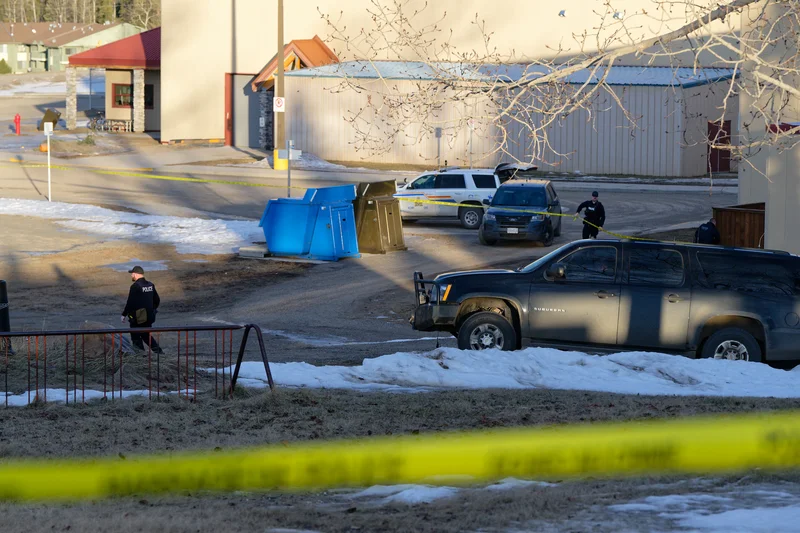
Newly released court documents show police received a flurry of calls as the fatal Tumbler Ridge school shooting unfolded, including a report that the suspect had killed her mother and half-brother and crashed into a snowbank as she drove erratically away from the family home.
RCMP quickly identified the possible suspect as a member of a family infatuated with firearms, the documents show. Multiple other calls flooded into 911 from terrified people trapped inside the school on the afternoon of Feb. 10.
Copies of several information to obtain a warrant documents, or ITOs, were recently released by a B.C. Provincial Court judge to a consortium of media outlets including The Globe and Mail as part of a court challenge. The records chronicle the chaos that erupted as a shooter, identified by police as Jesse Van Rootselaar, 18, began shooting students and teachers early in the afternoon of Feb. 10.
The documents are redacted, including whole pages and paragraphs, witness statements and what appear to be times and dates.
The ITOs, written in February and March, provide new details about the mass murder of five students, a teacher’s aide, the suspect’s mother and brother and the death of the suspect by a self-inflicted gunshot. The case has prompted calls for better mental health care and stronger regulation of artificial intelligence chatbots.
The documents show that after the shooting began, RCMP Inspector Chris Riddle reported the suspect possibly being “Jesse/Jessie JACOBS – a male that identified as female and member of a family ‘obsessed with guns.’”
Insp. Riddle then reported a possible second shooter as Jesse Van Rootselaar – the correct surname of the suspect – but the documents show officers reviewed the school’s CCTV footage to confirm there was only one shooter. An officer described the shooter as a “dark hair girl,” according to the ITO.
Mounties have said Ms. Van Rootselaar had transitioned from a biological male six years earlier and dropped out of Tumbler Ridge Secondary School two years after that.
Officers arrived at the school that day and noticed a green SUV parked outside with the engine running and the driver’s door ajar, according to the ITOs. The police had also fielded a call from someone reporting an armed driver maneuvering their SUV erratically with ‘side rear’ damage where it had backed into a snow bank as it left the home,” according to the ITO. The time of the telephone call appears to be redacted.
The caller reported that the driver was a male who “dresses like a female,” might go by the name “Steezy” and was the oldest son of someone whose name the court has redacted, the files state. The caller also reported “there were two dead bodies and shotgun shells on the floor” of the family home.
Some time during that day, a second person called to report the murder of Ms. Van Rootselaar’s mother and younger half-brother at the family home. Police searched and found the bodies of the two victims, as well as an empty shotgun and pellet gun, the documents show.
An RCMP’s emergency response team later arrived to search an RV parked on the property and a backyard shed, according to the ITOs.
“Insecure firearms were observed inside the residence,” according to the ITO.
After the shooting, Mounties also went to another possible residence of the suspect and found no one in the house, the ITOs state. The documents don’t say who the house belonged to.
A day after the shooting, the Mounties began extracting evidence from a cellphone belonging to the suspect, eventually singling out two separate photos a week later, according to one ITO. The documents do not explain why the photos are significant.
Mounties had soon interviewed more than 80 people and their investigation had revealed Jesse had “mental health problems and was fascinated by firearms,” according to the ITOs.
Staff Sergeant Kris Clark, spokesperson for the B.C. RCMP, said the Mounties cannot speak about an investigation that is still continuing. He said his agency remains committed to providing answers “where and when we can, and we appreciate the public’s patience as verified, official information becomes available.”
The documents show Constable Jonathan Paquin of the RCMP’s Major Crimes Section in Northern B.C. applied for five warrants the day after the shooting, asking to collect blood, hair and fingerprint samples, guns, ammunition, computers and cellphones, mail and any prescription medicines from the suspect’s family home.
He also asked for the authority to comb through the shooter’s digital life and footprint gleaned from her iPhone found at the school, another one found in her family home, as well as two laptops, a video camera and a purple camera found tucked on a ledge behind a mirror in the suspect’s room.
Six-and-a-half pages of evidence outlining the suspect’s activities on social media are fully redacted in the ITOs.
The ITOs detail how, five days after the shooting, the Federal Bureau of Investigation notified the RCMP that OpenAI had located two ChatGPT accounts believed to be used by the suspect.
Five days after that, on Feb. 20, a corporal in the investigation learned from a Wall Street Journal story that the suspect’s account was subject to an internal OpenAI review in June, 2025, after she discussed “matters that could be related to the school shooting,” the documents show. Police also learned from the newspaper story that the tech giant banned that account without notifying police, the documents show.
On March 3, according to an ITO seeking the chat logs of that account and another account also associated with the shooter, an RCMP investigator spoke with OpenAI’s senior lawyer Jeff Shih to gather more details about where the records of these chats were being held.
On March 6, a judge signed a production order giving OpenAI 14 days to hand over these files. B.C. RCMP declined to comment when asked if investigators now have the chat logs.
OpenAI did not respond this week for a request to comment on its interactions with police. In a Feb. 26 letter to Canadian federal ministers the company acknowledged that if the suspect asked such questions to its chatbot now, it would prompt a call to police.
The letter from Ann O’Leary, OpenAI’s vice-president of global policy, also set out a list of immediate actions the company would take to improve the safety of its products in the wake of the shooting, including opening direct lines of communication with Canadian police agencies instead of referring its concerns to the FBI.
The federal RCMP confirmed to The Globe on Wednesday that it has provided OpenAI with a designated official to whom they can refer their requests.