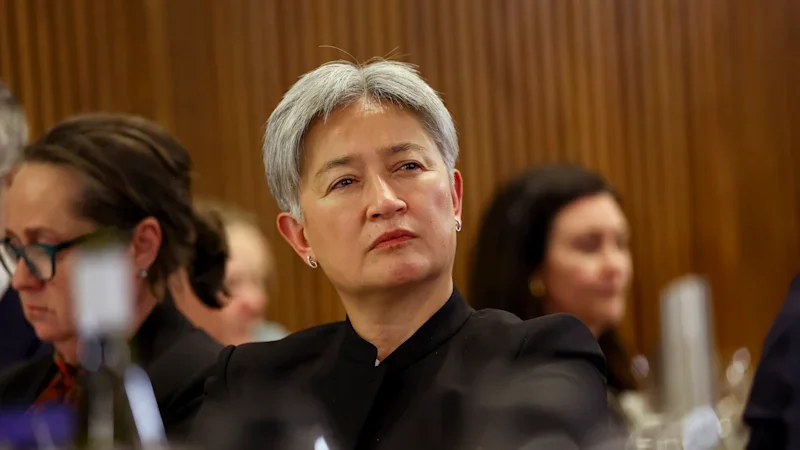
Foreign Minister Penny Wong will paint Pauline Hanson’s call for a monoculture as a major threat to national security, making the case that Australia’s diversity is a bulwark against global instability while reaffirming that regional diplomacy is Labor’s top priority.
Wong will argue that her own Malaysian background demonstrates how migrants have enriched Australia and helped it find common ground with other people in the world, also pointing to Burundi refugee Nestory Irankunda and his opening goal of the Socceroos’ recent World Cup campaign.
Her speech comes after a charged debate over multiculturalism was spawned in June by Hanson saying Australia should be monocultural. The One Nation leader later backtracked, saying the diverse Socceroos football team was an example of what she was talking about.
Labor has since worn multiculturalism as a badge of pride as it seeks to counter Hanson’s surging popularity, and Wong’s speech will take this a step further by making the direct link between diversity and successful foreign policy.
“Our multicultural society, along with our economy and our democratic institutions, are essential elements of our resilience and raise the costs for those who seek to coerce us,” Wong will say in a speech to the Lowy Institute on Friday.
“And those who seek to divide us for clicks and votes should know that they make us weaker at home and more vulnerable in the world.”
Wong will argue this is increasingly important given rising global instability, with China’s military buildup and recent ballistic missile tests in the Pacific, and United States President Donald Trump’s war with Iran.
She will say Australia’s multicultural make-up gives it particular currency in the Indo-Pacific region, since more than a million Australians trace their families to South-East Asia, and more still to South and North Asia.
“No other country I have visited can meet this region so naturally on its own terms,” Wong will say.
“We are more prosperous because of our diversity. We have more choices because of it. We are more capable in the world, and we are more able to find common ground with so many of the world’s peoples because of it.”
The Albanese government has re-oriented Australian foreign policy since coming to power, focusing on regional relationships in South-East Asia and the Pacific while building alliances outside the United States to shore up its strategic influence as a middle power.
Australian foreign policy has historically centred on the US alliance, regional engagement and a rules-based order, but Wong last year shifted this formula to put the region first and add another pillar of “resilience” to Australia’s diplomatic priorities.
Expanding on this approach on Friday, Wong will say: “The first priority must be the region, because this is where Australia has the most on the line.
“The second priority is relationships. It is not enough to exclusively champion the alliance. Our priority since coming to government has been to diversify our relationships, while strengthening traditional partnerships with the United Kingdom and the United States.
“We have always understood that President Trump envisages a different role for the United States in the world. Even so, the United States remains the world’s largest economic and military power, with daily influence over international events that have consequences for Australia.”
Wong will point to Australia’s ability to secure fuel and supplies from Asian neighbours when the Strait of Hormuz was closed due to the US-Iran war earlier this year as evidence this strategy had been successful.
She will also reference a range of pacts recently signed with Indonesia, Timor-Leste, Fiji, Papua New Guinea, Vanuatu, Tuvalu and Nauru to argue Australia had made “transformational breakthroughs” in building regional security.
“These agreements help us contribute to a strategic balance of power in our region ... Those relationships must be reinforced, thoughtfully, deliberately and continuously, by every part of government, businesses and the community. Security is everyone’s responsibility,” she will say.
But these would be undermined by talking down the region or retreating from global institutions, Wong will say, in a thinly veiled reference to Hanson.
“The ability of Australians to connect with people from every part of the world is a national asset,” she will say.
“The call for a monoculture is a call for Australia to curtail our choices and cut off our connections … To look inwards, to have no friends to work with, no partners to trade with, no opportunities to grow from. To be lonely in a dangerous world.”
Wong will warn that damage to the country will be done “well before we could ever realise this melancholic fantasy of monoculture”.
“Because Australians would be turned against each other. Australia would be a more hostile place,” she will say.
“At a time where external and internal forces are seeking to divide us, turning Australians against each other makes us more vulnerable. Division makes us easier to exploit, it doesn’t make us stronger. Turning Australians against each other is the opposite of patriotism.
“Our resilience starts with how we choose to live together... It starts with respecting that multicultural Australia is the only Australia that has ever existed.”