When I need to search the internet, I don't open Google anymore. Instead, I use Perplexity, though it isn't my newfound love — it replaced Google Search on all my devices a long time ago.
Although I feel Perplexity hasn't improved at the pace it should have, thus lagging behind its competitors, I keep coming back to it for its awesome web search results.
However, that's not the only instance when I use Perplexity. I often use Perplexity for questions I don't require a web search for.
I needed to break that habit, so I came up with a plan to see whether something else could take its place for questions I don't need a web search for. A local Large Language Model (LLM) was the only solution.
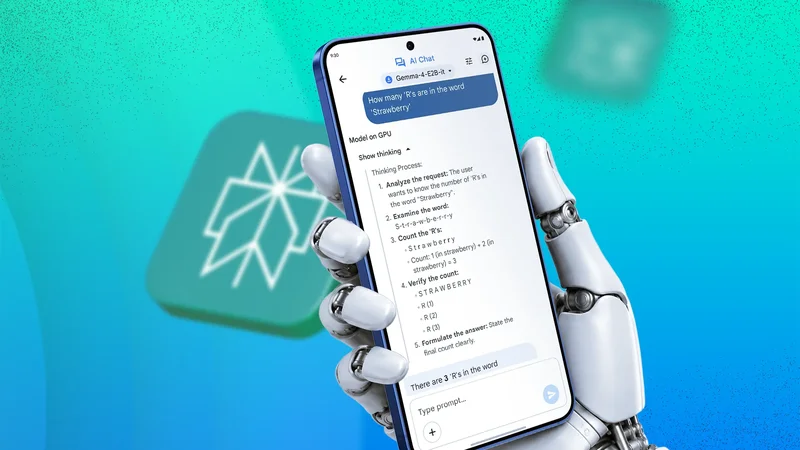
I did it on my Android phone. I replaced Perplexity with a local LLM on Android to get instant answers without an internet connection. Here's what I found in my experiment.
My local LLM was good at little things that don't need the internet
It was still unreliable
Google's Edge Gallery app is, hands down, the easiest way to run local LLMs on your Android phone, so I didn't waste time looking elsewhere and installed the app on my phone.
Installing Gemma 4 E2B was just as easy. All I had to do was download it from the Edge Gallery app, and it was ready to answer my questions.
After struggling for a few minutes to decide which prompt to use, I gave it a bunch of high school math problems. While it passed the test with flying colors, it wasn't easy to read its equation because it wasn't properly formatted.
I also noticed that it over-answers even the simple prompts. I asked it to write a quadratic equation, and it responded with several forms of the equation, which I clearly didn't ask for.
I haven't checked, but I'm sure Perplexity would give me a much shorter answer with an explanation of what it means.
I don't do math anymore, so it isn't a deal-breaker for me. But what was most disappointing is how much it hallucinates, even when answering factual questions.
Since its knowledge cutoff date is January 2025, I asked about events in 2024 or prior, and to my surprise, it gave me wrong answers multiple times.
In my next prompt, I uploaded an image of my balcony and asked it to suggest colors to paint my walls.
I really loved the comprehensive answer this time, as it gave me all the options for different moods based on the color of the floor tiles and the surroundings.
I can surely consider Gemma 4 E2B my go-to for interior tips when I need to give my bedrooms and balcony a makeover in the future. I won't need Perplexity for this.
I also love its ability to summarize long text. It's also good at pulling specific information from a block of text and brainstorming concepts.
I am never going back to Perplexity for these types of tasks.
I couldn't stop reaching for Perplexity
Even when I didn't need the web
Old habits die hard, and I kept reaching for Perplexity out of habit in a week-long experiment more times than I would've liked. However, I won't blame it entirely on my habit.
The local LLM didn't immediately replace Perplexity because it simply wasn't as good. It performed well sometimes, and gave me wrong and painfully long answers in other instances.
So, it was a combination of habit that I had formed and the limitations of the local LLM. Another major problem with the local LLM was that it wasn't a seamless experience to resume chats.
When I restart or switch to it from another app, it takes some time to initialize the model. Also, finding your old chats isn't as easy as it should be.
I also had to switch to Perplexity in the middle of a conversation while using the local LLM when I wanted to ask follow-up questions requiring current information.
This suggests that I must limit the local LLM usage to specific tasks, like tips to do something, summarizing texts, drafting emails, and brainstorming ideas.
I still need Perplexity, but not for everything
A local LLM can't replace an AI model that browses the internet. However, local LLMs can handle many things that don't require a web search.
Sure, it has its flaws, but I'm hopeful that its accuracy will improve with future updates. This doesn't mean I'll wait for it to get better. Instead, I'll keep using it for everything that it is good at right now.
Even if it doesn't improve, its ability to run locally and not send your data to the cloud makes it worth using, especially if you take your privacy seriously like me. I'm staying.