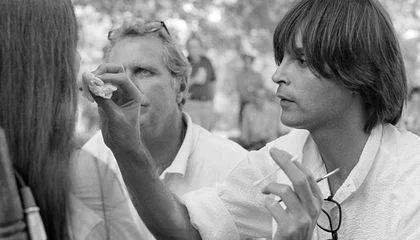
As a makeup artist, Way Bandy prized emphasizing his clients’ own beauty—and not using harsh eye shadows or clunky mascaras. “When a woman has on blue eyeshadow … you look at her and you say, ‘Mm, blue eyeshadow.’ You don’t say, ‘Mm, beautiful eyes,’” he told Miami television reporter Joan Hall in 1978 as he gave her a makeover. Bandy was then at the top of his field, often considered one of the first makeup artists to achieve celebrity status.
His clients included many iconic performers, from Elizabeth Taylor and Farrah Fawcett to Diana Ross and Barbra Streisand, among countless others. He also worked with photographers Francesco Scavullo and Richard Avedon, Vogue and Cosmopolitan magazines, and the brands Clinique and Pond’s. He was one of the most in-demand makeup artists in the world. Scavullo called him “one of the great makeup artists of our time.”
Bandy, born Ronald Duane Wright in Birmingham, Alabama, in 1941, came from a family of railroad workers who didn’t quite know what to do with a son who loved art and pop culture. “I liked to paint, too, but I painted people not the way they looked, but the way I wanted them to look—with makeup,” he told the St. Louis Post-Dispatch in 1981. He was an English teacher for a short while in Tennessee and Maryland, an experience he later referred to as “Dullsville!”
He then became a skincare specialist, studying under the renowned esthetician Christine Valmy, and later expanded into makeup as salon director at the famed Charles of the Ritz on Park Avenue in 1969. He went on to become a freelance makeup artist in 1971. Eventually, he was so popular he made a cameo in the 1976 film Lipstick.
The rise of artists like Bandy, who’d be brought in to make up the faces of an entire cast of models for a runway show, began in the 1960s and 1970s, notes fashion studies scholar Mark Joseph O’Connell of Seneca Polytechnic in Toronto. Bandy’s own simple but glamorous aesthetic—the look of disco—was on the rise in the 1970s, due to a greater interest in naturalism on and off screen. “The makeup was really a lot more minimal. The artifice was stripped away,” O’Connell says. And Bandy, media and makeup expert that he was, helped create the face that represented the era.
Did you know? Way Bandy’s guides
Bandy published two makeup manuals,Designing Your Face: An Illustrated Guide to Using Cosmetics
and
Styling Your Face: An Illustrated Guide to 15 Cosmetic Face Designs for Women and Men
.
Bandy’s influence did not end with his death. On August 13, 1986, he died from AIDS at age 45. The Centers for Disease Control (CDC) had first used the words “acquired immune deficiency syndrome (AIDS)” four years prior, and while usage of the term “AIDS” was growing in prominence during the 1980s, causes of death for those who succumbed to it were often listed as Kaposi’s sarcoma and pneumocystis pneumonia, the opportunistic infections and AIDS-defining illnesses that result from the disease.
“Most people didn’t want it in their obituaries, although it was clear that, from the early ’80s on, the number of obituaries just kept growing and growing and growing,” says Katherine Ott, a curator of science and medicine at the Smithsonian’s National Museum of American History, “and people knew it, but it wasn’t spelled out, except in gay newsletters and newspapers.”
Bandy saw all of this play out. It prompted him to request in his will that his cause of death from AIDS would be stated explicitly in his obituary. Hairstylist Maury Hopson, executor of Bandy’s will, saw to it.
As the Los Angeles Times reported, “Way Bandy, who boasted—with ample justification—that he took many of the world’s most beautiful women and made them even more attractive, is dead from complications of AIDS.”
Bandy’s agent, Helen Murray, told the Times that as “an intensely private person,” Bandy hadn’t made his illness public and continued working until his admission to New York Hospital-Cornell Medical Center in early August. But in noting to the newspaper that Bandy chose to share his specific cause of death, Murray said, “There was nothing downbeat about his life and there will be nothing downbeat about his death.”
The New York Times, after acknowledging Bandy’s request, described the death in detail: “Dr. Catherine C. Hart, Mr. Bandy’s physician, said the primary cause of his death was pneumocystis carinii pneumonia and that the ‘predisposing’ secondary cause of death was ‘an associated HTLV-3-related disease.’ The HTLV-3 virus, most scientists believe, is the cause of AIDS, or acquired immune deficiency syndrome, the fatal disease that cripples the body’s immune system.” (Today, HTLV-3 is known as Human Immunodeficiency Virus, or HIV.)
The makeup artist’s choice was so unusual that it became the subject of a news story by Ann L. Trebbe in the Washington Post. It chronicled not just Bandy’s achievements and passing, but his decision to be open about his cause of death after he passed. “We knew what Way’s wishes were about disclosing the nature of your illness if it helps save lives,” Hopson told the Post. “He died in a very courageous way and with great dignity. There should be no reason for anyone dying in shame because their body fell apart on them.”
“I think he did it because he knew it would humanize, hopefully, what was happening,” O’Connell says. “I had friends who passed, and their families chose to describe it as cancer or something else, even though everybody knew what was going on. To actually flat out say it, people just didn’t do it. So it was a pretty radical act.”
A few months after Bandy’s death, the CDC announced that as of early December 1986, U.S. health departments found that more than 28,000 patients met the AIDS case definition for national reporting. And of those patients, the CDC reported, close to 16,000 had died.
AIDS cases and deaths steadily increased throughout the 1980s and into the 1990s. By the end of 1991, the CDC stated that a cumulative total of 206,392 cases had been reported, along with 133,232 cumulative AIDS-associated deaths.
Before the first medications were approved by the Food and Drug Administration to treat AIDS, beginning with AZT in 1987, a diagnosis was often viewed as a death sentence, and, because it was associated with homosexuality and drug use, a heavily stigmatized one at that. People living with AIDS were discriminated against, lost their jobs, were kicked out of their homes and were disowned by their families.
“It was hard to find someone who would be willing to work with you, and if you were in the hospital, you were considered contaminated and contagious,” says Ott.
Before he died, Bandy established the Way Bandy Memorial Fund for AIDS Research at New York Hospital-Cornell Medical Center. At Bandy’s memorial, the Philadelphia Inquirer reported, Jeffrey Laurence, a doctor at the hospital’s research laboratory, praised Bandy’s candor and bravery.
“Way Bandy, in his own manner, overcame the inertia that may threaten all of us—the feeling that when you’re confronted with an overwhelming disease, people just want to give up,” Laurence said. “Let the action that each of us now takes become a living testament to his memory.”
In 1987, the AIDS Memorial Quilt became a testament to the memories of Bandy and so many others who died from the disease. The quilt, the brainchild of activist Cleve Jones, was displayed on the National Mall as a massive work of art with 1,920 panels that had come from all over the country, each representing a lost loved one. On August 9 of this year, what would’ve been Bandy’s 85th birthday, the AIDS Memorial Quilt honored him on social media.
Bandy’s legacy continues in the world of beauty wherever makeup is used to enhance and not obscure. His vision and philosophy remain vibrant on runways and red carpets today.
Bandy himself refused to hide, a spirit that lives on through his notable decision to be clear about his cause of death.
Upon Bandy’s passing, longtime friend and collaborator Francesco Scavullo emphasized Bandy’s talent and character. “Way was not only one of the greatest makeup artists of our time,” he said, “but also one of the most beautiful men in mind and spirit.”