- READ MORE: The best place to see the NEXT total eclipse in Spain in 2027? From the skies! Travel expert says watching at 30,000ft was 'incredible'
- See more Daily Mail on Google - save us as a Preferred Source
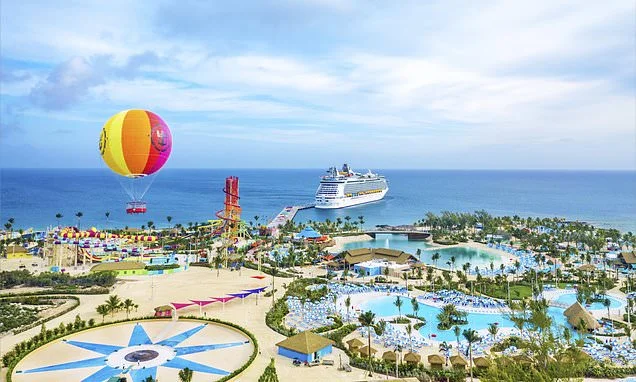
It's quite a sight. As our Royal Caribbean cruise ship slips closer to Little Stirrup Cay, a small island in the Bahamas, a vision appears before us.
Ahead, rising above dense tropical vegetation, is a twisting candy-coloured tangle of tubes that resembles giant writhing serpents locked in combat.
What on earth is going on, you may well ask? The answer is we have arrived at Perfect Day at CocoCay – and those ‘serpents’ are in fact waterslides in an aqua park.
Little Stirrup Cay, with its crescents of sandy coves, has been transformed into a private playground run by Royal Caribbean for passengers to enjoy on excursions while ships are moored close by.
I’m about to explore what is one of the biggest trends in cruising – the adoption of such islands by cruise lines to create exclusive ‘in house’ land experiences.
I join the throng going ashore and into the aqua park, where a chorus of shrieks slices through the air as an inflatable raft packed with a gaggle of young girls plummets down a slide into a pool.
Walking past sapphire lagoon-like pools full of happy families and on to powdery sands where couples toast each other with champagne in private overwater cabanas, it’s clear everyone is having a blast.
The 144-acre island is, in effect, a playground delivering the thrills of a waterpark boasting some of the tallest slides in North America along with serene adult-only hideaways. It’s proved such a hit that this tiny haven, opened in 2019, is the cruise line’s most popular stop globally, with Royal Caribbean now branching out with more private land offerings.
Perfect Day at Coco Cay, also known as Little Stirrup Cay, is a private island owned by Royal Caribbean
Travel writer Sara Macefield visited the 144-acre island
Last December saw the opening of its first Royal Beach Club in Nassau, a 17-acre retreat of chill, party and family zones (sadly closed due to inclement weather when I passed by). And in April the cruise line’s second beach club opened on the Greek island of Santorini.
This will serve a dual purpose – not only providing another amenity for customers, but also helping to relieve pressure on an island that has famously become too popular for its own good, with crowds packing the tiny streets.
While the trend for such private resorts may be gathering pace, it’s one that began back in 1977 when Norwegian Cruise Line became the first such company to acquire its own isle, Great Stirrup Cay, which became a stand-alone beach resort.
Since then, Princess Cruises, Disney Cruise Line and Holland America Line are among those to have followed with their own resorts.
These are also in the Bahamas, which has made a healthy business out of selling or leasing some of its 700 islands to cruise firms wanting to give passengers a taste of castaway life.
This accelerated seven years ago when Royal Caribbean pumped $250million (£187million) to upgrade CocoCay, and MSC Cruises reportedly spent $200million by transforming a former industrial island into a marine reserve called Ocean Cay.
Since then, others have joined the party, with adult-only line Virgin Voyages bringing the brand’s distinctive style to its beach club on the Bahamian island of Bimini.
Last summer, US-owned Carnival Cruise Line unveiled its Celebration Key resort across 65 acres of former scrubland on Grand Bahama Island – complete with a huge seven-acre swimming lagoon and one of the world’s longest swim-up bars.
While the Bahamas accounts for the lion’s share of private cruise line resorts, they are not restricted to the archipelago.
Cruise lines are increasingly using such spaces to 'create exclusive ‘in house’ land experiences'
CocoCay boasts its own waterpark area complete with tall slides
NCL has a second retreat, a 75-acre island in Belize called Harvest Caye, while Carnival Corporation brands – including Princess, HAL and P&O Cruises – share the private Amber Cove resort in the Dominican Republic.
As for Royal Caribbean, it is planning eight such resorts by 2028, including in Mexico and Vanuatu.
Cruise firms are finding that having their own resorts is a lucrative earner as they capture yet more passenger spend.
Basics may be complimentary, but charges for speciality dining, drinks, water sports and other extras mount up. On Royal Caribbean’s Perfect Day at CocoCay, waterpark passes start at £66pp, while the most luxurious cabanas can cost nearly £3,000.
Cruise lines also benefit from no docking fees, plus the bonus of swerving the ire of locals concerned about being swamped by hordes of visitors.