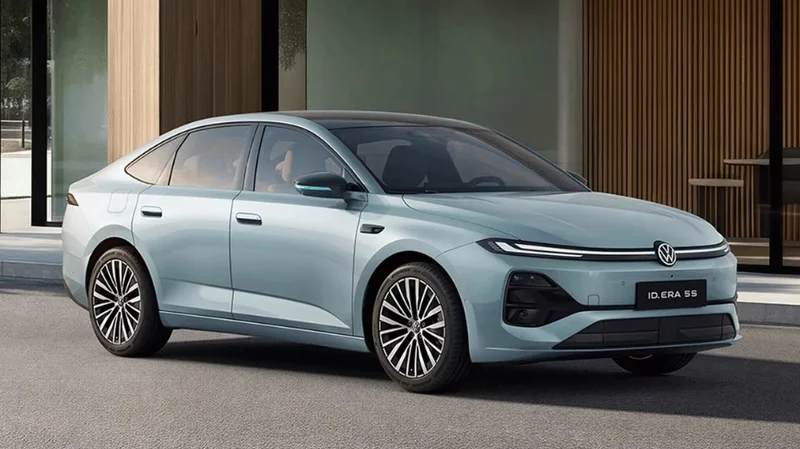
Start with the Volkswagen, because it is the one that should give Europe pause. SAIC Volkswagen, the joint venture with China’s state-owned SAIC Motor, opened preorders for the ID. Era 5S saloon this week.
The introductory price is 115,900 yuan, which Digital Trends converts to about $17,175. The car goes on sale in China on 21 August.
That is a Volkswagen badge on a car costing little more than half what the cheapest electric car costs in America.
What the money actually buys
The drivetrain is a 19.1kWh lithium iron phosphate battery, a 1.5-litre petrol engine and a 130kW electric motor. It covers 160km on electricity alone under China’s CLTC test.
The equipment list is where it gets uncomfortable. Buyers get a 15.6-inch touchscreen, an 8.8-inch instrument display, Apple CarPlay and wireless charging. The front seats heat, ventilate and deliver a 10-point massage, and the rear seats heat as well.
It is also the first Volkswagen saloon with the company’s Navigate on Autopilot for city roads and motorways. That remains a Level 2 system, so the driver has to keep watching the road.
The mid trim is about $17,770 and the top Max trim about $22,215. Even the expensive one undercuts the cheapest electric car sold in America.
BYD answered within a day
Then BYD launched the 2027 Seal 06 and went lower, Digital Trends reported. The plug-in hybrid starts at 99,900 yuan, or roughly $14,700, and the full electric version at 109,900 yuan, about $16,100.
The electric one is not a stripped-out city car either. It runs BYD’s second-generation Blade battery on an 800V architecture, in 52.9kWh or 64.3kWh capacities, for a CLTC range of 530km or 630km.
A 240kW motor takes it to 100km/h in 5.9 seconds. BYD has also given it the flash-charging platform it uses on far dearer models.
Higher trims add the God’s Eye B 5.0 driver-assistance suite and an electromagnetic damping system that adjusts the suspension continuously. There is a 15.6-inch rotating screen and an optional 29-inch head-up display.
None of that is unusual in China any more. BYD’s Seagull sells for around $10,300, and BAIC’s Arcfox Beta T1 starts near $9,200.
LiDAR and a Chinese model, in the cheap seats
Two details deserve their own line for a technology audience. The God’s Eye suite on the Seal 06’s higher trims is LiDAR-equipped, and Western carmakers still treat LiDAR as premium hardware.
The voice assistant runs on DeepSeek, the Chinese model that undercut Western labs on price. BYD’s Seagull, at about $10,300, can be had with LiDAR as well.
The pattern matches the pricing exactly. Sensors and software that Europe sells as flagship features are turning up in China at the bottom of the range.
What the same money buys in the West
The cheapest electric car in America is the 2027 Chevrolet Bolt at $28,995. Nissan’s 2026 Leaf starts at $29,990 before destination charges.
Kia has just priced its 2027 EV3 at $31,385 including destination, and that is the affordable option in its range.
So the Bolt costs roughly $11,820 more than the introductory Volkswagen, and almost $13,000 more than the entry-level Seal 06. Neither source reports a Western launch for either car at anything close to these prices.
The company that built it is European
Here is the part the American coverage skipped, and it wrote for American readers. The cheapest interesting car in this story wears a German badge.
Volkswagen did not build it in Germany. SAIC Volkswagen developed it for China, and neither source reports a plan to bring it west.
So the capability exists inside Europe’s largest carmaker. The factory, the supply chain and the partner do not.
Chinese brands are meanwhile surging in the UK, which is the market next door.
Three reasons the number is smaller than it looks
The $17,175 is a limited-time introductory price, not the list price. The regular Pure trim is about $17,770, so the headline figure has an expiry date attached.
The comparison is also not like for like. The Volkswagen carries a petrol engine, and the American cars it faces run on batteries alone. Digital Trends says so itself.
Then there is CLTC. China’s test cycle is generous, and a 630km CLTC figure is not 630km on a motorway in January. Treat all of these ranges as the optimistic end.
None of that closes a gap of $12,000 to $13,000. It just makes it a gap rather than a chasm.
The market these cars are fighting over is shrinking
There is one more caveat, and it comes from our own reporting. Electric and hybrid vehicles took a record share of the Chinese market in July at 65.1%.
Their sales still fell. A record share of a smaller market is what a price war looks like from the inside.
That is the context for both launches. Neither company is cutting prices from a position of comfort.
The gap is a cost base, not a price list
A carmaker can discount a price. It cannot discount what the car costs to build, and that is where the European industry is stuck.
Volkswagen has been cutting hard at home, including 100,000 job cuts. It has also cut EV production as demand shrank.
Every one of those decisions was about cost. None of them produced a cheap car.
European carmakers have already started borrowing the answer. The Smart 2, the Fortwo successor from the Mercedes venture, rides on a Geely platform.
So the cheap European car increasingly has Chinese engineering underneath it. The badge stays in Stuttgart or Wolfsburg. The cost base does not.
What would settle it
Two things are checkable rather than rhetorical. The first is what the ID. Era 5S actually sells for after 21 August, once the introductory price lapses.
The second matters more to anyone in Europe. Inside a joint venture it half owns, Volkswagen has now shown it can build a well-equipped plug-in hybrid for about $17,000.
The open question is whether any of that cost engineering travels back west, or whether it stays where it started. On this week’s evidence, BYD is not waiting to find out.
Get the TNW newsletter
Get the most important tech news in your inbox each week.