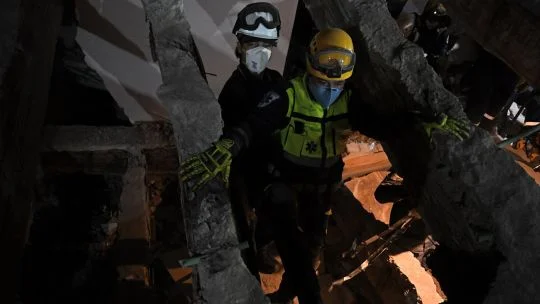
Rescuers in Colombia were still making last-ditch efforts to locate earthquake survivors on Thursday, as the critical 72-hour window for rescue operations neared its end.
The magnitude 7.4 quake, the strongest to hit Colombia this century, has killed 265 people, injured more than 3,500 and left almost 500 missing, according to local authorities.
In cities such as Cali and Pereira, emergency crews worked through a third night with their bare hands, cranes and sniffer dogs, stopping not to rest but to listen for signs of life.
Thursday marked 72 hours since the quake, a period when survivors are considered most likely to be found alive beneath collapsed buildings.
Cali resident Martha Pérez said she felt "helpless" as two relatives were thought to still be trapped under rubble. "We will hold on to [hope] until the very end," Pérez told AFP on Wednesday night.
"As you can see, all of us here – the entire city of Cali – are hoping to find more survivors," volunteer rescuer Fernando Loaiza said.
Cali Mayor Alejandro Eder said Wednesday that rescue efforts were "entering the final phase."
Colombia's newly installed president Abelardo de la Espriella has declared the disaster an "economic emergency" and announced three days of national mourning. "We will do what is necessary," he said in a statement, vowing to "emerge again as a country and as a society."
More than 11,000 dwellings have been destroyed and thousands of families have been rendered homeless, according to official figures.
Holding onto 'hope'
In Pereira, crews focused on a collapsed bakery where they believe a street vendor trapped since Monday's earthquake may still be alive beneath the rubble.
Rescuers using equipment that detects vibrations said they had picked up possible signs of life from Pablo Loaiza, prompting anxious relatives to gather near the wreckage.
"They tell us it could be him," said his 16-year-old niece, Sara Loaiza. "My heart is about to burst out of my chest."
Relatives said the trapped man appeared to respond when rescuers asked him to knock twice, then three times from beneath the rubble, drawing applause from those gathered at the scene.
"Every half hour we make everyone be quiet to see if we can find people alive," said volunteer rescuer Johana Sánchez. "So far, three people have been pulled out alive and three dead."
Many have already spent consecutive nights outdoors, either because their homes were damaged or because they feared aftershocks.
In the town of Roldanillo, Yuliana Méndez picked through the wreckage of the beauty products store where she worked, one of many businesses damaged in the disaster. "It's like starting over from scratch," she said.
In Pereira's Providencia neighbourhood, residents hauled furniture and household items from damaged buildings.
Among them was lawyer Ana Paulina Crosthwaite, whose apartment block was left unsafe by the quake. "We're in a state of shock," she said. "We're not prepared to tell our children that we have to pack whatever we can and start a new life."
Many Colombians have mobilised to help, bringing water, food and supplies to affected neighbourhoods, while long lines formed outside blood donation centers.
"It's about wanting to help your community, your city and your country," said blood donor Ferney Cabrera.
The United States announced US$15.5 million in emergency aid to Colombia, and the European Union pledged two million euros (US$2.3 million).
Government denial
Colombia's new government on Wednesday denied it rejected offers of earthquake assistance on ideological grounds, after only accepting rescue teams from right-wing-led nations.
The massive 7.4 quake has posed an early test for the government of President Abelardo de la Espriella, who took office only the previous Friday.
After it emerged that Colombia had only officially accepted rescue teams from Ecuador, El Salvador, the United States and Israel, the government tried to scotch accusations of political bias and putting lives at risk.
"We have been working around the clock to coordinate offers of humanitarian aid," said Foreign Minister Omar Bula. "Many countries have offered assistance, and it is our responsibility to organise that aid."
"We have facilitated several significant donations, and aircraft are arriving in the country: 100 tonnes offered by the government of El Salvador. Another flight from Mexico is headed to the hardest-hit areas... 58.5 tonnes from the Mexican government" he said. "We have not excluded any country."
It emerged earlier that some of Mexico's famed rescuers called "topos," or moles, had been prevented from working.
David Tamayo, head of Colombia's disaster relief agency, said it was a question of qualifications.
"We will only be accepting support from these countries, which can guarantee search-and-rescue teams that are recognised both by the international system and by their own governments as qualified for this work," he said.
"These teams are entirely self-sufficient," he added. "They will not require additional resources from municipal authorities. They are arriving with their own equipment, food supplies fully provided."
Tamayo said that Colombia's own well trained search and rescue teams were not yet overwhelmed.
Héctor Méndez, aged 80, a senior "Topo" and president of Topos Azteca, told AFP that 60 of his colleagues were in Colombia. He pleaded with authorities to allow them to work.
"So many people want to help, want to give everything they have to try to rescue those trapped," he said.
"I ask you, I beg you, let's work together and try to recover our brothers and sisters buried in different locations" he told AFP.
"If we start trying to politicise this, then we're on the wrong track."
– TIMES/AFP