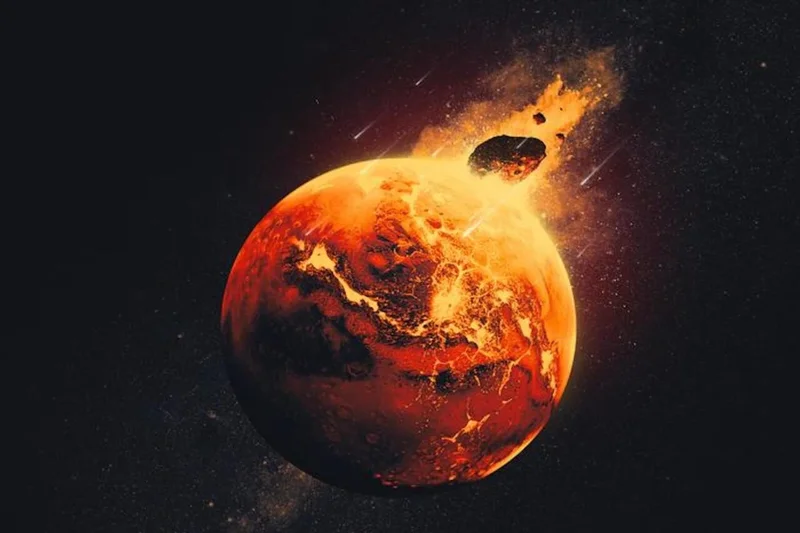
A Martian rock was flung from our neighboring planet and made its way to Earth, landing in the Sahara desert. Now, scientists have dated the meteorite and found that it unlocks a 1.8 billion-year-old gap in Mars’ history that’s so far been shrouded in mystery.
The meteorite, designated Northwest Africa (NWA) 13441, was discovered in Algeria in 2019. A team of scientists snagged a 0.03-ounce (0.9-gram) sample from the rock and analyzed it in the lab, discovering that it dates back to 1.27 billion years ago.Â
The findings, published in the journal Geochimica et Cosmochimica Acta, help scientists peer into a crucial time period in Mars’ geological record that transformed the planet during its early history.
Select your sample
Impacts on Mars sometimes send bits of the Red Planet into space, some of which land on Earth in the form of meteorites. Out of the roughly 400 identified specimens, none have been dated between 600 million and 2.4 billion years ago. Weird, right?
The most common type of Martian meteorite is shergottite, and most of these date back to around 600 million years, with two samples dating to around 2.4 billion years old. That leaves a nearly 2 billion-year gap in Mars’ history, which scientists know little about. Unfortunately, scientists can’t select which pieces of Martian rock land on Earth, so they can only hope to get lucky with the few ones that are found.
To identify the age of the recently discovered meteorite, the scientists behind the new study analyzed its chemical composition compared to other Martian rocks. While its composition matched that of shergotties, the scientists also found traces of a rare-earth metal called neodymium. The rare element is usually found in another kind of meteorite, called chrondrites, which usually date back to the early formation of the solar system 4.5 billion years ago.
âThe characteristics of this meteorite were entirely surprising,â Ethan Baxter, an Earth and environmental science professor at Boston College and co-author of the study, said in a statement. âNo other martian meteorite like this has an age of 1.27 billion years old.â
Scientists date rocks to when they solidified from magma. They believe that NWA 13441 formed near the boundary between Mars’ crust and mantle and was ejected by a volcano around 1.27 billion years ago, where it solidified on the surface.
NWA 13441 isn’t the oldest Martian meteorite ever found, but there are a few that date back to more than 4 billion years ago. It does, however, belong to the most common class of meteorites, the shergottites, which help scientists create a timeline of Mars’ activity over the years. Therefore, its rarity is owed to its common type.
Collecting Martian clues
Mars formed rather quickly, reaching its full size in less than 5 million years after the solar system began. Unlike Earth, Mars does not have plate tectonics, allowing its early-formed composition to remain pristine.
The meteorite’s shared characteristics between shergottites and chrondrites suggest that some deep parts of Mars remained relatively unaltered by the different geological processes that took place since it formed.
Meanwhile, the chondritic composition of NWA 13441 suggests that it came from a previously unsampled reservoir of Mars or a mix between enriched and depleted shergottites, according to the paper.
The scientists behind the study are hoping that the sample can provide information about magmatic and volcanic activity on Mars that took place in that 2 billion-year gap, which would help them better understand the processes that happened in the very early solar system as the Red Planet formed.