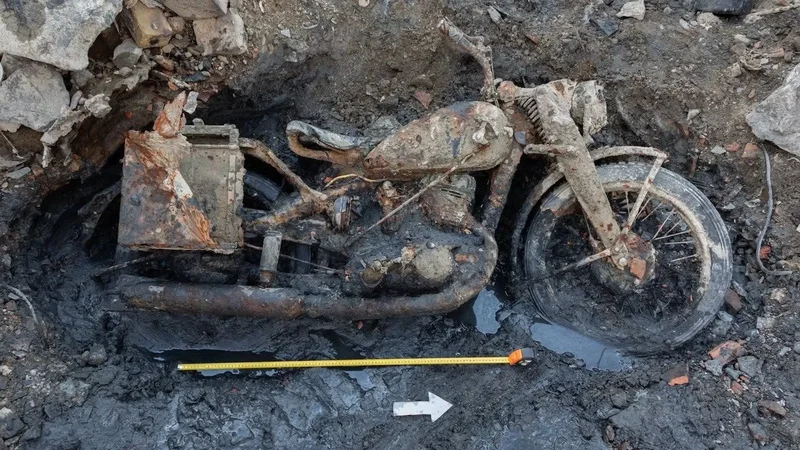
History continues to resurface as unprecedented heatwaves and droughts in Europe push the Danube River to its lowest levels on record. In addition to the dozens of World War II Nazi naval vessels near the Serbian town of Prahavo, archaeologists in Hungary have located an extremely rare Wehrmacht military motorcycle, along with the bodies of its two potential crewmembers. Due to the area’s unique conditions, both the vehicle and the soldiers’ remains are remarkably well-preserved even after over 80 years underwater.
The vehicle and possible remains were found in an exposed section of the Danube riverbed near the Hungarian Parliament building in Budapest. A combination of mud mixed with gas and oil ensured the finds didn’t succumb to deteriorating conditions usually experienced in aquatic environments. Because it is still nearly intact, experts quickly identified the vehicle as a DKW NZ 350-1 motorcycle, often known as the “Kräder” (which means wheels)). The Nazis built around 12,000 of these combat units towards the end of WWII, each featuring a single-cylinder, two-stroke engine providing 11.5 horsepower with a top speed of about 56 mph.
Although they only debuted in 1944, the motorcycles quickly became popular with troops on reconnaissance, dispatch, and courier missions. Unlike its predecessor model, the NZ’s frame was welded instead of bolted together. Because welding required higher amounts of power, the manufacturers at Auto Union AG could only construct their vehicles at night in order to reduce strain on surrounding electrical grids.
The NZ discovered in the riverbed was undoubtedly only one of many that once rode the streets of Budapest after the Germans arrived in March 1944. However, the occupation lasted less than a year. The Soviet Red Army launched a counterassault inOctober, resulting in the five-month Battle of Budapest. By the time the Germans surrendered on February 13, 1945, more than 30,000 Nazis, 80,000 Soviet and Romanian troops, and 17,000 Hungarians had died in the conflict.
Two of those casualties appear to be soldiers excavated from sediment beneath the motorcycle. Similar to the vehicle, the bodies and their personal effects remain in extremely good condition. Germany’s War Graves Commission has organized recovery efforts for the remains, and intends to inter them at the German war cemetery in the town of Budaörs west of Budapest. Although their identities are still unknown, both their military identification tags are intact and likely will be legible upon further examination. Commission officials noted that because both halves of each tag were still on their bodies, news of their deaths likely never reached Berlin.