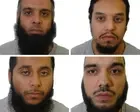
Lawyers representing four men convicted of terror offences are increasingly hopeful that revelations from the undercover policing inquiry could boost the chances of their case being reopened.
Ten years ago, Khobaib Hussain, Naweed Ali, Mohibur Rahman and Tahir Aziz were arrested and later convicted of plotting a terrorist attack in the UK after an elaborate covert police operation.
As part of the undercover operation, police set up a fake delivery firm – Hero Couriers – to snare Hussain and Ali, who, like one of the other “Birmingham Four”, had a previous terror-related conviction.
The investigation involved an undercover police officer working for the West Midlands’ “special projects team” under the alias “Vincent”. On Ali’s first day working for Hero Couriers, MI5 officers discovered a bag under the seat containing a “partially constructed” pipe bomb, a suspected handgun and a meat cleaver with “kafir” scratched on to it.
Lawyers representing the Birmingham Four have long expressed their belief that “Vincent” planted the evidence in the vehicle – a claim ridiculed by the undercover police officer during the trial and rejected by the jury. The lawyers submitted an initial application to the Criminal Cases Review Commission (CCRC) to investigate the men’s convictions in 2024 and are still waiting for a response.
Gareth Peirce, a lawyer known for successfully fighting miscarriage of justice cases, told the Guardian she had submitted further information to the CCRC earlier this year which included, but was not limited to, evidence heard at the undercover policing inquiry.
The inquiry is examining the conduct of undercover police officers who spied on more than 1,000 political groups between 1968 and at least 2010.
Peirce said the submission, although broad, cited evidence heard at the inquiry in November last year, where the managers of an undercover police officer believed he had concocted a gun plot to frame an animal rights activist. She said this incident had parallels with the Birmingham Four.
She said: “The coincidences and parallels with the Birmingham Four prosecution evidence are exact – an undercover officer, with access to firearms, claims to stumble upon a plot by an individual he is spying on.
“Both cases rest on the improbable ‘discovery’ of firearms and other weaponry in cars recently driven by the activists.”
Peirce said evidence heard during the undercover policing inquiry demonstrated the “easy ability of an undercover officer to fabricate evidence” as well as “how easy [it is] to rely on an organisational cover-up”.
Hussain’s sister, Mariam, has been fighting for the group’s case to be reopened with the Muslim advocacy group Cage. She said: “We’re in a position now, unfortunately, where you’re having to spoon-feed and redirect the CCRC to ‘go look here, go do this’ because we’re not getting regular updates so we don’t really know what’s going on and how they’re investigating.”
On Wednesday, Cage issued a joint statement signed by several organisations, including the miscarriage of justice charity Appeal and Muslim advocacy groups, which called for the CCRC to immediately review and reopen the case.
Stephen Kamlish, who represented Ali during the 2017 trial, said the evidence presented during the trial showed his client was innocent, including the fact Ali had willingly given his car keys to “Vincent”.
“I have no doubt at all that the defendants are innocent – all of them,” Kamlish said.
Mariam added: “There was no evidence to point that this bag belonged to any of the four men that were convicted.”
As the 10-year anniversary of their arrests approaches, Mariam said her brother continued to have many unanswered questions.
She said: “It hasn’t ended for us. That pain, it’s every day. We’re living a nightmare every day. You feel so helpless. There’s not a moment where [you] can switch off and just get on with our lives as normal. It’s truly horrific.”
A CCRC spokesperson said: “A review into these applications is ongoing. It would be inappropriate for us to discuss the case or make any further comment while the applications are being reviewed.”
A West Midlands police spokesperson said: “In 2017 all four men were unanimously found guilty by a jury. In 2018 Judge Hon Mr Justice Openshaw rejected their leave to appeal saying: ‘In my judgment there was abundant evidence of [Naweed Ali’s] extreme jihadist beliefs, to the effect that it was his duty to attack those whom he considered to be ‘unbelievers’ in this country.
“The exchange of messages in the heavily encrypted ‘three musketeers’ Telegram group account and elsewhere were only explicable upon the basis that he was plotting an imminent attack. A partially made pipe bomb was found in his van. He answered no questions in interview and did not give evidence to give any explanation for the many incriminating pieces of evidence against him. In my judgment, the evidence against him was overwhelming; the conviction is safe and his application for leave to appeal against conviction is accordingly refused.’
“In 2018 a full court of appeal examined the safety of these convictions in great detail and upheld the findings of the jury, with Lord Justice Holroyde stating: ‘We have considered whether anything put before us casts doubt on the safety of the convictions. We are satisfied that there is nothing that does so. The jury by their verdicts plainly rejected that the evidence had been planted. Having done so there was ample circumstantial evidence against each of the accused to support the convictions.”