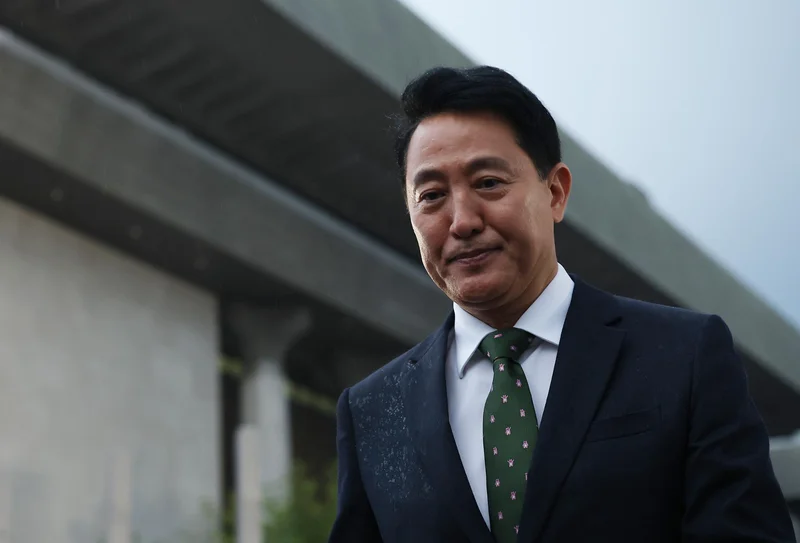
Seoul Mayor Oh Se-hoon returns to his seat after presenting a bouquet during a performance at the Garden of Gratitude in Gwanghwamun Square, central Seoul, Wednesday. Yonhap
Just weeks after winning an unprecedented fifth term as Seoul mayor, Oh Se-hoon now finds himself fighting for his political survival after a Seoul court fined him 10 million won ($6,820) Wednesday for violating the Political Funds Act, a sentence that would cost him his mayoralty if upheld.
Under the special counsel law's "6-3-3 rule," the case must clear the appeals court within three months and the Supreme Court within another three. With the first ruling handed down Wednesday, the appeals court would technically be required to rule by Oct. 22, with the Supreme Court completing its review by Jan. 22.
If that timetable holds, Oh could learn within six months whether he remains Seoul mayor and whether he retains any realistic path to the presidency.
The Seoul Central District Court found Oh guilty of receiving polling results from political broker Myung Tae-kyun ahead of the 2021 mayoral by-election and having businessman Kim Han-jung cover part of the cost.
Of 10 polls cited by prosecutors, the court found that Oh had commissioned five — three private polls and two published polls — whose combined cost of 21 million won was illegally paid by Kim.
Oh filed an appeal the same day and rejected the ruling in blunt terms.
“I cannot accept that five of the 10 public and private polls were found to be illegal. All of them should have resulted in acquittal,” he told reporters after leaving the courthouse.
“There was no evidence, only the testimony of Myung, a notorious liar, and circumstantial evidence ... The ruling was based on an inference that his account was probably true. I will fight this fiercely in the appeals court.”
The verdict came less than two months after Oh staged a dramatic comeback against Democratic Party of Korea (DPK) candidate Chong Won-o in the June 3 local elections. Oh's latest electoral victory made him the first politician to win five terms as Seoul mayor and elevated him into the front rank of conservative presidential contenders.
After the election, Oh moved quickly to broaden his support inside the main opposition People Power Party (PPP), meeting dozens of lawmakers. His relatively low level of resistance within the party, combined with his appeal to moderate and metropolitan voters, had made him a possible bridge between competing conservative camps.
That momentum has now stalled.
Park Chang-hwan, a political science professor at Jangan University, said the case is more damaging than the setbacks Oh has survived before, including his 2011 resignation over the free school lunch referendum.
“This is an enormous political crisis ... The Oh Se-hoon of today was largely built through the so-called Oh Se-hoon Law in 2004, whose core purpose was to eliminate illegal political funds. Now he has received a 10 million won fine for violating the Political Funds Act (which stems from the very law he proposed),” Park said.
“If this ruling is upheld, he could fall into a situation from which political recovery would be virtually impossible,” he added.
Oh’s legal options are also narrow.
A fine of 1 million won or more would remove him from office, while the first ruling imposed 10 times that amount. Park said Oh would realistically need the appeals court to overturn the conviction rather than merely reduce the fine.
“If he is acquitted, this could instead become an opportunity,” Park said. “He could argue that the special counsel tried to bring him down and that he survived it. But the first court’s reasoning on the parts of Myung’s testimony it accepted was more solid than expected. I do not think it will be easy to reverse.”
Until then, Oh can continue running Seoul, but his effort to build a national political base is likely to slow. Lawmakers may hesitate to rally around a potential presidential contender whose eligibility could disappear within months.
Closer to home, the Seoul Metropolitan Council — where the ruling DPK holds 80 of 118 seats to the PPP's 38 — was already stacked against him, with DPK council members wasting little time to seize the verdict, calling on Oh to "sincerely apologize to the citizens of Seoul and make a bold decision," language widely read as an indirect call for his resignation.
His troubles also leave the PPP with a wider problem. Park said Oh had offered conservatives an option outside the polarized choice between party leader Jang Dong-hyeok and Han Dong-hoon, a former justice minister who was expelled by the party and subsequently won a parliamentary seat in the June by-election.
“If Oh drops out, one pillar of the conservative rebuilding effort collapses,” Park said. “The party would be pushed toward a choice between Jang and Han, and neither choice would produce its best possible performance.”