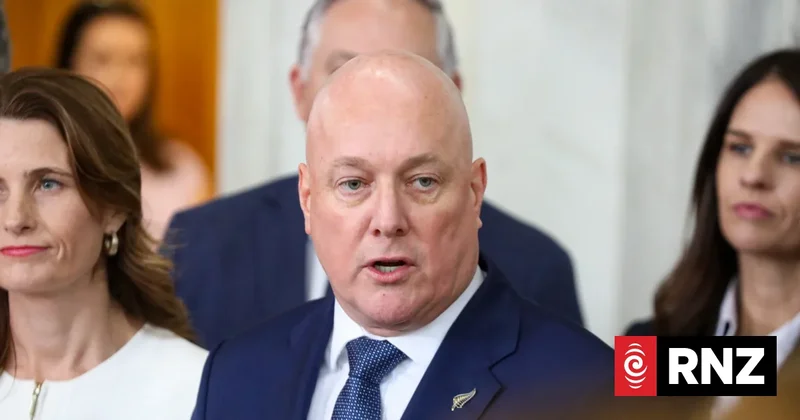
Luxon has survived, Penk is gone, and National is reeling after a week of political chaos that's threatened to reshape New Zealand's election.
Christopher Luxon has survived the week. But only just.
The Prime Minister has faced days of political chaos and speculation - still, he can now say he has survived two leadership challenges in just four months, the latest ending with Chris Penk stripped of his portfolios and announcing his retirement from politics.
And while Luxon emerged from Wednesday's emergency confidence vote declaring victory, the political damage may be hard to contain.
For Newsroom founder Tim Murphy, associate editor Sam Sachdeva, and senior political journalist Marc Daalder, there is little doubt about the state of New Zealand politics right now.
"In one word, and with apologies to Armando Iannucci, I would say 'omnishambles'," says Sachdeva.
Daalder is even more blunt: "It's a bit of a shitshow."
And Murphy? "I'd say 'clusterf***".
It's a remarkable assessment of a government just 12 weeks out from an election.
Because while Luxon won the vote that mattered inside the National caucus, he did so after hours of speculation about his future - the media coverage was saturated - and the challenge from Penk, who was labelled a "duplicitous shit" by Mike Hosking.
The question now is whether the prime minister can survive the election.
"The week's been a disaster, the fortnight's been a disaster, the four months have been a disaster," Murphy tells The Detail.
"But he will survive in the sense that he will limp through this election, in my view, unless he, in a very unlikely manner, looks internally at himself and decides to opt out. But what we've seen so far, you wouldn't put money on that."
And while Luxon walked out of the confidence vote flanked by senior ministers, including some of those rumoured to harbour leadership ambitions - yes, a pale and shocked-looking Erica Stanford over his shoulder - Sachdeva says the vote does not erase the divisions inside the caucus, or reflect well on what's happening inside the party.
"Yes, he's come through it. Yes, he walked out flanked by all these senior ministers, including some putative challenges, if rumours are to be believed.
"But there's clearly some pretty deep ructions and divisions in the caucus that I don't think magically dissipate just as a result of this confidence vote."
National now has less than three months to convince voters it's a stable, united government capable of winning another term.
Daalder says the biggest problem may not be the stability of the government.
"I think the question is less about stable government and more about stability within the National Party," he says. "And this is not a position of strength that he's emerging in. It's very much a position of weakness."
This, he says, was no quick rebellion. The caucus meeting lasted around three hours, and Daalder notes that several senior National figures declined to publicly express confidence in Luxon before the vote, including the party president, the chief whip ... and Stanford.
"It indicates that, you know, this is not a media beat-up as some National Party-aligned people might want the public to think," Daalder says. "This is very much a reflection of serious, ongoing, unresolved division within the National Party caucus."
And then, says Murphy, there is Penk, a National MP from a safe seat, a former military officer, and a Cabinet minister promoted by Luxon.
Having been promoted by Luxon and popular with fellow ministers, he's not an obvious "political assassin", which Murphy says makes his decision to challenge the PM so extraordinary.
"Even he, a loyal guy who Luxon had promoted and promoted, decided this guy [Luxon] wasn't up to it. Not for Penk's own advancement, although he might have got a better ministerial position possibly, or a seat, you know, a ranking under a new leader.
"But here he is going all out - going nuclear, to use the term of the policy he wanted to overturn - on this basis. So it wasn't for himself, most likely. It was for a cause."
And that raises the biggest unanswered question of the week: who was Penk doing it for? Was there a potential Erica Stanford-Chris Penk ticket? Was Chris Bishop involved? Or was this the work of a wider anti-Luxon faction?
Sachdeva says that remains the "million-dollar question".
He believes Penk may have become the "fall guy" for a wider group of disgruntled MPs.
"Clearly, this was not some unilateral move by him."
Either way, his coup failed, and now he's gone, while Luxon remains. And the people who may have been behind the challenge remain inside Cabinet.
For Luxon, the other problem he faces is that the political issues which sparked the latest crisis have not disappeared, nor have the blunders.
From his comments about an MMP referendum, to his remarks about businesses needing to be "adults", to his handling of Winston Peters' controversial comments, Daalder says these are not isolated incidents.
"Christopher Luxon is not a clear communicator, and he's not a details guy. And sometimes he gets away with that. And lately he has not been. These are kind of rookie mistakes. And he's not a rookie anymore. You start to run out of excuses."
Then came the latest poll, released just hours after the failed coup.
The poll, carried out from August 8 to 11, put Labour on 30 percent, down two percentage points from the previous poll, while National was unchanged on 29 percent. The Greens fell one point to 12 percent and Te Pāti Māori dropped one point to one percent.
Among the coalition parties, Act gained three points to sit at nine percent, while NZ First fell three percentage points to eight percent.
But Opportunity reached eight percent - well above the five percent threshold to enter Parliament, potentially giving it a decisive role in forming the next Government.
Suddenly, Winston Peters has competition for the title he has long held: kingmaker.
Murphy believes the rise of Opportunity is not necessarily about ideology.
"I think people you come across seem to be warming to it as an alternative - any alternative - to New Zealand First being in the middle and being the kingmaker."
For Peters, that could be a serious problem. Sachdeva says his leverage over the next government could be diminishing.
"He has always been the guy who could control or shape the next government. So to have that sort of leverage eroded away or undercut, that puts him in a very difficult position."
Luxon has already ruled out working with Opportunity, but if the numbers on election night demand it, that promise could become very difficult to maintain.
Daalder says National may now need four parties to form a government - National, ACT, New Zealand First and Opportunity. Labour, meanwhile, could potentially form a government with the Greens and Opportunity.
But that's a decision for November 7. More pressing for National is what the party can do now: how does Luxon get his government back on track?
Daalder says the PM has to convince voters that National is focused on them - not itself.
"What can Christopher Luxon do to demonstrate to the public that National is a serious party focused on the issues that Kiwis care about, and not on who's going to be the leader, who's going to be the deputy, who's going to have this job, that job."
You can also get in touch with us by emailing thedetail@rnz.co.nz