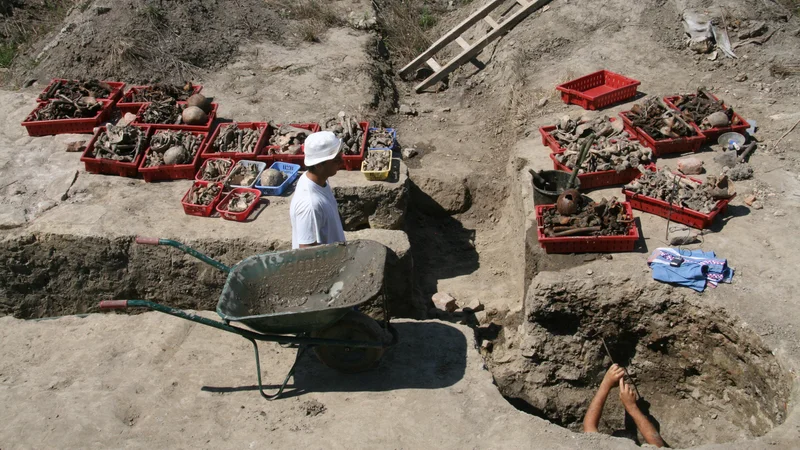
BERLIN — Nearly four dozen skeletons recovered from a deep well in the Croatian city of Osijek may be the remains of people who perished during the historic Plague of Cyprian that ravaged the Roman Empire in the mid-third century A.D.
"We have a whole bunch of these used Roman-period wells that were dug in antiquity," Mario Novak, a bioarchaeologist at the Institute for Archaeological Research in Zagreb, told Live Science. "They basically used these dried-up wells just to throw people in — either from battle or from epidemics."
Novak presented new research on the enigmatic burial Aug. 6 at the 25th European Paleopathology Association meeting in Berlin. It has not yet been published in a peer-reviewed journal.
The burial was excavated in 2008 near a Roman necropolis in Osijek, which was founded by Emperor Hadrian in A.D. 133. At the time, the city was part of the province of Pannonia and named Mursa. The city of Mursa was important in Roman times because soldiers stationed there helped protect the Danube and the limits of the Roman Empire, but much of the ancient city still lies unexcavated beneath modern Osijek.
Novak and his team previously found two wells full of young male skeletons that had suffered violent injuries around the time of their deaths. This led the researchers to conclude that the men may have been involved in the Battle of Mursa in 260.
But the newly analyzed skeletons were very different from the previous mass burials, Novak said in his presentation. At least 43 people were buried in the well, and the dead included adults and children of both sexes. None of them had any major injuries.
"I would say this is a typical demographic cross-section of a civilian population. So nothing resembling those two battle-related mass burials," Novak said. "Our working hypothesis is that these individuals might be victims of a plague."
Get the world’s most fascinating discoveries delivered straight to your inbox.
Historical records mention one major epidemic in the middle of the third century — the Plague of Cyprian. The disease outbreak first affected Roman troops on the Danube and likely caused mass mortality events in various parts of the Roman Empire. Experts don't yet know what caused this plague, but hemorrhagic fever and smallpox are possible contenders.
RELATED STORIES
"This provides some really interesting data," Patrick Randolph-Quinney, a biological anthropologist at Uppsala University in Sweden who was not involved in the project, told Live Science. "These weren't really mass graves — instead, the bodies were dumped into a series of pre-existing wells at the site."
The skeletons show evidence of non-life-threatening conditions like osteoarthritis on the vertebrae and dental cavities, Novak said. He also found a couple of possible cases of tuberculosis and scurvy. But so far, the skeletons have not revealed their cause of death.
"Obviously, harder data are needed to better contextualize this finding," Novak said. Results from DNA analyses are forthcoming, he said, which may confirm whether the people were hastily-buried locals rather than Roman soldiers who were conscripted from all over the Roman Empire.
Novak, M. (2026, August 6). Lay me down to rest: Bioarchaeology of a mass burial from Colonia Aelia Mursa (Osijek, eastern Croatia). 25th European Paleopathology Association Conference, Berlin, Germany. https://cfp.dainst.org/25th-european-ppa-meeting/talk/ZYNTXQ/
From Augustus to Nero, see how much you know about ancient Rome's famous leaders with our Roman emperor quiz!
Kristina Killgrove is a staff writer at Live Science with a focus on archaeology and paleoanthropology news. Her articles have also appeared in venues such as Forbes, Smithsonian, and Mental Floss. Kristina holds a Ph.D. in biological anthropology and an M.A. in classical archaeology from the University of North Carolina, as well as a B.A. in Latin from the University of Virginia, and she was formerly a university professor and researcher. She has received awards from the Society for American Archaeology and the American Anthropological Association for her science writing.