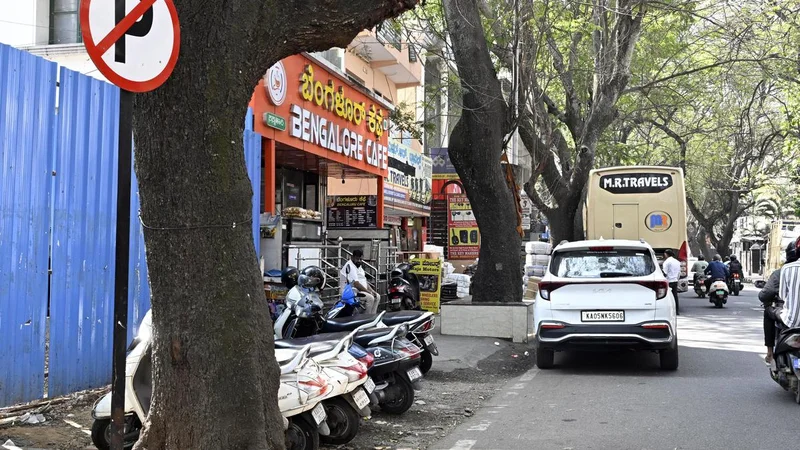
Parking in Bengaluru could become more expensive, with the draft Greater Bengaluru Authority (Parking) Rules, 2026, proposing minimum charges based on the category of the road and whether the parking is on-street or off-street, representing a steep increase from the current rates.
“On-street parking” refers to parking on roads, while “off-street parking” refers to parking in non-road locations, including vacant plots.
For on-street parking, the minimum hourly fee has been proposed at ₹20 to ₹40 for two-wheelers and ₹40 to ₹80 for light motor vehicles (LMVs). For off-street parking, the minimum hourly fee has been proposed at ₹10 to ₹20 for two-wheelers and ₹20 to ₹40 for LMVs.
The draft also proposes monthly off-street parking rates. Those opting for off-street parking only at night, between 8 p.m. and 8 a.m., may be charged 50% of the monthly off-street parking fee.
Road categories
Before implementing the rules, city corporations will categorise roads into three types: Categories A, B and C. The parking charges will vary depending on the category of the road where the vehicle is parked.
A commercial road that predominantly attracts people from across the city may be categorised as Category A. Commercial roads that attract people from surrounding neighbourhoods may be categorised as Category B, while other commercial roads catering largely to local residents may be categorised as Category C.
Currently, across the city, two-wheelers have to pay ₹15 per hour, and four-wheelers have to pay ₹25 per hour. The rationale behind the steep hike is to encourage off-street parking. However, in major commercial hubs, this is likely to affect officegoers.
In addition, stretches with a paid parking system already may move to a new charge structure, according to the draft.
Parking longer costs more
The proposed system also seeks to discourage long-duration on-street parking. Parking for more than two hours would attract exponentially higher charges, particularly where off-street parking is available nearby. City corporations may also introduce different rates for peak and non-peak hours, though the minimum and maximum rates at a parking facility cannot differ by more than 50%.
The draft further states that parking charges would be periodically increased based on demand and supply, with revised rates to be notified by the GBA chief commissioner. All parking fee collection would have to be carried out digitally, with the data made available to the city corporations and GBA for daily auditing.
Published - August 13, 2026 11:03 pm IST