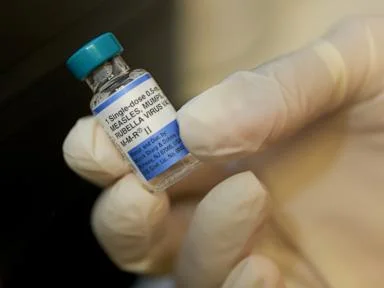
Why the MMR vaccine is given as one shot, and what separating it into more could mean
The MMR vaccine has been available since 1971.
Earlier this week, President Donald Trump signed an executive order recommending that the measles, mumps and rubella (MMR) vaccine be split into three separate shots.
"The MMR, we want to have separate visits separate times. The vaccine being broken into three separate single doses and vaccines being administered in separate visits," Trump said, claiming without evidence that it is safer to receive the immunizations individually.
The order sparked criticism from doctors and public health organizations, which said decades of studies and real-world evidence have shown that the MMR vaccine is safe and effective as administered. Splitting the vaccine into three shots would create a major logistic burden for families with no safety benefit, doctors say.
The MMR vaccine has been available since 1971, with research showing that the combined shot is as effective at providing protection as three separate shots.
Public health specialists told ABC News that "breaking up" the shot into separate vaccinations could have detrimental effects, especially as the U.S. currently faces the highest number of measles cases recorded in more than three decades.
More injections and more visits could mean more opportunities for children to miss their required vaccines, the specialists said.
"If you separate the vaccine into its three component parts, you have to have six shots instead of two, which makes it more burdensome and difficult," Dr. Paul Offit, director of the Vaccine Education Center at Children's Hospital of Philadelphia, told ABC News. "No doubt [that] will mean that there will be children who fall through the cracks during what is the worst measles epidemic we've had in this country in more than 30 years."
How the MMR vaccine came to be a single shot
In 1963, the first measles vaccine was licensed and approved using a live, weakened version of the Edmonston-B strain of measles virus. This was followed by an improved vaccine in 1968, the Edmonston-Enders strain, according to the Centers for Diseases Control and Prevention (CDC).
This led to similar efforts to create vaccines for mumps and rubella, which resulted in the Jeryl Lynn strain for the mumps vaccine in 1967 and the RA 27/3 strain for the rubella vaccine in 1969.
In 1971, the three strains were combined into what's medically defined as a trivalent shot: the MMR vaccine. The rubella vaccine component was changed in 1979, but the mumps and measles vaccine viruses have remained unchanged in the U.S. since 1971.
Clinical data found the combined MMR vaccine triggered a similar immune response to the individual vaccines, Offit said -- a feat that's more impressive than it may initially appear.
"It's not easy to do that when you combine vaccines," Offit said. "Sometimes they have buffering agents or stabilizing agents that are incompatible with another vaccine. Here it worked out where you could do that. ... So we're getting better at it, and that in theory makes it much easier for everybody."
In 1989, the CDC's Advisory Committee on Immunization Practices, the American Academy of Pediatrics and the American Academy of Family Physicians recommended children receive a second MMR dose.
The CDC currently recommends that children receive the first MMR vaccine at 12 to 15 months and the second between 4 and 6 years old. One dose is 93% effective at preventing measles, 78% effective at preventing mumps and 97% effective at guarding against rubella infection, according to the CDC, while two doses increases measles and mumps protection to 97% and 88%, respectively.
Adding more doctors' visits
Dr. Hana El Sahly, professor of molecular virology and microbiology at Baylor College of Medicine in Houston, Texas, told ABC News that currently there are no individual, monovalent vaccines for measles, mumps and rubella that are licensed for use in the U.S., nor is she aware of any pharmaceutical company planning to a produce any. Doing so would require research, development, clinical trials, approval from the Food and Drug Administration, mass manufacturing and distribution -- an expensive and time-consuming process
Another challenge is that separating the vaccines into three individual shots, each of which is given twice, would likely make it more challenging for families to attend six separate pediatrician appointments, meaning more children could miss shots and remain unprotected from potentially deadly diseases, El Sahly said.
"A general pediatrics office is one of the busiest offices when it comes to healthcare delivery," El Sahly said. "So instead of administering a safe and effective vaccine to a child in two visits over four years, we are demanding -- or the directive points them to -- six visits over that span of time. That multiplies by three the number of visits required to fully immunize the child against MMR. Major, major obstacle to healthcare delivery and access to care."
Additionally, many doctors' offices likely do not have the number of appointment slots available to accommodate an increase in visits for every child, according to El Sahly, assuming parents have the time to take their child to six individual appointments instead of two.
Safe and effective
During the executive order signing on Monday, Trump and Health Secretary Robert F. Kennedy Jr. asserted without evidence a link between vaccines and autism.
The MMR vaccine has been at the center of the claim due to a now-debunked paper published in a U.K. medical journal in 1998, which allegedly found that MMR vaccines cause autism. The journal retracted the study in 2010 and the author, who lost his medical license because of his assertion, has never been able to replicate his findings.
Numerous studies and meta-analyses have found that MMR vaccines do not cause autism.
During the executive order signing, Trump also made reference to an unsubstantiated claim that giving too many vaccines can overwhelm a child's immune system.
Offit said that modern vaccines have fewer total active antigens -- a substance that triggers an immune response in the host -- than vaccines Trump or Kennedy may have received in their childhoods. He added that children are exposed to common pathogens every day that tax the immune system far more than vaccines.
"You have trillions of bacteria that line your nose and throat and intestines. You actually have 10 times more bacteria on the surface of your body than you have cells in your body," Offit said. "Every bacteria has between 3,000 [to] 6,000 immunological components, and you respond to that because if you didn't, you'd be dead. ... So, the notion that vaccines in any way weaken or overwhelm or perturb our immune system is just nonsensical."