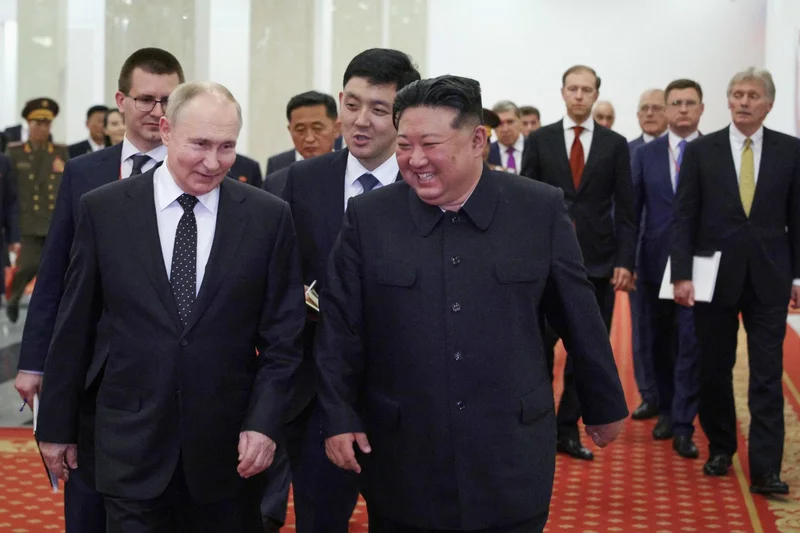
One of the biggest beneficiaries of Russia’s war with Ukraine is undoubtedly North Korea, or North Korean leader Kim Jong Un more specifically. Since Russia invaded Ukraine four years ago, North Korea’s foreign revenues have soared, earning $22 billion-- four times what it earned in the previous four-year period.
With 3.5% growth rates, the Wall Street Journal has called the Hermit Kingdom the most surprising economic success story of 2026. Kim has used some of this windfall to modernize its capital Pyongyang, which is now awash with fancy restaurants, skyscrapers that are 80 storeys high, electric cars, neon lights and modern technology, including ride sharing apps.
While Kim is triumphantly taking credit for the growth, he has Russia and China to thank. North Korea earned about $14 billion by providing military support to Russia and then hundreds of millions from in trade and foreign aid from China. Ukraine’s government estimates that from 2024-2025, North Korea supplied half of the munitions that Russia used on the front, including approximately 120 missiles and millions of artillery and mortar rounds. North Korea also sent about 14,000 troops to Russia but this will swell to up to 50,000 this year
Though North Korea is becoming more independent from China due to its burgeoning partnership with Russia, China is still Pyongyang’s economic lifeline. China accounts for up to 95% of North Korea’s total external trade though Beijing has mostly generated a surplus with North Korea. Yet in the past few years North Korea has seen an uptick in exports to China in goods such as wigs, hair products and tungsten ores, with two way trade growing this year by almost 20%.
These increasing ties between China and North Korea are not coincidental. As Russia and North Korea have gotten closer, Beijing has sought to reassert itself in a central role, with a face-to-face meeting between Kim and Chinese leader Xi Jinping taking place in June of this year—the first time in seven years. China is trying to catch up with the flurry of meetings that took place between Russia and North Korea in the last few years. Over the past 18 months Russia and North Korea have had 23 high level visits involving their ministers, compared to only eight between China and North Korea.
And China is not just seeking to improve its economic ties, but also military ties. Xi’s military alliance with Kim serves as a counterweight to Russia and counterbalances Japan’s military build-up, while also strengthening Beijing’s military options against Taiwan. A 1961 pact commits both countries to offer immed
both nations to offer immediate military aid if the other faces an unprovoked attack.
As evidence of this Sino-North Korean cooperation, in March the two countries revived the passenger trains that run from Beijing to Pyongyang that had been suspended due to covid-19. Direct flights between the two capitals resumed as well.
North Korea’s citizens are barely surviving
China and Russia certainly contributed to North Korea’s success but it’s not clear how much of this wealth trickles down to benefit the average citizen. Compared to South Korea which has the 14th biggest economy in the world, North Korea is still incredibly poor with 17 million of its 27 million people living in extreme poverty. The monthly salary of a doctor was less than the amount needed to buy one kilogram of rice. UN agencies also estimate that more than 40% of the population, or eleven million people—are undernourished.
One of the ways that North Koreans survived economic mismanagement was through black market activity. During the avoidable famine of the 1990s where up to 3 million died, the rationing system was unable to deliver food or other daily necessities to most citizens. Amid state breakdown, North Koreans turned to “self-help” by engaging in an illegal or quasi-legal market, known as jangmadang to exchange or barter. It started with bartering basic goods and services like fish, vegetables or even a haircut. This “grassroots capitalism” or “marketization from below” eventually led to smuggling, with goods coming from China popping up across the country. Initially the Kim regime tolerated these markets and even taxed them. But Kim Jong Un became concerned that the modern goods coming into North Korea such as USB drives, cell phones and DVD players could affect information control and propaganda.
In 2020 Kim used the pandemic as an excuse to crack down on these markets, with an anti-market campaign to curtail foreign influence. To stop internal market activity, citizens were told that seafood carried covid. To ensure that smuggling from China stopped, anyone coming in or out of the border was shot at, with shoot to kill orders.
Since then merchants have been actively forced back into state administered storefronts with profits going straight to the central government again. This has restricted cash flows for the average North Korean and diminished survival options but has built additional capital for the regime.
Exploiting North Korean Labour
Another source of wealth for the regime is Office 39 (also known as room 39 and bureau 39), a secret government organization, which was set up in the 1970s, to manage the Kim family’s slush funds and generates foreign currency for Kim and his elites. It is unknown how much it is worth exactly but may be worth in billions (possibly as much as $5 billion), and it functions as Kim’s personal piggy bank.
In interviews with high-level defectors that had worked for Office 39, profits were generated by arms and crystal meth sales, hacking (stealing $2 billion in cryptocurrency in 2025), but also by North Koreans working overseas. Workers are mostly sent to China and Russia, but have operated in forty countries around the world, mostly in construction, textiles, medicine, information technology and food service. The workers are watched constantly by North Korean agents to ensure they don’t defect and work 16 hours a day, earning about $10 a month. The program of sending North Korean labour abroad generates about $500 million in foreign currency revenue.
All of this has made Kim very wealthy. Satellite imagery has documented luxury palaces and residences across North Korea that Kim owns, a collection of over 100 luxury European cars, a private jet and a multi-million-dollar yacht.
Not surprisingly, the North Korean economic miracle will not lead to any sort of democratization push as it did in South Korea in the 1970s and 80s. In fact, despite the sanctions, North Korea is in a stronger position than at any point in decades, according to Andrei Lankov a specialist in North Korea from Korean Risk Group.
But the benefits of that growth have mostly just strengthened Kim. Most North Koreans outside of the Pyongyang have seen little of these gains.