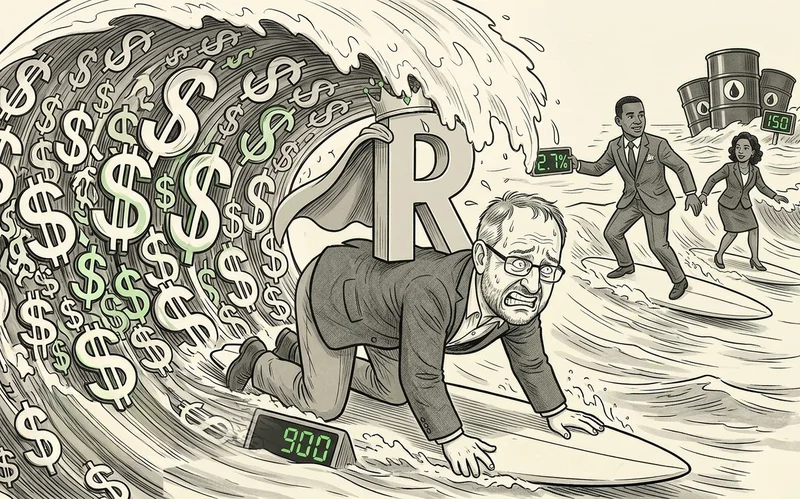
For much of my younger life I wondered what all the fuss was about with bonds and stocks and carry trades and all the rest. Why do so many well-dressed people get all excited about it?
I knew it was about money, but this was in those happy carefree days of my youth (which coincided with my pre-mortgage existence).
Now, as an older individual, which a much more furrowed brow (and hairline), I pay it all a lot more attention. It has a direct impact on the numbers I look at so often in my banking app, and the particular number in the particular account that tells me how weâre doing.
There is a wonderful series of mechanisms that drive it all. And some of it is so complicated that so many (again, well-dressed) people can get it all so wrong.
I was one of those who worried, along with The Economist, that oil prices might hit $150 or $200 a barrel. I didnât know then what much of the world knows now, how China has been able to store so much oil that it is able to move the market more than the Organization of the Petroleum Exporting Countries (OPEC) could.
Now, the one indicator that we should all follow quite closely, the rate of the rand to the dollar, has been fascinating to watch over the last few months.
At the start of the year, all was looking good. Gold prices were up, oil prices were low, reforms were coming through and people were worried about the future value of the dollar, which lead to the âdollar debasement tradeâ.
Then you-know-who did you-know-what in Iran and everything changed. Gold dropped, the dollar strengthened, our reforms mattered less and the rand sank.
Suddenly, despite the fact there is no peace, and I fear very little prospect of peace, between the US, Israel and Iran, the rand is stronger again.
People still better dressed than I tell me itâs because of US interest rates and the carry trade. Essentially, because interest rates in the US are at a certain rate, and interest rates here are at a certain rate, if you move your dollars into rand and keep them here for a while, you will make some money.
Bloomberg calls it âthis monthâs most lucrative emerging-market carry tradeâ and says that traders have earned â2.7% in the dollar-funded carry trade so far this monthâ.
All of this means that people are buying our governmentâs debt.
And one of the reasons for that is because the government has been able to get in more money than itâs spent, which means itâs paying back debt more quickly than forecast. And while there are many things in life that make you happy, I bet very few of them match paying back debt more quickly than you expected.
All of this helps us in some wonderful ways, it is the kind of wave that you donât really expect that genuinely lifts all our boats.
One of our major problems at the moment is obviously higher fuel prices.
And while petrol prices are relatively stable, the shortage of diesel refining capacity around the world (partly because of higher oil prices, but also because of Ukraineâs attacks on Russian refineries) is going to keep diesel prices higher for longer.
But, if the rand is stronger, then that might offset some of the impact of higher oil prices. While we must take this wave and surf as far as we can on it, it does remind us of how small we are in a sea so big.
Yes, we can control some things, like spending less and paying back more debt, and our Reserve Bank can manage interest rates appropriately. But we have no influence whatsoever over what the Federal Reserve does (although, having met Lesetja Kganyago I do wonder if they consult him from time to time⦠I would if I were them).
Which means we can do very little to keep the wave going.
Momentum
That said, a little bit of momentum can really go a long way. This weekâs employment numbers, showing we had lost about 400,000 jobs in the second quarter, are a reminder of how tough things are.
Anything that makes them a little easier must be used to give us some breathing space.
Last week it emerged that the National Treasury believes the bond market has already âupgraded usâ to âinvestment gradeâ, despite the fact that the major ratings agencies havenât yet done the same thing.
That means that exceptionally well-dressed people are watching what we do. They will want to know if we can keep it going.
The global machinery that leads to the particular number in the particular account in your banking app is finally moving slowly in our direction.
Best we ride the wave as far as we can. DM