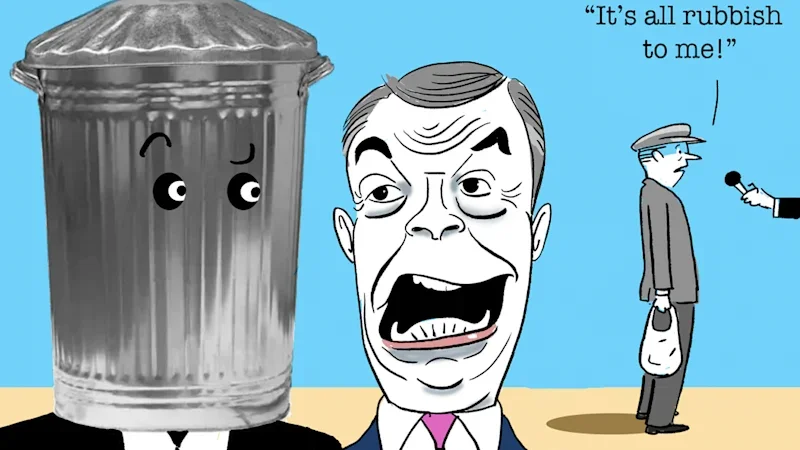
By the time you get around to reading this, there’s a good chance Nigel Farage will have won or will be about to win the Clacton byelection. If so, he will have seen off the intergalactic threat of Count Binface, a serial candidate with a bin on his head, who claims to be an alien space warrior from Sigma IX. Thus closes a circus of a chapter in British politics whose meaning, for now, is strangely ambiguous. I’ve spent much of this campaign trying to figure out if Binface represents the salvation of democracy or its nadir. Now it has concluded, I wonder if my confusion stems from the fact that I was asking a question Binface had no interest in answering.
The whole byelection was born in farce. Farage manufactured it as soon as controversy began to bite after he failed to declare a £5 million ($9.6 million) payment from a crypto-billionaire. A parliamentary integrity watchdog is investigating, so Farage thought he’d subvert the process by resigning from parliament and letting the people decide. That’s meaningless without the investigation having been completed. It’s also a waste of time and money given its findings might force another byelection in any case. But victory would allow Farage to dismiss all this scrutiny as anti-democratic, elite nonsense. As a result, the major parties boycotted, leaving Binface as the principal challenger.
The satirical potential was enormous. Farage called this a contest between the people and the establishment, but what did this mean once he was going head-to-head with a bin? If Farage wasn’t the establishment, was Binface? And was Farage therefore even less conventional, and more ridiculous than that? If so, Farage was less a rebel for the people and more a self-indulgent character taking everyone for a ride. The early days of the campaign carried a sense – mostly from the media and people around the world who don’t like Farage – that perhaps Farage, vulnerable for the first time, would meet his kryptonite. An electorally meaningless poll had Binface leading Farage by 12 points among British voters nationwide, 33-21.
The trouble is this loaded onto Binface more than the character can bear. It cast him as a kind of protest candidate. But that’s not what Binface is. He is a comedy candidate. On this score, he succeeds. His interviews are genuinely funny in the most British way. I laughed a lot watching him explain how the word “manifesto” comes from “two root words: ‘manifest’ meaning abundantly clear, and ‘o’ meaning nothing whatsoever”. His policy to nationalise Adele is wonderfully absurd. Binface is the creation of a comedian, Jonathan Harvey, who studied classics at Oxford University, and all of this shows. When asked for his thoughts on Christopher Nolan’s Odyssey on a popular politics podcast recently, he answered in (I presume) Homeric Greek to hilarious effect.
You could say he is satirical, but not quite in the way those hoping to oust Farage might have been hoping. Among Harvey’s writing credits is The Thick of It, the British forerunner to Veep, and he campaigns in that vein. His promise to “cut your taxes, and raise them for everyone else” is brilliant – a pointed riff on the senselessness of pure self-interest and the incoherence of populist policy. In the 2019 election, when the Tories promised 20,000 new police officers, Binface ran and promised 20,001, lampooning the law-and-order auction. In the 2021 London mayoral election, he said he’d tie government ministers’ salaries to those of nurses for the next 100 years. And in Clacton, the Binface manifest-o had some pointed barbs at Farage: a promise not to take £5 million donations from crypto-billionaires; to spend more time in Clacton than in Washington, DC; to serve out his term without triggering another byelection, which would immediately save £350,000. “Put that on a bus!” he declared, an acidic reference to Farage’s misleading Brexit campaigning.
But the thing about The Thick of It and Veep, like Yes Minister before them, is that they’re satirising a general political culture. The main character’s party is never stated. That’s wonderful satirical technique. Satire debases itself when it becomes partisan. But its power is limited in an election campaign. In Binface’s previous campaigns, when he was a novelty in a field of serious parties, his candidacy played the role beautifully. In that context, the long British tradition of novelty candidates (like Screaming Lord Sutch or the Official Monster Raving Loony Party) really is one of British politics’ glories: a symbol that democracy is for everyone and that the gadfly is useful in pricking and deflating the pretensions of career politicians. But when put head-to-head against Farage, the calculations change dramatically. The heightened focus and stakes make comedy difficult, because the joke can only be told so many times. And the pursuit of laughs is very different from the pursuit of votes.
I’ve seen nothing to indicate that Binface had any real interest in winning, or even in doing surprisingly well. He hasn’t conscripted the boycotting parties into his cause, for instance. He refused to criticise his opponent directly. It’s not even clear he was particularly aiming to damage Farage. He might have done so anyway, of course, though that’s really a matter of subjective impression. The local polls had Binface attracting about 20 per cent of the vote, and if the results reflect that, some will no doubt say that’s humiliating for Farage. But the counter is that’s about the size you’d expect the anyone-but-Farage cohort to be.
It’s been fun, though more for the broader audience than the locals. We laughed, or at least I did, and maybe there’s something noble just in the relief at a time like this. Whatever hopes people might have had for the coming of the bin, it seems the good Count didn’t share them. If there’s any fallout here, it comes not so much from the result, but from the simple indignity of Farage being forced to beat a personified joke. And on that, the best zinger came not from Binface, but inadvertently from a Clacton voter speaking to The Independent before polling day: “I don’t think I’ll vote for anyone. They’re all the same.”
Waleed Aly is a broadcaster, author, academic and regular columnist.
The Opinion newsletter is a weekly wrap of views that will challenge, champion and inform your own. Sign up here.