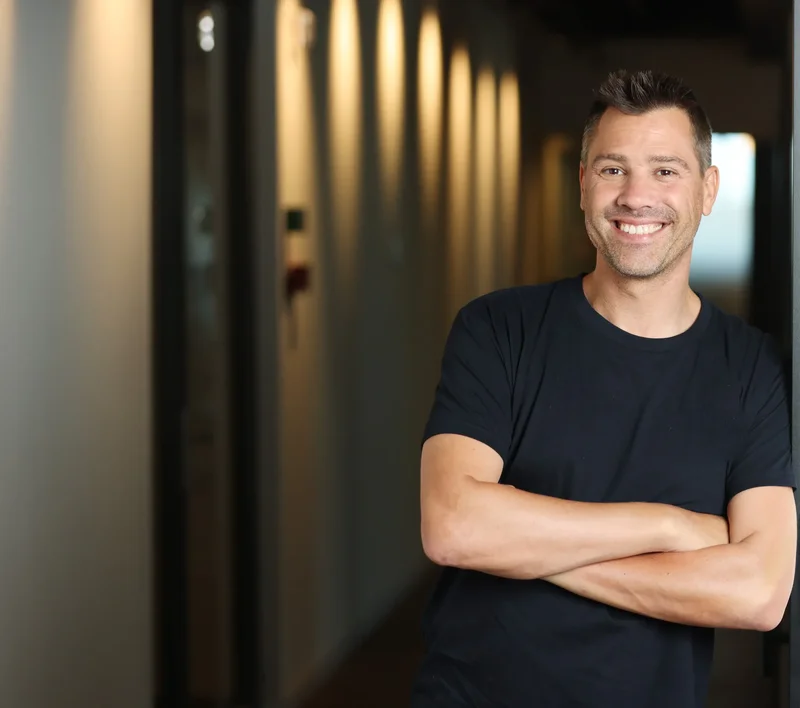
Yoni Assia, 45, founded eToro together with his brother Ronen almost two decades ago. Today, it is one of the largest online investment platforms in Europe and has been listed on the U.S. Nasdaq for a year. The brothers followed in the footsteps of their father, David Assia, who took a technology company public there in the 1990s.
This week, eToro announced the acquisition of TradeZero, a U.S. firm that offers more complex financial transactions to specialized traders, for $231 million.
Assia, who was born in Savyon, a town a few miles from Tel Aviv, spoke with EL PAÍS via video conference on the same day he presented the company’s second-quarter results, which showed a net profit of $53 million, up 77%. Although business appears to be picking up, the investment technology group has lost more than 40% of its value since its stock market debut.
Question. You reported an increase in profits, yet the share price has fallen again. How do you explain the market’s reaction?
Answer. I’m a big fan of Warren Buffett, who always says you really can’t explain the irrationality of markets. We are working to make the market better understand eToro, our growth and our acquisition strategy.
Q. eToro went public on Nasdaq a year ago, and its shares have fallen by more than 40% since then. How do you assess the experience?
A. I’m a fan of capital markets. I weather volatility well — just as I do in crypto markets. Capital markets offer opportunities to grow through acquisitions and to be more aggressive in competing in new markets like the U.S. and Singapore, which are growth markets with huge opportunities.
Q. What does the TradeZero acquisition mean for eToro?
A. It’s a great opportunity to position ourselves in the United States. They have built great infrastructure for more advanced users — more sophisticated traders — many of whom are involved in short selling. It gives us access to a more sophisticated audience that uses a more sophisticated trading platform.
Q. eToro is a company that was founded in Israel but has a strong European identity. How strategically important is the United States for the group?
A. I think it’s a major part of our potential hyper growth. I believe we can grow a nine-digit business in the U.S. by 2030, and we are likely accelerating that to 2027 or 2028.
Q. In the last quarter, you bought TradeZero, Zengo and Bit2C. Why have you accelerated acquisitions so aggressively?
A. Each deal is a unique opportunity and tells a slightly different story. The Bit2C deal lets us expand eToro into the Israeli market. Despite our Israeli origins, we had not been active in Israel. Zengo is an uncustodial crypto wallet. We are what’s called a traditional finance company dealing in crypto. With Zengo, we get 10,000 crypto assets versus 200 on eToro. We’re targeting younger audiences, especially Generation Z. We see many young people wanting to hold their assets on-chain in crypto, in stablecoins, and to trade. Even when they trade stocks, they want to trade tokenized shares. We are building a bridge between traditional finance and digital-asset finance through the acquisition of Zengo.
Q. Wall Street and many stock markets around the world are at record highs. How long do you think this bull market can last? Do you still see room for further gains?
A. It’s very hard to understand when and where a market correction will happen. Some people talk about an era of hypergrowth ahead. The big question is AI — how it drives that growth and whether it generates GDP growth.
Q. Do you think we are entering an era of hypergrowth?
A. Many people think and talk about that. We are seeing growth among AI-related stocks shift between the hyperscalers, semiconductors and other software companies. It’s very difficult to say how long that double-digit growth will last. But if you look at markets over the past 15 years, average returns have been accelerating, not slowing.
Q. So do you see any risks in financial markets, like an AI bubble?
A. I always see risks. We are in the business of enabling people to learn about risk and to buy risk. When you buy stocks, you are buying risk. The biggest risk in the market is not taking risks, so I firmly believe in participating in capital markets.
Q. How do you see the market in the long term?
A. Europe is our largest market, but it is hugely underinvested. Europe represents a $100 trillion market and most of it is in insurance and bank deposits. Capital markets have historically proven to be a better investment over time than bank deposits in single-digit returns. In the long run, I’m certain capital markets will continue to be a good investment.
Q. Isn’t it contradictory that volatility benefits investment-platform businesses? The war in the Middle East, tariffs, the war in Ukraine, Donald Trump’s policies...
A. I think the world is becoming more volatile. That’s unrelated to eToro. I think politics is becoming more volatile. It’s something that began about 15 to 20 years ago with cellphones and social networks, where polarization became more extreme. Before, you heard one or two stories in the news. Suddenly, you hear a thousand different stories, which create more pockets of volatility. People talk about the markets, not politics. I think that is the tendency of the world. When I meet young generations, Generation Z, and talk with them, they sound crazy to me. So volatility will probably only increase.
Q. Just a couple of months ago, you said in an interview that cryptocurrencies would reach new highs by the end of the year. However, the market has continued to decline since then. eToro’s cryptocurrency business has also weakened. Do you still stand by that forecast?
A. I always say I think cryptocurrencies will surpass their all-time high at some point within the next four years. We are in what crypto calls a bear cycle. Crypto cycles tend to be more aggressive than capital-market cycles. It’s a more volatile, high-risk market. I believe at some point we will see a return of a kind of bull market, probably closer to the end of the year.