Japan protests Putin’s first visit to disputed islands
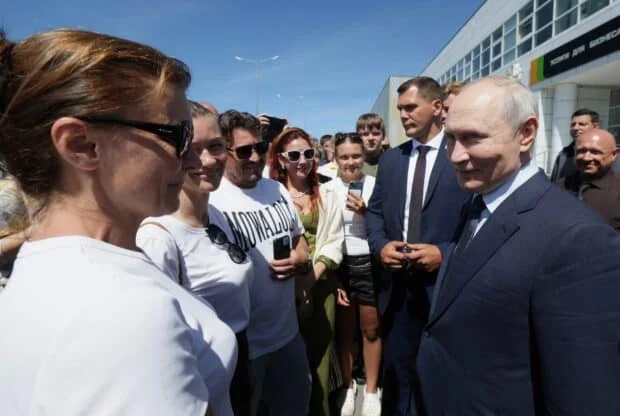
MOSCOW, Russia — President Vladimir Putin visited Russia’s far-eastern Kuril islands for the first time on Thursday, prompting protests by Japan, which also claims the territory — quickly dismissed by Moscow.
Russian-Japanese relations have long been dogged by the contested islands, known in Japan as the Northern Territories and seized by the Soviet Union in 1945.
The Kremlin posted a video of Putin on one of the four main islands. Russian media said he had visited a fish-processing plant and showed him trying local caviar.
Article continues after this advertisement
It was the first visit by a Russian president since Dmitry Medvedev in 2010.
Japan summoned Moscow’s ambassador to protest and Prime Minister Sanae Takaichi told reporters: “The Northern Territories are an inherent part of Japan’s territory, both historically and under international law.”
Putin’s visit “offends the sentiments of the Japanese people and is absolutely unacceptable,” she added.
Moscow rejected Tokyo’s protest in a foreign ministry statement later Thursday.
“We categorically reject these statements, which we consider politically inappropriate, insulting and, of course, legally unfounded,” said ministry spokeswoman Maria Zakharova.
Article continues after this advertisement
“The Northern Territories are an inherent part of Japan’s territory, both historically and under international law,” she added, denouncing what she called Tokyo’s “anti-Russia policy bordering on hostile.”
READ: Japan sees ‘urgent’ need to boost military
Article continues after this advertisement
UN calls for restraint
Putin, 73, travelled to the Kuril Islands after visiting the nearby Russian island of Sakhalin on Wednesday, where Russia’s navy was conducting drills.
He held a meeting “on ensuring the security of Russia’s eastern borders” while in Sakhalin, state media reported.
In response, Japan’s Foreign Minister Toshimitsu Motegi summoned Russian Ambassador to Japan Nikolai Nozdrev to lodge a “strong protest” against Putin’s surprise visit.
Russia’s embassy in Japan said the ambassador had said the islands were “an integral part of the Russian Federation” and that Putin’s travel there was not “a matter for discussion with foreign states.”
A spokeswoman for the United Nations’ Secretary-General Antonio Guterres, Shirin Yaseen, said “this is a bilateral issue between member states.
“We encourage all concerned to exercise restraint, to act responsibly, and to avoid any actions that may escalate tensions further,” she added.
Ukraine sanctions
Ties between Japan and Russia have worsened since the full-scale conflict in Ukraine began in 2022.
Japan has joined other G7 countries in sanctioning Russia and giving money and non-lethal defence aid to Kyiv.
Putin on Wednesday called Japan’s sanctions “unprovoked”.
“Japan has identified Russia as a main source of threats. I would like to point out that we are not threatening Japan… On the contrary, it has territorial claims against our country,” Putin said.
Russia and China have also moved closer, their navies and air forces conducting joint exercises near Japan, prompting frequent scrambles by Japanese jets.
North Korea, which this month termed Japan’s military build-up a “transformation into a war state”, has also sent troops and artillery shells to help Russia’s war against Ukraine.
Japan’s latest defence white paper issued this month again highlighted growing risks from all three countries.
Harsh climate, few people
The Soviet Union took the strategically located islands in the final days of World War II, and has maintained a military presence there ever since.
The contested islands are part of the volcanic Kuril archipelago, which runs in a broad arc from Russia’s Kamchatka peninsula down to Japan’s main northern island Hokkaido.
Their population of about 20,000 Russian citizens lives in a harsh climate, but the islands have mineral deposits including gold and silver, and rich fishing grounds.
After occupying the islands in 1945, Moscow deported their Japanese population of about 17,000 people.
The islands have acquired strategic importance, providing air and sea bases during the Cold War as the Soviet Union confronted the United States and Japan.
“The Kurils have been fortified with Bastion coastal defence missile systems and SU-35 fighter aircraft,” said Yee Kuang Heng, a professor at the Graduate School of Public Policy at the University of Tokyo.
“These provide Russia with instruments of control over sea lanes in the region, as well as leverage against Japan’s claim to the islands,” Heng told AFP.
“Putin’s visit may be a reminder of the cards he holds and also his displeasure with Japan’s continuing sanctions on Russia.”