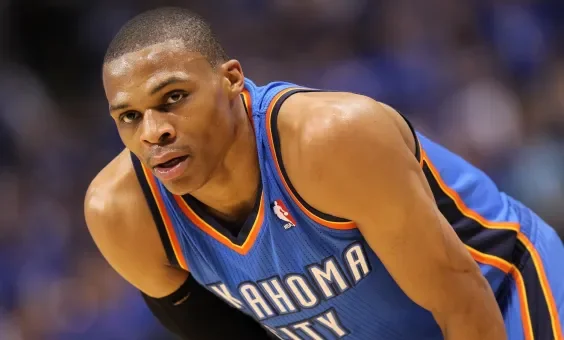
When the Seattle SuperSonics drafted Russell Westbrook fourth overall in 2008, around six weeks before they officially became the Oklahoma City Thunder, the league had no idea what to do with such an athletic and violent point guard. Westbrook, who announced his retirement this week, leaves behind a very different NBA than the one he joined 18 years ago, but, despite the considerable passage of time, the extent to which the game changed, and the extensive accolades he racked up, he never became a player who made sense. No sane coach would ever have instructed any of their charges to play more like Russell Westbrook, less because of the riskiness inherent to such a tactic, and more because of its plain impossibility. Westbrook was singular.
Consider the NBA that Westbrook joined. It was ass. By 2008 the group of bigs—Shaquille O'Neal, Tim Duncan, Kevin Garnett, Dirk Nowitzki, and others—that dominated the decade to that point had begun their decline. Despite obviously being the best player in the league, LeBron James was ruled unworthy of being named MVP by a newspaper-dominated national media class that relished preserving the legacy of Michael Jordan. So, at the end of the 2007–08 season, the voters gave the award to Jordan cosplayer Kobe Bryant, to congratulate him for being lucky enough to have Pau Gasol on his team. David West and Caron Butler were all-stars. Steve Nash, Chris Paul, and, to a far lesser aesthetic extent, Deron Williams were carrying forth the point guard position, which was in a pretty dire state.
Not for long, it turned out. The first bit of Westbrook's career came alongside the immediate success of Derrick Rose, taken at the top of the same draft, which became the natural and obvious way to make sense of it. Both were among the best athletes in the league the second they joined it, promising to remake the point guard position, before that primarily thought of as the domain of tricky little craftsmen and heady floor generals, into something crazier. Move over, Jose Calderon, we got guys who can dunk now.
But Westbrook and pre-injury Rose were extremely different players. Rose was polished, more of an evolution of the form than a departure. Slotted into the veteran-heavy Bulls, Rose learned how to run a team the right way. He would dunk all over guys, but he was a dutiful distributor. He rarely sought contact at the rim.
Westbrook, meanwhile, was given broad artistic license, and he used it to experiment. There were no responsible hit-ahead passes to John Salmons; instead, Westbrook spent his rookie season dribbling into triple teams, flying down the floor when given even the faintest hint of daylight, and at the other end gambling on any and every even notionally wayward pass. He saw rim protectors as summits to climb, not hazards to avoid.
The detractors would probably point to this as an original sin of sorts; by the time Westbrook was on a team with ambitions, he was hardened, more or less, into what he would always be. But I loved watching early Westbrook. The sense of possibility he played with was magnetic. Only someone supremely talented could be that messy, like a violin prodigy trying to pick at the strings and play riffs.
Those early Thunder teams belonged to Kevin Durant, but even he was explicable: "Dirk Nowitzki with a bag" is a ridiculous player, but one built of ultimately familiar components. You couldn't use the terms of any extant players to describe Westbrook. Was he Andre Miller with a jetpack? Gary Payton on HGH? Black-metal Jason Richardson? Dwyane Wade if he went to the therapy that made you evil? 5G Baron Davis? Not really, no.
Westbrook was simultaneously a tremendously gifted passer, with a natural eye for open teammates in the corner and dropping low onto the block, and a world-historic artist at turning the ball over. He was one of the very best players at turning complex situations into simple plays, and also one of the best at turning simple plays into clusterfucks. He was never at any point in his career strictly guardable; he would reliably stop himself far more often than anybody else could.
That version of the Thunder never won a championship. They ran into the Nowitzki Mavericks in 2011; in their lone Finals run the following year, they ran into the LeBron Heat and had the shit beaten out of them; after a combination of injuries and the San Antonio Spurs held them back for a few seasons, they blew their last real chance in 2016's conference finals, when Golden State's Klay Thompson invented new ways to shoot the basketball. Durant left for the Warriors after that season. Westbrook would only ever get past the first round one more time as a significant player, in 2020 with the Houston Rockets. But balanced between the feel-good highs of the early Thunder days and the lows to come was Westbrook's 2016-17 revenge season.
For one season, we got to see the fully realized version of Westbrook. For the first time his team's unquestionable leader, he grabbed rebounds away from Steven Adams, controlled every possession, committed 438 turnovers, and became the first player to average a triple-double across an entire season since Oscar Robertson in 1961–62. That season's MVP discourse wars will be remembered for their intensity and meta-discursive intrigue, and while one faction will smirkingly offer the Thunder's feeble first-round exit, and Westbrook's eventual unraveling as an effective player, as evidence for why someone else should have won the award, Westbrook was a totally deserving winner.
Kawhi Leonard and those guys made sense, and their defenders could make rational cases in their honor. But Westbrook's win was a validation, even if only for a brief, defiant moment, of the idea that basketball is bigger than its rational representation. What you had to do was watch Westbrook play, and you'd see a guy at the peak of his idiosyncratic powers.
Even in the depths of his excesses, there was no better shot creator in the NBA. Isn't that a point guard's job? I'm not going to argue for Westbrook as a crypto-traditionalist—nobody with a career highlight reel closer to Evel Knievel's than Chauncey Billups's could ever be called that—though in the aggregate, peak Westbrook approximated the distributive excellence of many of his regular-style forebears.
We have to talk about the back half of his career, which was, in its own strange way, rather remarkable. Westbrook's final all-star season was his lone campaign in Houston, and his effectiveness waned rapidly afterward: in exile in Washington; as the piece that broke the LeBron Lakers' reign as a real contender; as a bit player across the aisle with the Clippers; as an oddly endearing stuntman in Denver; and finally in proto-retirement in Sacramento.
Yet even in decline, Westbrook was unique. The theory of Westbrook, in his earliest days, was that he would truly come into his own once he stopped turning the ball over on every fourth possession and that his peak would end once his athleticism went. But neither of those things ever happened: He never stopped blending horrible decisions with amazing decisions, and his athleticism never went.
Last year, he engineered bizarrely great two-man chemistry with Maxime Raynaud and briefly wrote a new page in the playbook on how to attack Victor Wembanyama. The problem was simply that the game changed around him. The point guard position he never quite revolutionized shifted all the same, toward guys who could, more than anything, create and hit their own jumpshot. Westbrook's Achilles heel was that he never ever became a credible jumpshooter, so instead he became obsolete.
That's impressive, to me. Westbrook was so good he didn't have to do the most important thing in basketball well to be extremely effective, and, more to the point, cool. At the very end of his career, you can see a few players who sort of play like Westbrook. The Thompson twins, Amen in Houston and Ausar in Detroit, are in his athletic lineage, though I think their total inability to play offense should make everyone appreciate Westbrook even more. There's nobody like Russ, and there never has been.