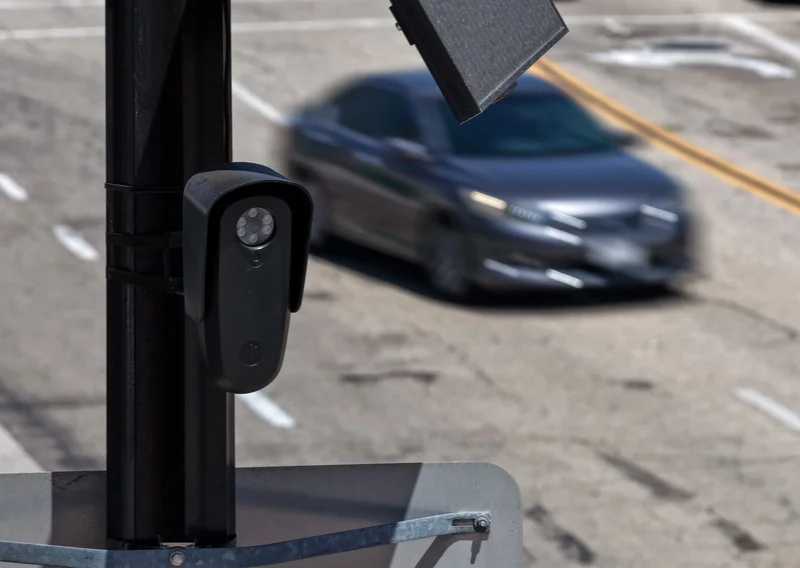
Controversial surveillance technology company Flock Safety has unveiled sweeping new privacy "guardrails," seemingly intended to quell growing unrest over its devices' presence across the country.
Days prior, CEO Garrett Langley went on a media run to convince the public that the company was not the latest cog in a dystopian surveillance state, but rather a purveyor of public safety. "We’re not Big Brother," said CEO Garrett Langley. "We’re focused on protecting people."
But many still wonder, if it looks like Big Brother, and it talks like Big Brother...
You May Also Like
What is Flock's new privacy policy?
Under the new policy, Flock will be adjusting its default data retention period from a 30 days to seven. Prior to this, Flock systems were automatically set to store an individual's registration and location information for a full month, but this can still be changed to longer or shorter periods according to state and local policy. The ACLU has previously recommended that data retention defaults be set to 48 hours.
In addition, Flock will now require law enforcement agencies to use a case code that delineates a potential offense before searching the Flock database. Previously, this was an optional setting for Flock clients, and dozens of law enforcement officers have been accused of using the database to stalk and harass individuals. The company's "Audit Assistance" tool, intended to flag inappropriate uses, will become standard on all Flock packages.
Flock is also adding a new feature called "Offense filtering for sharing." The tool will let cities moderate how other agencies access their residents' data by categorizing which types of offenses are searchable.
Does this make Flock cameras safer?
All of these changes come with exceptions. "Every community will continue to choose the retention period that fits its public safety strategy," according to Flock.
The company also announced a new "Evidence Mode," which allows law enforcement to bypass retention policies and store specific ALPR data if it is deemed evidence in an active investigation. The feature could be a step in the right direction, or it could make everything worse, according to civil rights groups.
"If 'Evidence Mode' only retains hit result data that police determine may be evidence in an active investigation of a specific case, then the change may be a positive one," the ACLU wrote in an analysis of the new policy. "But if 'Evidence Mode' triggers the retention of any ALPR data that is searched, then the new mode could indefinitely retain all the ALPR data Flock collects and shares nationally."
Broadly, many of Flock's new safety features have not been proven to prevent pervasive law enforcement misuse, the ACLU argues: "Transforming an exceptionally dangerous mass surveillance system into one that is fully protective of civil rights and civil liberties is a difficult, if not impossible task."
Why are Flock cameras controversial?
In the last month, communities have rallied to "deFlock" their neighborhoods, including destroying, blocking, and even stealing Flock cameras installed there. Many city governments, and even fellow tech companies, have canceled contracts with the company, as others debate continued partnerships.
To many, the "eye-in-the-sky" Flock camera has become a looming symbol of tech-enabled state surveillance and unfettered data collection. As of June, the company operates more than 120,000 cameras in 6,000 different neighborhoods, used across a gamut of businesses, law enforcement agencies, and even homeowner associations to monitor anyone who happens to drive by.
For years, privacy experts and civil rights advocates have raised alarms over the escalation of automated license plate reader (ALPR) systems across the country, as well as the covert nature of ALPR surveillance hardware in public spaces. In addition to automatically scanning passing cars to crosscheck their registration against law databases, ALPRs often store personal registration and location data for indefinite periods to later be used by national networks and law enforcement agencies — before you've even committed any crime.
In offering such services to agencies and businesses across the country, activists allege companies like Flock have enabled a mass state-accessible tracking apparatus unbeknownst to citizens. That is, until recently.
or
get Mashable push alertstoday.
Chase joined Mashable's Social Good team in 2020, covering online stories about digital activism, climate justice, accessibility, and media representation. Her work also captures how these conversations manifest in politics, popular culture, and fandom. Sometimes she's very funny.