Kuril islands: strategic chain at heart of Russia-Japan dispute
MOSCOW, Russia — Called the Kuril islands by Russia and the Northern Territories by Japan, the volcanic islands lay at the heart of a territorial feud that has prevented the two countries from formally ending World War II.
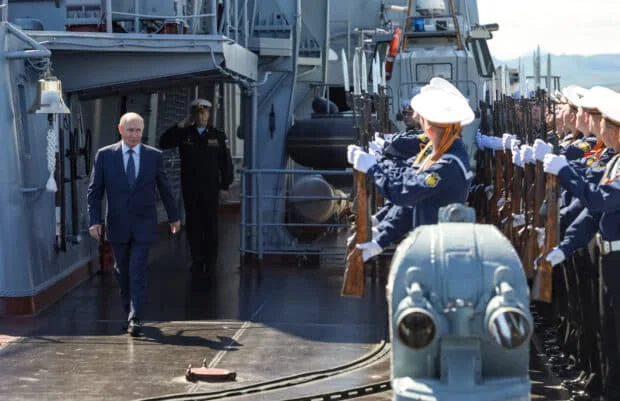
The row flared again on Thursday, with President Vladimir Putin’s first visit to the islands prompting protests by Japan.
READ: Japan protests Putin’s first visit to disputed islands
Article continues after this advertisement
Here are some key facts about the Kuril islands:
Location
Japan claims four of the islands — Iturup (Etorofu in Japanese), Kunashir (Kunashiri), Shikotan and Habomai. They are the closest to Japan, just off the coast of Hokkaido.
The four are the southernmost islands in the 1,300-kilometer (810-mile) archipelago stretching from Russia’s Kamchatka Peninsula to Hokkaido, separating the Sea of Okhotsk from the Pacific Ocean. There are 56 islands in the chain in all.
The islands are administered by Russia as part of the Sakhalin region. Japan considers the four they claim as part of Hokkaido prefecture and says they are “illegally occupied” by Russia.
Treaties
Russia’s Empress Catherine the Great claimed sovereignty over the Kuril islands in 1786 after her government declared they were discovered by “Russian explorers” and therefore “undoubtedly must belong to Russia”.
Article continues after this advertisement
In the first treaty between tsarist Russia and Japan in 1855, the frontier between the two countries was drawn just north of the four islands closest to Japan.
Twenty years later, a new treaty handed the entire chain to Japan, in exchange for Russia gaining full control of the island of Sakhalin.
Article continues after this advertisement
Japan seized back control of the southern half of Sakhalin during its crushing victory in the 1905 Russo-Japanese War.
Soviet takeover
The Kuril islands have been back at the centre of a territorial dispute since Soviet troops invaded them in the final days of World War II.
The Soviet Union only entered into war with Japan on August 9, 1945, just after the United States had dropped an atomic bomb on Hiroshima.
Soviet troops completed their takeover of the islands after Japan’s general surrendered later that month.
Russia argues that US President Franklin Roosevelt promised Soviet leader Joseph Stalin he could take back the Kurils in exchange for joining the war against Japan, during the Yalta conference in February 1945 when Allied leaders divided up the post-war world.
The Soviet capture of the islands has prevented Moscow and Tokyo from signing a formal treaty to end the war, despite repeated attempts over the past 70 years to reach agreement.
In 1956, Soviet leader Nikita Krushchev offered to give Japan the two smallest islands, Shikotan and Habomai, in exchange for signing a peace treaty but dropped the idea after Tokyo struck a military alliance with the United States.
Strategic value
Though home to only around 20,000 people in the entire chain, the islands are economically and strategically valuable.
They are rich in fish stocks and contain deposits of minerals and rare metals, including rhenium, which is used in the production of supersonic aircraft.
Control of the islands gives Russia year-round access to the Pacific Ocean for its Pacific Fleet based in Vladivostok, since the strait between Kunashir and Iturup does not freeze in winter.
Russia has military bases on the archipelago and has deployed missile systems on the islands.
Dispute reignited
The territorial row shows no sign of ending.
Japan has hardened its stance since Russia launched its full-scale invasion of Ukraine in 2022.
Putin inflamed tensions by becoming only the second Russian leader to visit the islands, after President Dmitry Medvedev’s landmark trip in 2010.
Japan’s Prime Minister Sanae Takaichi said Putin’s visit “offends the sentiments of the Japanese people and is absolutely unacceptable” and “made it more difficult to restore relations” between the countries.
Russia insists the islands rightfully belong to it and that there is nothing to negotiate.