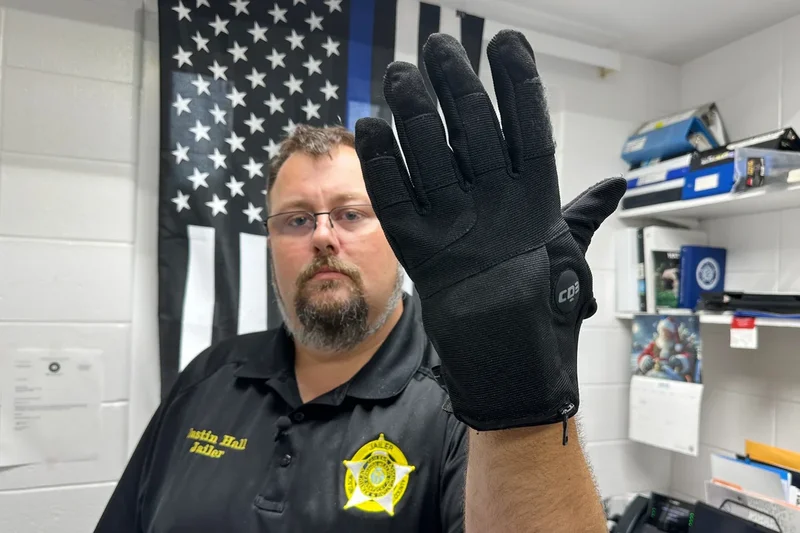
White House border czar Tom Homan defended Immigration and Customs Enforcement's plan to give officers gloves that deliver painful electric shocks, calling them a tool to help officers end confrontations without using deadly force.
“It’s another device to help someone get compliant when they are not,” Homan said Thursday in an interview on Fox News Channel's “Fox & Friends.” “You can't just go from 0 to 100, right, and the first thing you go for is lethal force.”
Homan's remarks were the Trump administration's first public defense of ICE's plan to spend up to $20 million to purchase thousands of “conductive distraction and de-escalation devices” for officers and agents. The devices are known as the G.L.O.V.E., which stands for Generated Low Output Voltage Emitter, and are manufactured by Compliant Technologies LLC. They have been used in recent years by some jails and police departments.
The plan has drawn intense criticism from civil rights groups, Democrats in Congress, and some use-of-force experts, who say ICE agents have been too quick to use force while carrying out President Donald Trump's crackdown on illegal immigration. At least six people have been shot and killed by immigration enforcement agents since last year, including motorists last month in Maine and Texas.
Homan argued the gloves could help avoid such encounters. He said they would give another less lethal option to ICE officers, similar to Tasers or pepper spray, for use in potentially violent situations on the streets and in detention facilities. He said that it would “be awhile” before the gloves are deployed in the field by ICE officers because the agency is still working out training protocols and other policy issues.
In Bardstown, Kentucky, Nelson County Jailer Justin Hall said Thursday that his agency began using the gloves four years ago to try to gain compliance when inmates are out of control. He said that, unlike Tasers, the shocks do not incapacitate people and make them fall or leave contact or burn marks.
Hall estimated that he had been shocked by the gloves more than 10 times during training, and the pain was intense but stops once the gloves are no longer touching skin. He said the shock gloves have been used sparingly, but are helpful as an initial deterrent when de-escalation techniques do not work.
“It’s just a safer way. It’s safer on the inmate. It’s safer on the staff. And most of the time, most of the time we get compliance,” he said. “It's been a great tool for our facility.”
Geoffrey Alpert, a criminology professor at the University of South Carolina who has written extensively about police use-of-force and tactics, said the devices should be studied more broadly to ensure departments have proper guidance on when and how they should be used. He said it might be a wiser investment for ICE to start with a smaller purchase, given how little is known about them.
“You are wholesaling these to a group of officers who may not be trained in other strategies like de-escalation or trained to interact with the public in non-enforcement ways, like most local police officers are,” he said. “User error is almost predictable at some level. The tech may be fine, but let’s take a minute and make sure that it is used in an appropriate custom and practice.”
Foley reported from Iowa City, Iowa. AP reporter Claudia Lauer contributed to this report from Philadelphia.