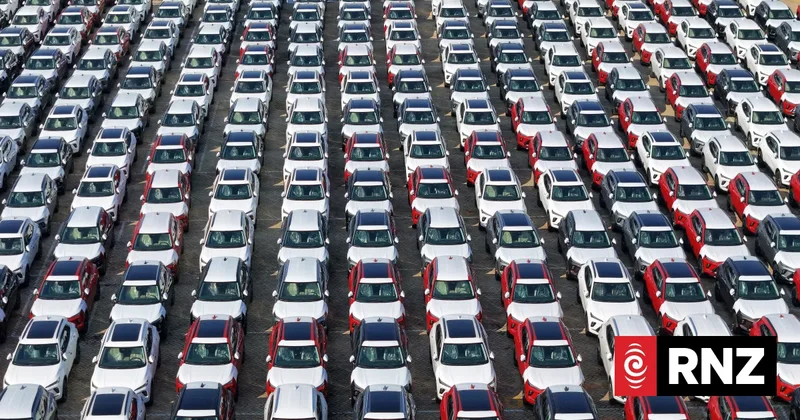
Chinese-made electric vehicles are reshaping the country's car market.
The value of reduced-emission vehicle imports, including fully electric vehicles, hybrids and plug-in hybrids, rose 33 percent to $2.9 billion in the 12 months to 30 June, accounting for 48 percent of the total value of all passenger vehicles imports, according to the latest Stats NZ figures.
Japan remained the main source of hybrid vehicles, accounting for 63 percent of imports, while China supplied 73 percent of New Zealand's fully electric vehicles.
The Motor Trade Association said 29 Chinese vehicle brands were now represented in New Zealand, including BYD, Chery, Dongfeng, Geely, GWM, Leapmotor and Zeekr.
This count excludes established global automakers that manufacture some electric vehicles in China, including BMW, Cupra, Honda, Kia, Mazda, Mini and Tesla.
It also excludes Volvo, Lotus and Polestar, which are partly Chinese-owned.
Industry experts and vehicle dealers say the influx has expanded consumer choice while challenging long-established Japanese and European brands with lower starting prices, broader model ranges and increasingly sophisticated technology.
Market shift
Larry Fallowfield, sector manager for dealers and specialist services at the Motor Trade Association, said the growing presence of Chinese-made vehicles had marked a significant shift in New Zealand's car market in recent years.
He said Chinese brands had expanded consumer choice, while lower prices had encouraged more buyers to consider electric vehicles.
"By lowering that price point, perhaps buyers who were not looking at battery-electric vehicles are now looking at battery-electric vehicles," he said.
"If we look at July this year compared with the previous 12 trading months, there has been ... [an] increase in the number of battery-electric vehicles sold," he said.
"I would suspect that most of those battery-electric vehicles are coming from Chinese manufacturers."
Fallowfield said the surge in fuel prices, driven by conflict in the Middle East earlier this year, had boosted EV sales.
However, the broader shift towards electrified vehicles had been building for years.
"Over the last five years, rental companies have been buying more electrified vehicles," he said.
"Many of those hybrids eventually end up our in-service market and are then sold to the general public," he said.
"People often start with a hybrid and then move to the next stage of electrification," he said.
"Whether that is a battery-electric vehicle or a plug-in hybrid, those appear to be the areas experiencing the strongest growth."
Fallowfield said New Zealanders' perceptions of Chinese vehicles were changing.
Competitive starting prices had helped Chinese electric vehicles enter the market quickly, he said, while improving quality had helped them maintain their position.
"Traditionally we bought British cars," he said.
"Then Chinese cars started coming in and they were a little bit of an entry level.
"But over time Chinese manufactured vehicles have come into the country with all the technology [found] in established brands - safety features, advanced driving, big touch screens. They are now at that level of quality."
Fallowfield said the next challenges for electric vehicles in the future would be how many of them can survive in the market.
GVI Group, an Auckland-based importer of used Japanese vehicles, has specialised in electric vehicles since 2014.
Hayden Johnston, the company's director and general manager, said New Zealand's vehicle market had changed significantly over the past 12 years.
More distributors and dealers were now offering new electric vehicles, he said, while prices had fallen enough to make electric vehicles accessible to a much broader group of households.
"We were selling first- and second-generation Nissin Leafs," he said. "That was the staple of what was available to us from Japan and the UK at that time.
"They were expensive, a used Nissan Leaf cost around $40,000 at that time, and we were selling to a very specific type of customers.
"But now we've got uptake from the public, EVs are a lot more common and accepted. Almost every manufacturer has at least one EV option now."
Johnston said customer interest in Chinese electric vehicles was also growing as more Chinese-made vehicles entered New Zealand with competitive pricing and increasingly strong product offerings.
He said he believed it was only a matter of time before Chinese brands became dominant players in New Zealand's EV market.
But as competition intensified, he said, not every brand would survive.
"I don't think there's a place for all of them in the New Zealand market, " he said.
"We could also see some of the legacy manufacturers that we are familiar with drop out of the market. New Zealand is not a huge market."
Crowded market
According to the Motor Trade Association's latest New Zealand Vehicle Fleet and Industry report, one of the most significant changes in recent years has been the rapid growth in new EV imports from China, including both Chinese brands and vehicles made in China for overseas manufacturers.
Japan was New Zealand's largest source of EV imports in 2020, but China overtook it in 2021.
China accounted for 10 percent of New Zealand's EV imports in 2020.
Its share rose to 58 percent in 2022 before easing to 42 percent in 2024.
The trend reflects China's growing role in the global electric vehicle industry.
The report said China now accounted for 70 percent of global EV production, with Chinese brands making up 80 percent of that output.
China also accounted for 40 percent of global EV exports in 2024, and Chinese brands made up 70 percent of those exports.
The rise in Chinese-made EV imports has brought a growing number of Chinese brands into New Zealand's increasingly crowded market, a trend the report said was likely to continue.
BYD, a Chinese EV manufacturer that entered the New Zealand market in 2022, sold 152 vehicles in a single day in March.
Warren Willmot, BYD's New Zealand general manager, said the surge was driven by fears that the government might impose restrictions on vehicle use and that fuel supplies could run short because of conflict in the Middle East.
He said orders had since fallen considerably but remained well above the levels recorded before the conflict.
Willmot said BYD had faced supply constraints in recent months because of the global fuel crisis and shipping disruptions.
A small number of customers had waited up to three months for their vehicles, he said, but more than 2700 vehicles were arriving in August, helping to ease the backlog.
Willmot said that although New Zealand's vehicle market had become increasingly crowded, more Chinese manufacturers were still preparing to enter.
He agreed that not every brand would ultimately survive, including some Chinese brands.
"Some Chinese brands think entering export markets will help them survive," he said.
"It's not going to be the case. The same can also be said of some established Western and Japanese brands," he said.
"Nissan, Mitsubishi and Volkswagen are all under pressure," he added.
"Even this month, we have seen KGM, a South Korean brand, and LDV, a Chinese brand, pull out in New Zealand market."
Willmot said BYD's founder and chairman, Wang Chuanfu, expected a period of global reconciliation in the automotive industry, with about 30 percent of the brands currently in the market likely to withdraw from the marker within the next two years.
Chinese automaker Dongfeng Motor entered the New Zealand market in late 2025 with three fully electric models, led by the compact Box hatchback, which was priced from under $30,000.
Simon Rutherford, chief executive of Auto Distribution Holdings, the company that introduced Dongfeng to New Zealand, said competitive pricing alone would not be enough to succeed.
Brands also needed to offer strong overall value and a compelling ownership experience, he said.
"We are well on our way to our first 1000-unit sales milestone and have already delivered more than 900 vehicles," he said.
Rutherford said there was still room for new brands in New Zealand, but their survival would depend on whether they could achieve sufficient sales volume, build market share and operate sustainably alongside established global competitors.
"There will be consolidation and changes across both retail and distribution channels deployed in the market," he said.
"Some long-established brands will shrink, while others will grow rapidly. But that is a win for consumers, because so many companies are now competing for their business."
The Motor Trade Association report noted that, in China, nearly all small electric cars were priced below the average small internal-combustion vehicle, including petrol and diesel models.
Prices fell significantly across most vehicle segments between 2023 and 2024, driven in part by lower battery costs.
The report said battery prices were expected to keep falling over the next few years because of an oversupply of lithium and continued expansion in battery manufacturing capacity.
That could further reduce EV purchase prices in New Zealand, particularly for vehicles imported from China, and accelerate the electrification of the country's vehicle fleet.
Fallowfield said price was a major factor in encouraging consumers to consider electric vehicles, but quality, servicing and after-sales support would also shape their decisions.
He said Chinese manufacturers were likely to remain major players in New Zealand, although whether they would come to dominate the market would depend on which brands survived.
"I think they are established enough now that they will continue to grow," he said.
"Probably not at the same rate as they have over the past couple of years. That growth will start to slow.
"It will really depend on how other manufacturers respond to what is happening, both in New Zealand and overseas."