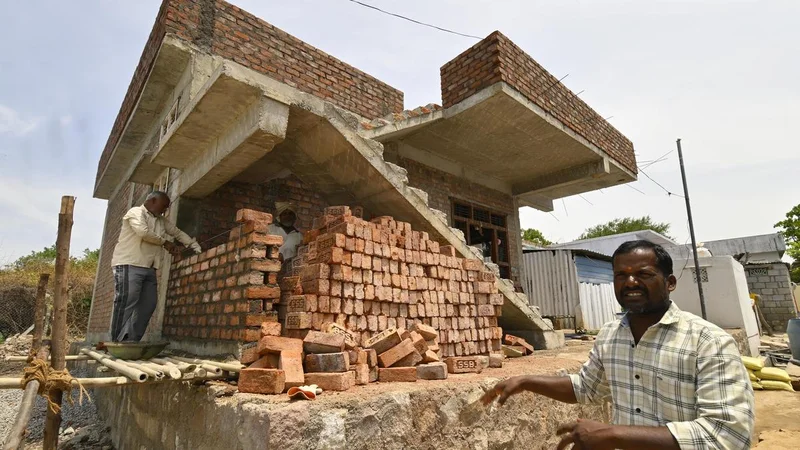
Despite the ₹5 lakh financial assistance provided by the Telangana government for the construction of houses under the Indiramma Indlu scheme, several beneficiaries have dipped into their savings or taken loans, as rising construction material and labour costs have pushed expenses beyond the sanctioned amount. Officials say shear wall technology could help keep construction costs within ₹5 lakh. However, the technology has not yet gained widespread acceptance.
G. Suraj (name changed), a youngster from Sangareddy district, was among the beneficiaries who saw his dream of owning a house take shape with the Indiramma Indlu scheme. But completing the house cost him an additional ₹5 lakh over and above the government subsidy.
While construction stretched over nine months as the prices of cement, steel, sand and other materials steadily increased, the delay was compounded by a shortage of labour, with masons and workers taking up other projects. He finally held his housewarming ceremony this year.
His experience is not an isolated one. Several beneficiaries across the State have had to dip into their hard-earned savings or take hand loans to complete their houses.
Rising costs
Meanwhile, beneficiaries cited two main reasons for spending beyond the ₹5 lakh subsidy: rising construction material costs, particularly those of bricks and sand, and increasing charges for masons and labourers. Some also pointed to delays in receiving subsidy instalments and masons taking up multiple projects.
This apart, the Telangana Housing Corporation Limited (TGHCL) officials point to another factor — the size of the house. The scheme envisages houses of 400 sq. ft., but beneficiaries sometimes extend slab projections beyond the permissible limits. Such additions, along with spending on tiles, tapware, woodwork and other costlier materials, can substantially increase the overall expenditure. The concern is particularly significant as the scheme expands. Unless costs are contained, more beneficiaries from economically weaker backgrounds could be forced to exhaust their savings, take on debt or face prolonged delays in completing their houses.
₹1 lakh hurdle
Chief Minister A. Revanth Reddy launched the Indiramma Indlu scheme in Bhadradri Kothagudem in March 2024, providing ₹5 lakh in 100% subsidy to poor, houseless families for constructing houses. The first phase envisaged 4.5 lakh houses, with 3,500 houses in each Assembly constituency. Only those who owned land but did not have a house were considered under Phase I.
The subsidy was to be released in four instalments. But beneficiaries had to spend ₹1 lakh on laying the foundation before becoming eligible for the first instalment. For many beneficiaries, arranging this initial amount itself has been a challenge.
Speaking about the progress of the scheme last month, Housing and Revenue Minister Ponguleti Srinivasa Reddy said that housewarming ceremonies were held for 1.35 lakh houses constructed under Phase I, while slabs had been laid for another 1.25 lakh houses.
The State government launched Phase II on June 1 this year, with plans to allot 2.5 lakh houses. Housing Minister said people living in huts would be given first priority.
Housing Department Secretary and TGHCL Managing Director V.P. Gautham said applications were received and the selection of beneficiaries was underway with officials conducting on field verification.
However, the ₹1 lakh requirement for laying the foundation remains a concern, particularly with Phase II targeting some of the State’s poorest families. According to sources, some applicants living in huts expressed their inability to arrange the money. “Some of them are already in debt. We are looking at options to help them generate the money. They definitely cannot afford to spend any amount over the ₹5 lakh subsidy,” sources said.
Slab extensions
The Housing Corporation has been aware of the problem of beneficiaries borrowing money to complete their houses. In a government order (G.O.) issued on June 27, Gautham noted that a majority of beneficiaries were extending slab projections from the permitted three feet to as much as eight feet beyond the building plan.
“This increase in slab area is resulting in substantial additional construction costs, compelling beneficiaries to borrow from private lenders or halt construction midway due to financial constraints. The above situation defeats the core objective of the government to provide subsidy housing to shelter-less poor families,” the G.O. stated. It said there was a need to restrict the maximum slab area to prevent cost escalation, avoid putting beneficiaries into a debt trap and facilitate completion of houses within the sanctioned financial assistance.
Housing Project Directors in various districts said planning and construction decisions play a crucial role in either containing or increasing costs. They suggested restricting slab extensions to three feet on the front side and one foot on the other three sides. Suggestions were also made on materials and designs that can prevent rainwater from entering through door and window openings without adding significantly to the construction cost.
Mr. Gautham said tokens for sand — a material whose cost can steadily increase — would be provided when a house is sanctioned, reducing beneficiaries’ dependence on private sellers. Talks have also been held with construction material manufacturers to reduce the number of intermediaries in the supply chain and provide materials directly to beneficiaries.
Shear wall solution
Another solution being explored by the Housing Corporation is shear wall technology, which officials say could help keep construction costs within the ₹5 lakh subsidy. Under this method, formworks or moulds made of plastic, aluminium or other materials are placed according to the required house design. Steel rods or mesh are embedded inside the moulds, which are then filled with cement. The roof can also be cast at the same time. Apart from reducing construction costs, the technology can significantly shorten the construction period. and this method is widely used in high-rise construction.
Saddi Mahender Reddy, Managing Director of A.S.A. Consultants, said aluminium formwork systems were commonly used for repetitive, mass-housing reinforced concrete construction, particularly residential towers with repetitive floor plans. However, the system requires a high initial investment. Formwork design, fabrication and procurement are project-specific and costly, making the technology economical when the cost is spread over a large number of repetitive pours — commonly 200-plus repetitions or 500-plus identical units or floors.
The technology can help complete a floor in three to five days, including walls, slab and staircase in a single pour, compared with seven to more than 10 days using conventional methods. But it requires careful planning since modifications to walls constructed using shear wall technology are difficult, electrical and plumbing sleeves have to be planned and embedded before casting. “Constructions using shear wall technology require early, finalised structural and architectural coordination — all wall positions must be locked before formwork fabrication, leaving little tolerance for late design iteration,” Mr. Mahender said.
Housing Project Director, Sangareddy, Ch. Chalapathi Rao said the technology was particularly viable in areas such as Patancheru, where land was scarce. It could also benefit beneficiaries who cannot afford to take time off to supervise construction for several months. Houses can be built in 15 to 30 days using shear wall technology, he said.
The technology has already been tested in some parts of the State. Houses were constructed in 12 days in Asifabad. In Aroor village of Sadashivpet mandal in Sangareddy district, nearly 10 Indiramma houses have been built using the shear wall technology.
One of the beneficiaries, Padma Anthaiah, had earlier lived in a house that suffered from seepage. He said he did not spend anything over the ₹5 lakh subsidy on constructing his new 400-sq.-ft. house, apart from the cost of a metal staircase outside the house.
The new houses in the village are interspersed with the new structures built using shear wall technology. Showing the exterior walls of one of the houses, Reshma Katakam, Assistant Engineer (Housing), Sadashivpet mandal, said that they do not need another layer of cement for a smooth finish, unlike conventional brick walls.
Aroor Panchayat Secretary Malkapuram Mallesham said the technology was particularly useful for people who could not afford additional expenditure on house construction. However, there is a hiccup. Private contractors who build the houses using shear wall technology are demanding ₹5 lakh upfront payment and not in instalments.
Upfront payment hurdle
In Aroor, Sarpanch Naikoti Lavanya Madhu said discussions were held with contractors to find a solution. Construction materials were provided in coordination with store owners, while beneficiaries and village leaders signed bond papers to facilitate the transfer of instalments after construction. But beneficiaries in some other parts of the State said they did not have ₹5 lakh to pay contractors upfront and, therefore, could not opt for the shear wall technology. Unless the upfront-payment issue and delays in the release of instalments are addressed, widespread adoption of shear wall technology could face roadblocks. Officials also believe that greater awareness of the technology among Gram Panchayat members is necessary.
Housing Corporation officials said there was no mandatory time gap between different stages of construction for releasing instalments. If a house is completed within a few weeks, the instalments can be released at one go.
The officials also said that one of the ways to address the issues with need for capital upfront is to help women Self Help Groups (SHG) own these formworks (molds) and give them on lease to local masons. “If the lease amount is collected later, the burden on beneficiaries will come down. The SHGs may have sufficient business since the second phase of the housing scheme too is rolled out,” said an official from the corporation.
SHGs could provide the answer
Officials are also exploring a model that could reduce the need for beneficiaries to arrange large sums upfront. One proposal is to help women’s Self-Help Groups (SHGs) own the formworks and lease them to local masons. The lease amount could be collected later, reducing the immediate financial burden on beneficiaries. “If the lease amount is collected later, the burden on beneficiaries will come down. The SHGs may have sufficient business since the second phase of the housing scheme too has been rolled out,” a Housing Corporation official said.
Published - August 14, 2026 06:48 am IST