Brazil · Business
Key Facts
—Subsidy Amount The federal government pays R$1.12 (\~US$0.22) per liter of road diesel sold by enrolled producers and importers.
—Program Duration The subvention runs from June 1 to December 31, 2026, under Provisional Measure 1,363.
—Price Cut Petrobras reduced its average diesel price to distributors by R$0.3515 (\~US$0.07) per liter to R$3.30 (\~US$0.65) on June 1.
—Cumulative Receipts By July 6, 2026, Petrobras reported cumulative subsidy receipts of approximately R$4.7 billion (\~US$922 million).
—Reimbursement Mechanism The government reimburses companies within 30 days after fortnightly reporting and verification by Brazil’s petroleum regulator, the ANP.
The Petrobras diesel subsidy program in Brazil has channeled R$4.7 billion (\~US$922 million) to the state-controlled oil giant through mid-2026, as the federal government deploys direct per-liter reimbursements to shield consumers from volatile global fuel prices.
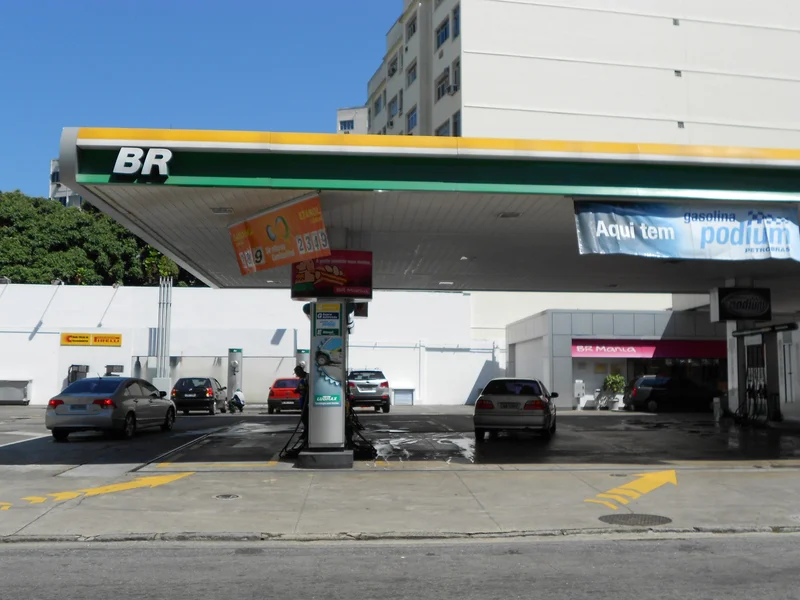
A Petrobras BR fuel station in Rio de Janeiro; the state oil giant is collecting federal diesel subsidy payments. Photo: Wikimedia Commons (public domain).
RTAsk Rio TimesMarkets, currencies and the economy›
RT
Ask Rio Times
Latin American markets, currencies and companies.
×
Markets todayThe currencyRates \& inflationEconomy outlook
Inside the Petrobras Diesel Subsidy
Petróleo Brasileiro S.A., universally known as Petrobras, is Brazil’s state-controlled oil and gas giant and the dominant force in the country’s fuel market. While publicly traded on stock exchanges in São Paulo and New York, the Brazilian government holds a controlling share of voting stock, making the company a critical instrument of national energy policy.
In 2026, Petrobras became the primary beneficiary of a federal diesel economic subvention, a direct subsidy program designed to stabilize road diesel prices. The mechanism is straightforward: the government reimburses fuel producers and importers a fixed amount for every liter of road diesel they sell, provided they pass the full discount on to buyers.
The current framework was established by Provisional Measure (MP) 1,363, issued on May 30, 2026. It set the subvention at R$1.12 (\~US$0.22) per liter and applies to sales made from June 1 through December 31, 2026. Petrobras’s board of directors formally approved the company’s participation on June 1-2, describing the move as complementary to an earlier adherence under MP 1,358 from May 13.
How the Reimbursement Mechanism Works
For international observers, the program functions as a conditional rebate rather than an upfront grant. Eligible companies must formally enroll with Brazil’s National Agency of Petroleum, Natural Gas and Biofuels (ANP), the sector regulator. They are then required to prove that the subsidy amount was fully discounted in the sale price of road diesel and explicitly show that discount on customer invoices.
The administrative process runs on a fortnightly cycle. Producers and importers submit declarations every two weeks detailing their eligible sales volumes. The ANP verifies these reports, and the federal government then disburses the reimbursement within 30 days after the declaration is filed. This timeline was codified in a June 9 decree regulating MP 1,363.
This pay-after-verification model creates a working capital consideration for fuel suppliers. They must first reduce their selling prices and only later recover the difference from the Treasury. For a company of Petrobras’s scale, the cash flow impact is material but manageable, with billions of reais cycling through the program over its seven-month lifespan.
Live Company IntelligencePetroleo Brasileiro Petrobras SA ADR — the full investor dossierInside: live share price, market cap, three-year financials, valuation, ESG and peer benchmarks — plus the latest Rio Times coverage.
P
◆ Live Company Intelligence
Petroleo Brasileiro Petrobras
NYSE: PBRPETR4EnergyOil \& Gas Integrated43,199 employees
$119.48B
Market cap
Analyst target $22.58
Wall Street view
4.4Buy/ 5
11 Buy3 Hold0 Sell
Avg. price target $22.58 · +41% vs 200-day
Valuation \& profitability
Market cap$119.48B
Revenue (TTM)$498.09B
P / E ratio5.8
Profit margin21.6%
Return on equity25.6%
Price \& risk
52-wk low
$10.9752-wk high
$22.07
Beta (volatility)-0.14
200-day average$15.99
Revenue trend · 6y
20202025
Latest $88.10B
Ownership
Institutions21.8%
Shares outstanding3.72B
Top holderGQG Partners LLC
Institutional holders5+ funds
Dividend
Yield16.4%
Payout ratio29.1%
Fwd. annual$1.76
What Petroleo Brasileiro Petrobras does. Petróleo Brasileiro S.A. – Petrobras explores, produces, and sells oil and gas in Brazil, China, the United States, the Americas, Asia, Europe, Singapore, and internationally. It operates through three segments: Exploration and Production; Refining, Transportation \& Marketing; and Gas \& Low Carbon Energies. The Exploration and Production segment explores, develops, and produces…
Price Cuts and Market Impact
In tandem with joining the new subsidy framework, Petrobras announced a significant price reduction at the refinery gate. Effective June 1, the company cut its average diesel price to distributors by R$0.3515 (\~US$0.07) per liter, a 9.6% reduction that brought the price to R$3.30 (\~US$0.65) per liter.
This price adjustment was explicitly designed to align with the subsidy architecture. By lowering its base selling price, Petrobras ensured that the combined effect of the commercial discount and the government reimbursement would keep market pricing stable without distorting its own revenue structure.
The broader context for these interventions was an energy-market shock tied to conflict in the Middle East. In a filing with the US Securities and Exchange Commission (SEC), Petrobras stated that the subvention’s purpose was to stabilize price and supply, ensuring national fuel availability during a period of external volatility. The company emphasized that its participation was optional and compatible with its commercial interests.
Fiscal Cost and Payment Timeline
The subsidy program carries an explicit and growing cost for Brazil’s federal budget. Because the Treasury reimburses every eligible liter sold, the fiscal exposure scales directly with national diesel consumption. The earlier aid scheme under previous provisional measures had provided a much smaller support level of R$0.35 (\~US$0.07) per liter, making the jump to R$1.12 (\~US$0.22) a more than threefold increase in per-unit fiscal burden.
Petrobras’s own disclosures provide the clearest window into the money flows. On July 6, 2026, the company reported it had received R$2.7 billion (\~US$529 million) in two installments covering the periods of April 20-30 and May 1-15. These payments brought cumulative receipts under the broader subsidy program to approximately R$4.7 billion (\~US$922 million).
The April and May payment dates indicate that the program’s financial machinery was already in motion before the June 1 formal launch of MP 1,363. This reflects the layered nature of Brazil’s policy response, with multiple provisional measures creating an overlapping sequence of support mechanisms that were later consolidated under the current framework.
Policy Evolution and Legal Architecture
The 2026 diesel subvention did not emerge from a vacuum. It represents the culmination of a rapid sequence of provisional measures. Earlier provisional measures, starting with MP 1,340 in March, set up initial qualification processes that were later superseded. MP 1,358, issued on May 13, provided an interim framework to which Petrobras adhered before the more comprehensive MP 1,363 arrived on May 30.
Petrobras’s June 2 SEC filing explicitly noted that the new measure superseded the qualification processes under the earlier MPs while complementing the MP 1,358 mechanism. This legal layering is typical of Brazilian executive policymaking, where the president can issue provisional measures with the force of law, subject to subsequent congressional approval.
For foreign investors and expatriates, understanding this architecture matters because it reveals how Brazil’s government can rapidly deploy large-scale fiscal interventions through its state-controlled enterprise. The program blurs the line between commercial operations and public policy, with Petrobras serving as both a market participant and a conduit for federal subsidies.
What This Means for Foreign Stakeholders
For expatriates living in Brazil, the diesel subsidy directly affects the cost of goods and transportation. Road freight is the backbone of Brazilian logistics, and diesel prices ripple through the entire economy. The government’s intervention aims to prevent sudden price spikes from reaching consumers, though it does so at the expense of a growing fiscal commitment.
For international investors in Petrobras, the program presents a dual-edged dynamic. On one hand, the subsidy ensures that the company is made whole for price reductions, protecting its revenue line. On the other, the mechanism ties a portion of Petrobras’s cash flows to government reimbursement cycles and the political sustainability of the subvention itself.
The program is scheduled to expire on December 31, 2026. Whether it is extended, modified, or allowed to lapse will depend on global oil market conditions, domestic inflation pressures, and the government’s fiscal capacity. With cumulative receipts already approaching R$5 billion (\~US$980 million) by early July, the full-year cost to the Treasury is likely to be substantial.
Connected Coverage
Related reporting from The Rio Times: Petrobras Cuts Diesel 9.59% as Brazil's Fuel Subsidy Takes Effect.
Frequently Asked Questions
What is the Petrobras diesel subsidy program?
It is a federal economic subvention in Brazil that reimburses Petrobras and other fuel producers R$1.12 (\~US$0.22) per liter of road diesel sold, provided they pass the full discount to buyers. The program runs from June 1 to December 31, 2026, under Provisional Measure 1,363.
How much has Petrobras received from the diesel subsidy so far?
As of July 6, 2026, Petrobras reported cumulative receipts of approximately R$4.7 billion (\~US$922 million) under the subsidy program, including R$2.7 billion (\~US$529 million) received in two recent installments covering late April and early May.
Why did Brazil introduce the diesel subsidy in 2026?
The subvention was designed to stabilize diesel prices and ensure national fuel supply following an energy-market shock linked to conflict in the Middle East. It aims to prevent volatile global prices from passing through immediately to distributors and consumers.