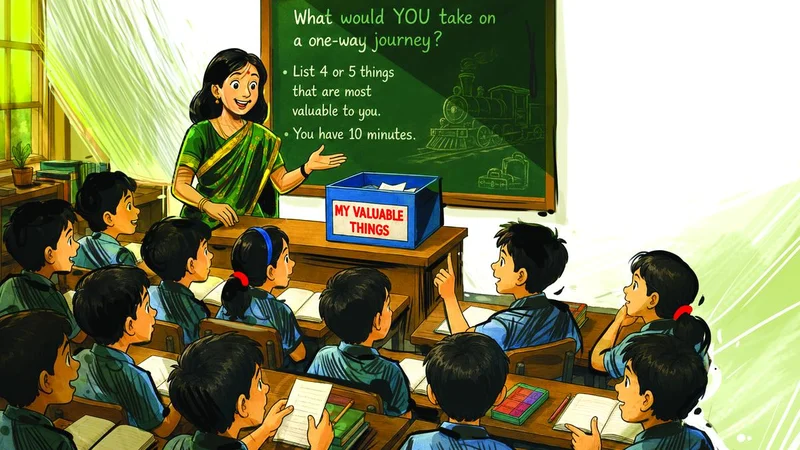
It was the week leading up to Independence Day. Every day, Winlab Global School had some programme related to it. When Bharati Sindhuja entered Class 6, the children cheered loudly. She was their favourite teacher for her ‘out-of-the-box’ special sessions, literally and figuratively.
Ms. Sindhuja returned their greeting and then said, “Silence in the class, please. Today’s activity involves a hypothetical situation. You have to set off on a long one-way journey to a new land soon, probably never to return. You can take only four or five things that are of utmost importance with you. What would they be? I want you all to think about it, make a list on a slip of paper and put it in this box. You have 10 minutes.”
Choices made
Soon the full box was on the table. Ms. Sindhuja picked four slips at random and read them out loud. Zeba had chosen her cat, her favourite comforter without which she couldn’t sleep, a fat book with many stories, some snacks, and Scrabble. Roy’s list had his Nintendo Switch to play video games, his skateboard, his spectacles that helped him see clearly, and his new branded shoes to use before he outgrew them. Ira wanted to take her badminton racket since she was in the school team, her library card, a wallet with as much money as it could carry, and a mobile phone. Shreyash said he wished he could take his five friends instead of things, with him.
When all the slips had been read, Ms. Sindhuja told them a true story; of people from a different time who had been given a similar choice.
In the past
“In 1947, the British had finally decided to leave India. But the country was being divided into two: India and Pakistan,” she explained. “In the first week of August 1947, my grandmother, eight years old then, lived in a large mansion in Shikarpur in the northwestern part of India. They were told that the house they lived in and the land they owned would no longer be part of India but would be included in the newly formed nation of Pakistan. There was no guarantee that they could ever return to this place. So, they had to take what they could while moving to India. They could not carry heavy loads across the upcoming new border.”
Ms. Sindhuja continued, “Under these circumstances, a library membership card of a foreign land would be of no use. Neither would being part of a school team if you were not going to be in the school any more. A video game and mobile phone were not even heard of back then. Scrabble, though invented in 1931, reached India only much later. When family members got separated and lost in the overcrowded trains and ships, chances were that friends would too.”
As the class listened quietly, she clarified, “I’m telling you this to give you a perspective of that time in history, and to make you value the freedom you enjoy. We owe our independence to many who suffered and sacrificed as they fought colonial rule – our freedom fighters, martyrs and the citizens who were forcibly displaced. Another important lesson lies hidden in today’s session: what is of real value in our life? So many people paid a huge price when forced to make such a difficult choice: to stay back in their homes that would no longer be in the country they knew or move to an unfamiliar land that was far away and very different from their native place. Mind you, they were not refugees because they were only moving to another part of their own country, but were treated as such. ”
“What did your grandmother choose to bring with her?” asked Miranda.
“Like any eight year old, she wanted to take her dolls, toys, pretty dresses, and books. But she had also heard discussions among the adults around her. Everyone knew it would be a long time before they could even afford necessities, let alone comforts and luxuries. But her grandfather suggested that they take along things that money could never buy. The things he wanted to take were a small bundle of salt that he had made along with Gandhiji during the Dandi March, his late father’s turban, a quilt his mother had made, and a pile of letters and postcards received from friends and family over the years. Guess what my grandmother decided to bring with her? Her family album, precious framed pictures of their house and family members, a stone mortar and pestle that she used to help her late grandmother pound and break open walnut shells, and the small brass lamps that they lit as part of their daily prayers. Her family was very proud of her.”
In a museum
“Do you still have these things, Ma’am?” asked Yaasha.
“Some of these things can be seen in The Lost Homeland section of the Partition Museum in Delhi,” said Ms. Sindhuja.
The class smiled but it set them thinking about what was really valuable in life. They began a serious discussion on the topic.
Ms Sindhuja announced, “The school has decided to plan a visit to this museum next term. You will get to connect with history and the stories of families uprooted from their homes, their courageous journeys, and their resilience in rebuilding shattered lives. It will also teach us gratitude and the importance of peace, harmony, and mutual respect”.
The mood in the class changed from sombre to one of anticipation and thrilling excitement!
Published - August 14, 2026 09:00 am IST