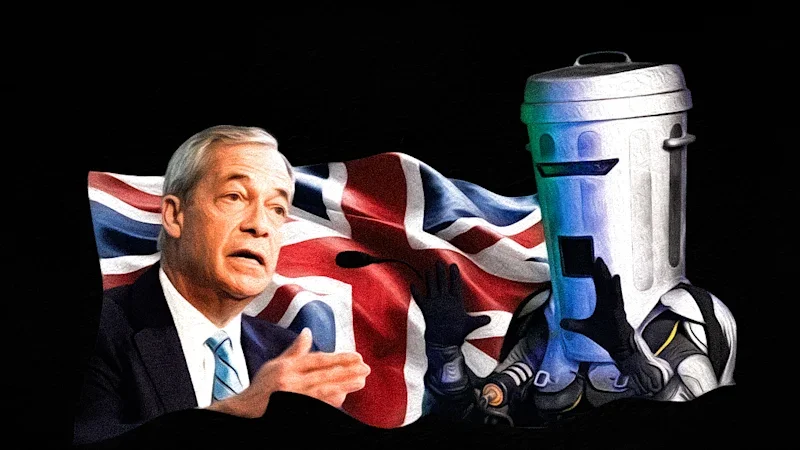
London: Nigel Farage will no doubt see his return to the UK parliament as a victory for common sense after the voters of Clacton endorsed him at a byelection he forced upon them.
In fact, the outcome is a victory for English farce. And that is not only because the Reform UK leader ended up in a battle for votes with a man who wears a garbage bin on his head.
There were few surprises when the results were declared at about 6am on Friday local time (3pm AEST) after a very long count because the ballot paper had 34 candidates.
Farage won with 22,239 votes. His main rival, Count Binface, secured 9455 votes.
Turnout was lower than at the general election just over two years ago. Back then, 58.7 per cent cast ballots. This time, 44.4 per cent did so. Voting is not compulsory in the UK, and many voters were clearly unimpressed with the need for this election.
Farage won a slightly higher number of votes than the 21,225 he received last time. So, given the lower turnout, he gained a higher percentage of the vote. Last time, it was 46 per cent. This time, it is 62.7 per cent, although it will take time to see all the results because of the sheer number of candidates.
That is a win, of course. But Farage boycotted the vote count and avoided the traditional moment when candidates appear on stage together – when he might have ended up standing alongside Binface. He claimed police warned of a campaign to disrupt the result, but he also complained about the photo opportunity.
“I’m damned if I’m going to stand on a stage having won a resounding victory, a ringing endorsement of all that I’ve tried to fight for and you’ve tried to fight for, and be demeaned and humiliated by nobodies,” he told supporters before the final tally was announced.
That just highlighted the farcical nature of the outcome.
In a sense, both candidates got what they wanted. Farage gained the formal endorsement of Clacton, an electorate on the English coast north-east of London that he has held for just over two years. Binface, the creation of comedy scriptwriter Jonathan Harvey, gained global attention for his brand of humour.
Even so, nobody really shone. The campaign had its moments of comedy, thanks to Binface and his space warrior outfit, but it was hardly memorable.
The Binface routine was a visual gag without any witty lines, even though podcasters and media commentators gave the comic candidate plenty of opportunity. In the end, the joke was fairly humdrum in a nation that has given the world so much biting political satire – not least Monty Python’s the People’s Front of Judea.
So, while there was farce, it was mostly scripted by Farage himself.
The Reform UK leader called a referendum on his future early last month by staging a dramatic press conference at which he announced his resignation from parliament. Then he said he would stand for his own seat again.
It was a massive display of pique. Farage was simply fed up with media scrutiny of his financial arrangements and seemed to think a byelection could work like a circuit-breaker – or perhaps a distraction such as those that have often helped US President Donald Trump change the conversation.
It hasn’t worked. Farage merely highlighted his weakness. Everyone can see he is highly sensitive about his ties to wealthy donors like investor Christopher Harborne, who gave him £5 million ($9.7 million), and crypto millionaire George Cottrell, an aristocrat known as “Posh George” and a long-time supporter of Reform.
This guarantees more scrutiny. The parliamentary inquiries into his donations are expected to resume.
Voters knew the byelection was unnecessary, and they knew Farage was putting his own constituency through a waste of time and money.
The major political parties contributed to the farce by choosing not to field candidates, and thereby depriving Farage of the serious contest he wanted.
Tactically, this made sense. At a deeper level, however, it showed that the Conservative Party did not have the courage to take on Farage in a seat he won from them in 2024. The Conservatives, under leader Kemi Badenoch, are still recovering from that rout at the general election after 14 years in power.
The bigger contest lies ahead. If the inquiries into Farage and his finances go against him, he may be forced to fight for his seat at another byelection. The Conservatives would have a chance to knock him off in a deadly serious campaign over donations and favours. The mere prospect of removing Farage from parliament, and beheading Reform UK, has his enemies salivating.
The mainstream view, conveyed in most of the media, is that Farage has peaked. This is reflected in a change in coverage from one summer to the next. One year ago, the more conservative parts of the media would report his every utterance as major news. This year, the same outlets are openly sceptical about his fortunes.
Voters have drifted away from Reform since Farage said he would quit parliament.
In early July, 25 per cent said they would vote for Reform. At the start of this week, it was 22 per cent, according to YouGov. Taken in isolation, these numbers are cited as proof Reform is on the decline.
The bigger factor, however, is the bounce for Labour since Andy Burnham became prime minister. The party has risen from 20 per cent to 24 per cent, according to YouGov.
But this is a polling honeymoon, and everyone knows they end. Burnham has barely begun to wrestle with the intractable problems of the UK government. He marks his fourth week in the job this Monday.
There is no point extrapolating a result in Clacton in 2026 to the rest of the country when the general election is not due until 2029.
A lot depends on whether voters really care about the financial support Farage receives from mysterious crypto investors.
Many will engage instead with his argument that Britain is broken, simply because it resonates with their daily experience, regardless of the chatter in Westminster.
Asylum seekers continue to cross the English Channel in small boats. Migration is still too high for many voters. Everyday costs are rising. The nation is still debating whether to cut taxes and welfare spending, or do the opposite.
There is, in other words, a long way to go before Britain reaches a decisive contest between Burnham, Badenoch and Farage.
A minor farce in Clacton is only a small step along the way.