Sign in. It’s quick, free and it’s up to you.
An account is an optional way to support the work we do. Find out more.
“I HAVEN’T RULED out the possibility. And I’m very humbled to see the tremendous amount of support out there.”
“I think that anything is possible at this juncture.” “I’m focused on the midterms…I’m running for Congress right now.”
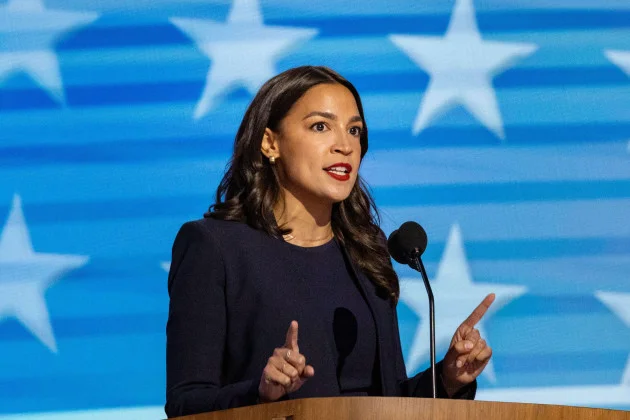
These were the three responses offered by United States Representative Alexandria Ocasio-Cortez – better known as AOC – to questions with respect to her future during an interview last weekend on ABC’s This Week programme. Perhaps the key words are “right now” in the latter answer on what she is doing in 2026.
In the first and second quote, the New Yorker signals that, in two years, she could be making a bid for the Oval Office or seeking the seat in the US Senate currently held by Democratic minority leader Chuck Schumer. And why wouldn’t AOC be bullish about what lies ahead of her?
She is sitting on a massive pile of cash, raised largely from individuals, without accepting donations from corporate political action committees or special interests. The congresswoman has a huge profile; she is one of the most instantly recognisable American politicians across the 50 states and around the world. She is a young, vibrant woman from the rapidly growing Latino community. She has a compelling backstory to tell. And AOC is one of the leaders of the thriving progressive wing of her party.
Betting markets and premature polling – both of which should be evaluated with an entire shaker, not a grain, of salt in hand – have her at or near the top of the field of prospective Democratic successors to President Donald Trump. Notwithstanding the reality that there is a long, long way to go until the first Tuesday in November of 2028, it would be foolish to dismiss altogether the odds that she could be their standard-bearer. If the crucial elements of luck and timing wind up favouring her, my view is that she could actually beat the likes of California Governor Gavin Newsom, the ex-cabinet member and mayor, Pete Buttigieg, US Senator Jon Ossoff of Georgia, et al.
But if that were to transpire, a general election in which she would have to broaden her appeal significantly would be quite a different kettle of fish.
Her association with the “far left” – in American parlance – her being a native of the Big Apple, her ethnicity, her gender and myriad other fair and unfair considerations would work against her, especially given how the Electoral College system operates.
I suspect two factors will be to the fore in her calculus. First is personal. Not yet 40, is AOC in the toughest business there is for the long haul, or does she already envisage a life after politics?
If the former, the safest route is to try and take out Schumer. She’d either prompt him to announce his retirement or win comfortably. Making her presence felt subsequently in the upper house would be another arrow in her quiver.
Conversely, this may be the perfect time for her to go for broke. For all of the foregoing reasons and more – not least of which are President Trump’s unpopularity and an increasingly prevalent feeling that the US has morphed into a “gerontocracy” on both sides of the aisle – AOC might determine that she is the woman for a fraught moment. Even if she were to fall short of the promised land, she could still be influential and, to be brutally frank, she wouldn’t be poverty-stricken.
The second is the upshot of the impending midterm contests. Much has been made of the insurgency of the Democratic Socialist of America (DSA) movement and those whose stances on the issues are closely aligned. Francesca Hong, who was barely defeated in the Wisconsin gubernatorial primary, and Abdul El-Sayed, who prevailed by a whisker in the Michigan US Senate primary, are the best known of the bunch.
These were both a lot tighter than pollsters had forecast; Hong and El-Sayed were supposedly “sure things.” This indicates that the level of intra party support for the DSA and the DSA-affiliated may be overestimated.
Nonetheless, that Hong, despite a litany of past disparaging utterances regarding Thanksgiving, “whiteness,” etc, almost managed a triumph in a purple state portends reasonably positively for AOC’s chances.
Tellingly, and shrewdly, Ocasio-Cortez declined to endorse the controversial Hong, who was out of her depth. She has gone “all in” on El-Sayed, however. And she will be watching earnestly to see if the public health doctor and Muslim can garner more votes than his Republican opponent, who cannot easily be characterised as an extreme conservative.
If El-Sayed accomplishes this uphill climb in Michigan, where Trump won in 2016 and 2024, it also augurs well for Alexandria Ocasio-Cortez’s putative ambitions. To be blunt, he is more unpalatable on the surface to certain segments of the electorate, some of whom will need to be persuaded to discard their biases, than she is. His victory would suggest that she can compete strongly in Middle America, which has a major say in selecting the temporary residents of 1600 Pennsylvania Avenue.
It is obviously silly to extrapolate excessively from any one race. Yet if El-Sayed and similarly-minded nominees lose elections that were there for the taking when the conditions for big gains on Capitol Hill and throughout the US were absolutely ideal, it should give AOC pause. It would mean that she would be wise to launch a Senate campaign.
Zooming out, her party’s seasoned operatives understand that, internally, the wind is blowing, though not gusting, in aid of an anti-establishment left.
But grandees are filled with trepidation at how the ascendancy of a new generation of progressives and all that flows from it will play with the wider electorate. That’s partly why the aforementioned presidential aspirants and others are holding fire as they assess whether they have a path to the White House and plot the central contents of their messaging.
AOC is not the only Democrat with plenty to learn from the voters’ decisions in the midterms.
Larry Donnelly is a Boston lawyer, a Law Lecturer at the University of Galway and a political columnist with TheJournal.ie.
To embed this post, copy the code below on your site