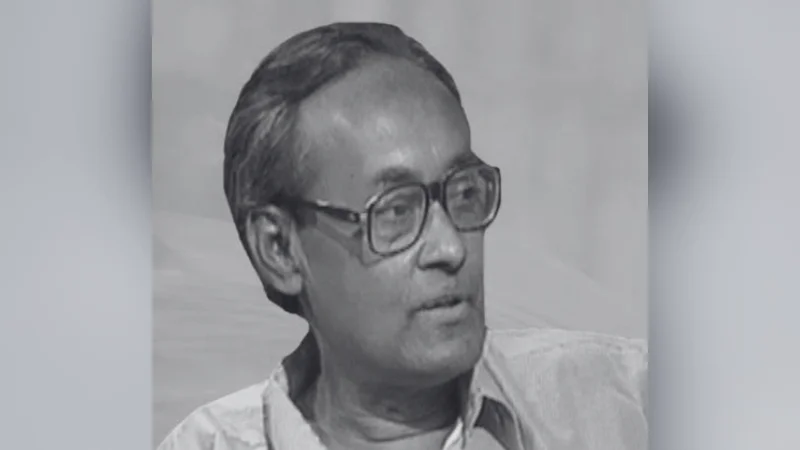
In the History Department’s first-floor lecture room in North Campus, sometime in 1998, Sumit Sarkar walked in to introduce a course titled ‘Social History of Modern India’. I still have vivid memories of that class, which was an overview of what to expect over the coming weeks.
Of the many things he spoke about that day, I remember a few ideas and names that I was hearing for the first time.
Having come to the M.A. programme as a Physics graduate, I had never heard of Bernard S. Cohn, E.P. Thompson or C.A. Bayly. The second was the defining reading of the course: Prof. Sarkar’s own then newly published book, Writing Social History. Within the first week of his classes, I bought a copy. By the end of the year, everything that I saw around me, and experiences that one routinely encountered, seemed to acquire new meanings. Why is the sweeper the sweeper? Why do we think the way we think? How do we come to learn the languages we learn, and in the manner that we do? It was an exhilarating journey of learning.
He is described as a Marxist historian. But that, I think, was too comfortable a chair for Sumit. He was a historian who embraced intellectual discomfort, with the resulting habit of questioning and revising positions he had once endorsed.
I still have that same copy of Writing Social History on my table as a ready reference. Whether I am writing on census, caste, communalism, regionalism, nationalism, globalisation, education or identity, there is invariably something that sends me back to that book. I got it signed in later years and, later still, added a copy of his last book, Modern Times, signed by both Sumit Sarkar and Tanika Sarkar, to my shelf of frequently consulted books.
There is no other scholar, no other historian, who can match the breadth, sweep and intensity of Sarkar. He achieved all this while keeping his own presence barely noticeable in either his books or his lectures. Real scholarship requires humility. In an era of the digital marketing of scholarship, scholars are often expected to compete with rock stars. Sumit Sarkar belonged to a different era, a different ethos.
His last book, Modern Times, was conceived as a two-volume project, but only the first volume could be published. Covering India from the 1880s to the 1950s, it is in itself a monumental achievement. The second volume would undoubtedly have become the supreme epic on the modern republic. I firmly believe that, taken together, the two volumes would have surpassed even the majesty of Eric Hobsbawm’s volumes on modern Europe. An unfortunate accident intervened, and Sarkar could not complete the project. “There will not be a second volume.” I remember hearing Tanika say this, with disappointment, sometime around 2014. I still hope that Tanika Sarkar may one day add her own volume on the modern republic. Even so, Sumit Sarkar’s first volume remains a masterclass on modern India.
Term papers were not mandatory for the M.A. at Delhi University in those days. But Sumit encouraged writing. He would painstakingly write notes in the margins, ask further questions, suggest alternative framings here and there, and then return those handwritten pages. I had preserved them like treasures for several years, but somewhere along the way I misplaced them.
Among his most enduring interpretations was his understanding of the evolution of Hindu identity as a continuum across centuries, expressed through three remarkable phases: Hindu, Hinduism and Hindutva. He explored the limits of drawing a rigid distinction between mainstream Indian nationalism and Hindu nationalism. He also examined the formation of caste identities, particularly their links with colonial administration, educational policies and nationalist mobilisation strategies.
“Ethnocentric arrogance is fairly cross-cultural, but what has been qualitatively new in the modern era is the power developed by dominant groups in one section of the world to impose their values and assumptions on others, and even get them internalised on a global scale,” he wrote in Modern Times. The weight of those words has only grown exponentially in an age of hyper-technologies.
A few months after completing my M.A., I visited him and Tanika at their home on the St Stephen’s College campus. Tanika, too, had taught an optional course that I had taken, on women in the Indian national movement. It was evening, and Sumit offered me a drink. I was thrilled at the prospect of sharing one with the Professor.
“I will add some water,” I said as he handed me the glass.
“Water is already added,” he replied.
Even with the water, it could not have exceeded 60 ml. I was too unsure of myself to ask for a second.
Cheers, Prof., as you pass over to become part of history. Those curious about India will continue to find you, for generations to come.
Published - August 14, 2026 12:35 pm IST