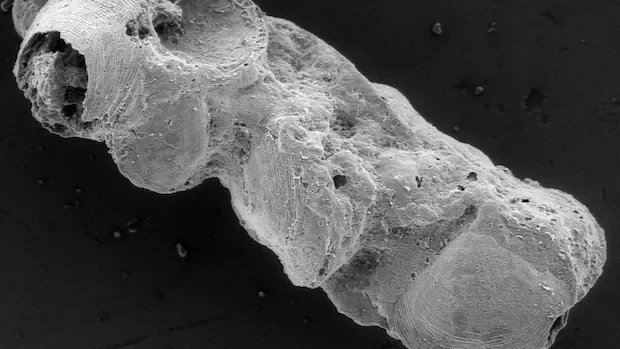
Why fossilized feces from ancestors of modern animals help us understand Earth’s early ecosystems
Role of feces in deep oceans 540 million years ago might tell us more about modern nutrient cycles
Long before dinosaurs roamed the Earth, an eruption of biodiversity saw the emergence of the predecessors to modern animals — and an increase in poo.
While not the most popular brand of paleontology, a study published last week is shining a light on how the study of coprolites — or poo fossils — helps us understand Earth’s early ecosystems, along with nutrient cycles and animal relationships today.
The paper, published in the journal Trends in Evolution & Ecology, drew on analysis of fecal fossils from the Cambrian period, beginning about 540 million years ago.
Looking at feces records from early worms, invertebrates and mollusk-like organisms, researchers found fecal matter likely contributed to making deep water ecosystems more habitable and nutrients more available during that time — about 300 million years before dinosaurs.
For researchers, the study’s finding that feces appeared in abundance during the Cambrian period is significant for understanding where today’s ocean ecosystems originated.
“Barely anyone that looks at a marine ecosystem thinks there's so much poo floating around that keeps the modern marine ecosystem alive … and that is actually a huge thing,” said Julien Kimmig, a co-author of the paper and head of the paleontology division at the Karlsruhe Natural History Museum in Karlsruhe, Germany.
“You should always have an eye open on what actually drives modern and past ecosystems and potentially evolution.”
For some paleontologists, the research points to how coprolites — fecal matter preserved and mineralized in rock — advance knowledge of not only which animals lived in the distant past but also how their ecosystems worked.
**Clues for modern ecosystems **
Kimmig and co-author Russell Bicknell analyzed records of several hundred coprolites from 37 deposits around the globe, including some fossils they collected themselves over the years and others within museum collections.
The feces came from a variety of burrowing worms, arthropods, brachiopods and hyoliths (similar to cone-shaped mussels). The earliest fossils were microscopic, but by 15 million years into the Cambrian period, they were close to the size of a rabbit dropping, Kimmig said. Later, they became visible to the naked eye and contained pieces of shell or worm.
Beyond clues about evolution and which animals ate each other, Kimmig said studying coprolites helps understand Earth’s ecology and why the Cambrian Radiation — a rapid appearance of modern animal groups in the fossil record also known as the Cambrian Explosion — brought so much change to ecosystems.
He said ecology might be where paleontology is most relevant to modern society — how past ecosystems adjusted to changes in temperature, oxygen or nutrient levels and biological adaptations might be relevant to what’s to come.
“It is important to not only understand what animals lived through time, but also in which environments they lived and … what led to these different ecological habitats through time,” he said.
“We can take the modern and look at the past … but we can also take the past and actually look at the modern and the future and try at least to model or predict what the future might look like.”
The case for Cambrian coprolites
For paleontologists who study the Cambrian period, the study of feces adds another dimension to understanding one of the Earth’s most fascinating events.
Before the Cambrian, the Ediacaran period saw the emergence of fossils large enough to see, said Karma Nanglu, an assistant professor in University of California Riverside’s department of Earth and planetary sciences.
The animals within them, however, were “so strange and so different than what we see in modern oceans … that we have a hard time assigning them to any modern group of animal life.”
- Squirrel poop dating back to last ice age is full of mammoth, horse DNA
- New fossil species discovered on Cape Breton Island may be one of the earliest plant-eating animals
The Cambrian Radiation — about 520 to 540 million years ago — produced fossil records of relatives to modern animals. With indications of relatives of shrimp, marine mollusks and more, Nanglu said, the Cambrian saw “the establishment of diversity as we know it.”
“If you're interested basically in where the oceans of today came from, the origins have to be traced back to the Cambrian,” he said. “I would argue that there are not many more time periods more important to understand than the Cambrian.”
The study showed the Cambrian Radiation also saw a significant expansion in feces compared with the Ediacaran.
Interest in the Cambrian Radiation, Nanglu said, often focuses on predator-prey relationships or “evolutionary arms races.” Looking at waste, nutrient and energy cycles and knock-down effects on biological diversity, however, means looking beyond animals to ecosystems and even beyond that to geological periods.That can help understand modern and future ecosystems.
“If we were to look at forward projections in terms of what might change in the ocean, we have basically a single record of life in the universe,” he said. “By looking back, we can look at environments that are analogous to ones that we're not living in now, but we may experience in the future.”
'Far less studied than they should be'
For some paleontologists, poo has become central to their research.
When she learned about fossilized feces as a graduate student, Karen Chin thought it “was the craziest thing.”
Now, Chin is the curator in the Museum of Natural History and professor in the Earth science department at the University of Colorado. She has also co-written three kids books about coprolites, including Dino Dung: The Scoop on Fossil Feces, with Thom Holmes.
She said coprolites are rare, variable and don’t always provide clear clues of what organism produced them.
“I think because they are so challenging to study and frankly, they don't have the charismatic cachet of dinosaur bones or fossil wood … they are far less studied than they should be,” she said.
Chin’s research focuses on the Mesozoic period, about 252 to 66 million years ago, when dinosaurs roamed the Earth. She said fossils of animal and plant bodies can uncover their biology but coprolites add another dimension: interaction. They can indicate “who ate who” and provide clues about carbon cycles in which organisms fed on, decomposed or utilised feces.
- Ancient mammals had mostly dark brown coats during the dinosaur era, new study reveals
- Oldest fossil footprints from reptile found in Australia
She said it is exciting to learn unexpected things from fecal fossils — for example, she has seen evidence some herbivores fed on rotting wood and others ate crustaceans.
“There's a lot we don't know about the ancient world,” she said.
Kimmig’s first interaction with coprolites came while working in the MacKenzie Mountains in the Yukon and Northwest Territories while doing his PhD with the University of Saskatchewan. He began studying them after his second run-in with them — finding a stash in a drawer at the University of Kansas. He said he looks forward to seeing more data on them soon.
“[We] encourage people to show a little bit more interest in these fossils that are often overlooked.”