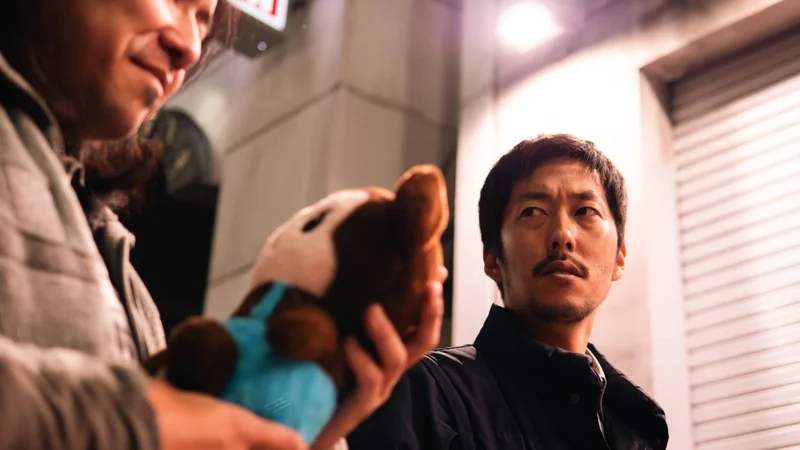
Winner of the Audience Award at the 2025 Cinema Jam film festival and other prizes, Kai Yamaguchi’s “Cattle Muti-Leiko” — with “muti” being short for “mutilation” — is a charmer of a film despite its gruesome title. And to reassure the queasy, no cattle are harmed in the story.
Yamaguchi is also scriptwriter and star of this debut feature, playing the role of Suzutani, a jack-of-all-trades private investigator who finds himself enthralled by the titular Leiko (Fuu Maeda).
He first hears about Leiko from an enraptured client who proclaims that “she’s in my blood.” Soon after, while searching for a stray cat — pet detective being one of his professional hats — Suzutani sees Leiko smiling at him from under a car and knows he has found the girl of his dreams. Literally so, since Leiko appears in his recurring dream, provocatively turning her head toward him, but never showing her face.
Once the PI and other lonely guys become attracted to Leiko, they start seeing her everywhere, like an ad campaign girl whose likeness is on everything from subway posters to digital billboards. Meanwhile, the faces of other women become blurs — or transform into Leiko’s smiling visage.
With its sci-fi and fantasy stylings, unfettered imagination and scrappy energy, “Cattle Muti-Leiko” resembles another recent microbudget movie, Makoto Ueda’s “You Are the Film.” And both owe something to that influential indie crowd-pleaser of nearly a decade ago, Shinichiro Ueda’s “One Cut of the Dead.”
But I was also reminded of this summer’s most talked about blockbuster: Christopher Nolan’s “The Odyssey.” Think of Leiko as a modern-day version of the sirens, the part-bird, part-human creatures who try to lure Odysseus and his men to their doom.
Unlike the besotted Leiko fans around him, Suzutani also has a crush on the real flesh-and-blood Luna (Mari Yonemura), a cute if clumsy server at his favorite coffee shop. The shy Suzutani is slow to reciprocate her obvious interest in him, but his just-friends relationship with her keeps him marginally sane when his Leiko mania takes hold.
It would be a spoiler to reveal Leiko’s true identity and mission. But through the course of Suzutani’s frantic attempts to track her down, we come to understand that Leiko’s mysterious presence and hypnotic appeal are, like the melodious voices of the sirens, lures to destruction.
In Yamaguchi’s low-key comic performance, Suzutani is no Odysseus, but neither is he a caricature. He gets laughs instead from his typical male weakness for surface female traits. Ridiculous and, for many, relatable.
All this may make the film sound like a light comedy with a sci-fi veneer, but it also weaves in a darkly satiric critique of present-day Japanese society. Leiko and the forces behind her use media manipulation to wipe mental hard drives and install their own software to nefarious ends that the film suggests — but wisely doesn’t make explicit.
Perhaps a more accurate point of reference for Leiko is not the mythological figures from an ancient poem but the internet memes that fascinate millions and soon vanish, to be immediately replaced by others.
In Yamaguchi’s entertaining, disturbing dream world, Leiko’s addictive allure masks something more sinister. Call it a nightmare from which we never awaken, or even realize we’re having in the first place, since we’re no longer aware unless love — the real thing, not its digital simulacrum — saves us from ourselves. Mutilated maybe, but still human.
| Rating | |
|---|---|
| Run Time | 77 mins. |
| Language | Japanese |
| Opens | Aug. 15 |