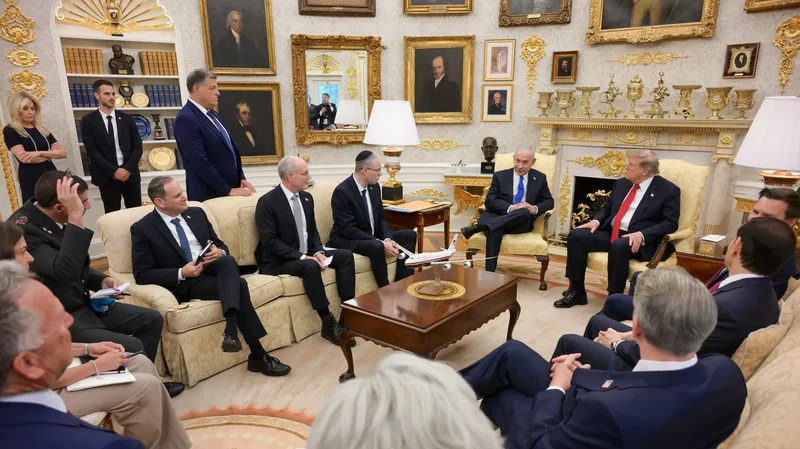
When Benjamin Netanyahu and Donald Trump met in the Oval Office two weeks ago, the president asked the Israeli prime minister how he was doing in the polls ahead of an Oct. 27 election.Netanyahu paused. Then one of his advisers piped up: "Mr. President, he is winning," the aide said, according to a U.S. official familiar with the exchange.Why it matters: Netanyahu is not winning. And so far, Trump hasn't given him the endorsement he hopes for, despite being asked about it repeatedly by reporters.The president could still change his mind. But with just 75 days left until the election, time is running short for Netanyahu.State of play: Netanyahu's current coalition has 49 to 53 seats in those surveys — far fewer than the 68 seats it holds today and the 61 needed to swear in a government. Israel's opposition parties, on the other hand, have 67 to 70 seats. Netanyahu's main rival, former Israel Defense Forces (IDF) Chief of Staff Gadi Eizenkot, has better favorability ratings in most of the polls. But Netanyahu doesn't necessarily have to win. He just needs to not lose.His main effort at the moment is to secure enough votes to prevent his opponents from swearing in a government without the support of Arab-Israeli parties. If he manages to do that and neither side is able to form a government, Netanyahu will remain as a caretaker prime minister for several more months until another election is held.At the moment, that is a real possibility. Driving the news: In the first few weeks of the war in Iran, some of Trump's close advisers were confident he would endorse Netanyahu.At the time, Trump was advocating loudly for Netanyahu to receive a pardon to end his corruption trial. But as time passed and the war bogged down, Trump's and Netanyahu's foreign policy goals — and their domestic political interests — started to diverge.More and more daylight has opened between them over the last three months — not just on Iran, but on Lebanon and Gaza as well.Two senior U.S. officials said that while Trump likes Netanyahu on a personal level, he's been frustrated by his decisions and policies."Bibi is his own worst enemy," Trump said, according to two people who spoke to the president about Netanyahu recently.Zoom in: The latest episode to strain their relations was Netanyahu's public rejection of Trump's Gaza Board of Peace plan for disarming Hamas.A senior U.S. official said the White House saw Netanyahu's statement on Sunday as election-season politics and not necessarily as a policy declaration."We understand Bibi's political needs. We have no problem with it as long as he continues to do what we ask — especially regarding restraining attacks in Gaza," the U.S. official said.Last week, Netanyahu spoke on the phone with Trump envoy Jared Kushner and promised to give the Board of Peace plan a chance, despite his skepticism. He also pledged to curb attacks on Gaza so the demilitarization process can begin, a U.S. official said.Since then, Israel has conducted far fewer strikes on Gaza and the IDF pulled back to the Yellow Line — where it was supposed to be deployed under the agreement.Kushner is planning a trip to Israel next week to meet Netanyahu and other officials and discuss the Gaza plan, according to four sources with knowledge of the matter.Behind the scenes: Several Netanyahu political adversaries — including Eizenkot and former prime ministers Naftali Bennett and Yair Lapid — have expressed concern that Trump will endorse the incumbent leader, two of their aides told Axios.According to two sources with knowledge of the outreach, those opposition figures back-channeled messages to Trump and his aides through mutual friends, donors and other political allies, urging the president to remain neutral. A former U.S. official briefed on the situation claimed that Netanyahu's weakness in polls has deterred Trump from getting involved.Yes, but: Trump has been extremely popular in Israel, but his standing has eroded in the last three months over the deal he signed with Iran and his decision to back away from the war after the agreement was violated. Israelis have also chafed at the restraints Trump has put on Israel's military operations in Iran, Gaza, Syria and Lebanon.What he's saying: Trump was asked by reporters four times in recent weeks whether he endorses Netanyahu. Each time, he has stopped short of doing so."Is there anyone in Israel better than him to do the job?" radio host Hugh Hewitt asked Trump in July. The president dodged. "Well, I don't know most of them. I know some of them, obviously, but I don't know most of them," he said, referring to Netanyahu's opponents.In several recent interviews, Trump praised Netanyahu for being a "great wartime prime minister," but each time referred to him in the past tense.While Israeli officials said Trump raised the issue of the pardon in private during his last meeting with Netanyahu, the president hasn't spoken about it publicly for months. What to watch: The Israeli election is crucial for Trump's Middle East agenda for his final two years in office, especially with the Iran crisis in a "no deal, no war" limbo.Trump also wants to push forward his Gaza peace plan, make progress in negotiations between Israel and Lebanon, cinch a security agreement between Israel and Syria and, most importantly, broker a historic peace deal between Israel and Saudi Arabia.Trump and his team are traumatized by the 2019 political crisis in Israel that led to three consecutive elections and resulted in a lost year of Middle East diplomacy.A senior U.S. official said the White House will not repeat past mistakes and allow Israeli domestic politics to hold up its regional agenda.
Trump stops short of endorsing Bibi as his campaign falters