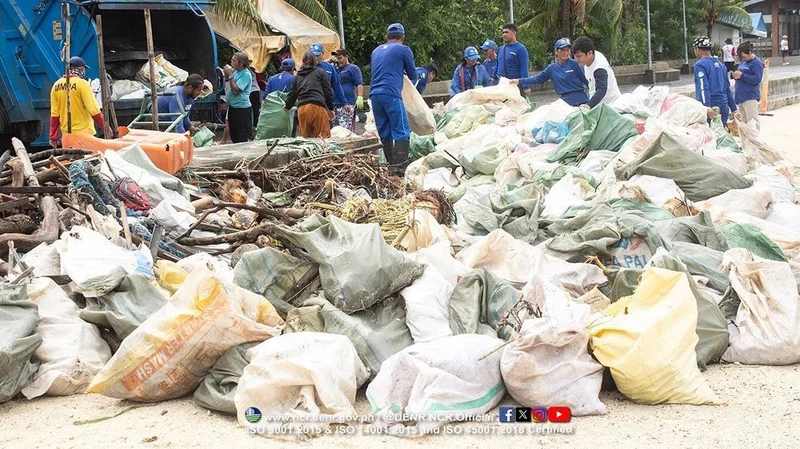
Over 2,000 sacks of trash collected from Manila Bay dolomite beach
MANILA, Philippines — More than 2,000 sacks of garbage were collected from the Manila Baywalk dolomite beach following a series of cleanup operations, the Department of Natural Resources (DENR) said on Friday, August 14.
In a statement, the DENR-National Capital Region said that the garbage collected from the artificial beach is estimated to weigh around 60,000 kilos.
Among the wastes collected were clothes, slippers, plastic bottles and other plastic materials, styrofoam, wooden debris and other materials.
“Isinagawa ang series of cleanup activity bilang bahagi ng patuloy na pagkilos upang agad na matugunan ang mga basurang naipon sa shoreline at mapanatili ang kalinisan at kaayusan ng baybayin na bahagi ng Manila Bay,” the agency said.
(The series of cleanup activities were conducted as part of the continuous action to immediately address the garbage accumulated along the shoreline and preserve the cleanliness and orderliness of the coast of Manila Bay.)
The artificial white-sand beach was part of the Manila Bay Rehabilitation Program launched by former DENR Secretary Roy Cimatu in 2019.
It was created through beach nourishment by spreading 3,500 tons of crushed dolomite rocks mined and quarried from Alcoy, Cebu.
Stinking issue
More than a week of heavy rains in Metro Manila revealed its stinking problem.
It started to become apparent after a sea of trash covered the Redemptorist Water Channel in Parañaque City, which filled almost 100 dump trucks during the clearing operations.
DENR Supervising Undersecretary for the Forest Management Bureau and the Manila Bay Coordinating Office Jonas Leones told GMA News’ "Balitanghali" on August 13 that an individual in the Philippines generates around 0.7 kilograms of trash every day.
Overall garbage generation in the country falls between 61,000 tons and 65,000 tons.
However, only 52% of the total trash generated in the Philippines was properly collected.
The rest, which is about 48%, either goes to waterways and other bodies of water or is scattered elsewhere.
Cleaning it up
The government and concerned organizations are offering ways to clean up the country’s trash problems.
For instance, local government units in Metro Manila are pushing for tighter regulations on waste management and stricter penalties of up to P5,000 for irresponsible garbage disposal, adding that discipline among citizens is key to resolving the problem.
However, President Ferdinand Marcos offered a different take and said that putting up facilities where people can put their garbage is more necessary than imposing fines.
“Nobody wants to be fined. Wala namang gusto ng mamumultahan pero kailangan bigyan din natin ng facilities na kung saan pwede itapon ‘yung basura,” Marcos said during his inspection at Diokno Pumping Station on August 12.
The national government is also eyeing the establishment of waste-to-energy facilities that convert solid waste into electricity, heat or fuel to solve the garbage problem.
Environmental advocates BAN Toxics, Oceana Philippines and Ecowaste Coalition, meanwhile, rejected the waste-to-energy facilities proposal, denounced the government for passing the blame to people, and called for stronger implementation of Republic Act 9003, or the Ecological Solid Waste Management Act.
- Latest