Japanese companies have stepped up their efforts to prevent their employees from suffering heatstroke as temperatures exceeded 40 degrees Celsius in some parts of Japan this summer.
General contractor Obayashi had its employees work at construction sites from 7 a.m. to 1 p.m. in July and August, earlier than their usual work hours of 8 a.m. to 5 p.m.
The company, in introducing the summer shift, looked to “further reduce the risk of heatstroke,” an official said. If a construction schedule is affected by the shift, work hours are extended when temperatures are low.
Since May, West Japan Railway has provided workers in charge of on-site maintenance and inspections with an app developed by the company to allow such workers to obtain information on heatstroke prevention.
At the company, examples of measures and products used to deal with heat are being shared. In September, short-sleeved polo shirt uniforms will be introduced on a trial basis to about 15,000 station staff and crew members. The uniforms will offer improved breathability and sweat absorption.
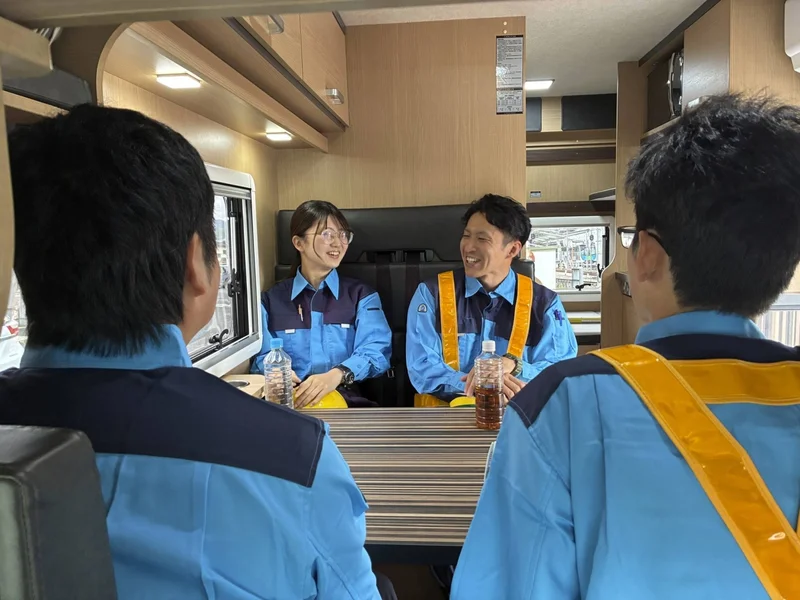
Seibu Railway is providing staff working in mountainous regions with recreational vehicles equipped with air conditioners, refrigerators and other amenities to serve as rest areas and to improve work efficiency. Previously, a round trip to a rest area took about 40 minutes in total.
Heatstroke measures are also being undertaken at busy commercial facilities.
At a beer garden on the rooftop of Matsuya department store in the upscale Ginza district in Tokyo, employees put stickers on their arms to get a visual representation of changes in their body temperature under a demonstration program with cosmetics and health food company Fancl, which supplies the stickers.
“The kitchen is especially hot,” Mizuki Shimomura, a 23-year-old employee, said. “As the color (of my sticker) changes, I’ve become more conscious about drinking water.”
Last year, the ordinance on industrial safety and health was revised to oblige business operators to implement measures against heatstroke.
According to a survey conducted by research company Teikoku Databank in July, 50.0% of companies said their operations had been disrupted by intense heat.