- READ MORE: Britain's best walks with a pub at the end – from castle ruins and spectacular views to hidden village inns
- See more Daily Mail on Google - save us as a Preferred Source
Tourists visiting the Lake District have been warned about a blue-green algae growing that can be poisonous to humans and dogs.
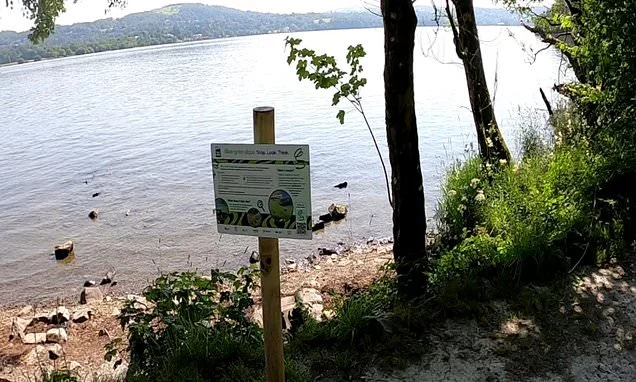
Around 40 permanent information boards are set to be placed around popular Lake Windermere informing people of the dangers of the cyanobacteria algae blooms.
A further 40 signs are also to be installed across other locations in Cumbria too.
The blue-green algae thrives in still bodies of water such as lakes, reservoirs and slow-flowing rivers - and grows faster in hot, dry weather.
Nutrients found in pollutants like sewage can also encourage the growth, according to the BBC.
Humans can become ill from coming into contact with the toxins the algae produces and ingesting it can be fatal to animals and wildlife, including dogs.
The Lake District hotspot is currently at its busiest, drawing in hordes of visitors every day over the summer months who come for the beautiful views of the water and surrounding hills.
Signs are being installed by Lake Windermere and other locations across Cumbria warning tourists about potentially dangerous blooms of algae
Each sign will provide information on what the algae looks like, to help people identify the potentially dangerous blooms.
The signs have been funded by the Environment Agency and are the result of a collaboration between organisations within the Love Windermere partnership.
The permanent signs will provide year-round guidance on the blue-green algae including what it looks like, where people can find current bloom information and how to report sightings of it.
The signs link users to the Bloomin’ Algae app and other sources of up-to-date information.
People and animals can become exposured to the blooms through swallowing the water, inhaling airborne droplets or coming into contact with water containing the algae.
Symptoms include nausea, diarrhoea, vomiting, irritation of the eyes or throat as well as breathing difficulties, the BBC previously reported.
They aim to spread awareness of the toxic blue-green algae that blooms on still bodies of water
The algae is known for its distinctive blue-green hue bur can be fatal to animals who drink it, and can cause skin and eye irritation in humans (Pictured: The algae at Frampton on Severn in Gloucestershire)
Visitors who plan to spend time on or around the water have been advised to check current conditions before travelling and familiarise themselves with the signs of blue-green algae.
Liz Cheslett-Davey, catchment coordinator at the Environment Agency, said: 'Blue-green algae can appear quickly and the conditions that encourage it to form aren't always easy to predict.
'These are both actions that affect water quality and natural factors.
'Clear on-site signage, alongside the Bloomin' Algae app and other online resources, helps people make informed decisions about using the water safely.'
Nearly 250 cases of the toxic blue-green algae have been reported in Northern Ireland's waterways, with others hitting Scottish lochs and lakes as far afield as Lancashire to Hampshire.
The latest case on a lake in Essex has left heartbreaking scenes of dead ducks, geese, moorhens and fish floating on a surface of 'scum' left by the algae, with many residents hitting out at council bosses for not taking enough action.