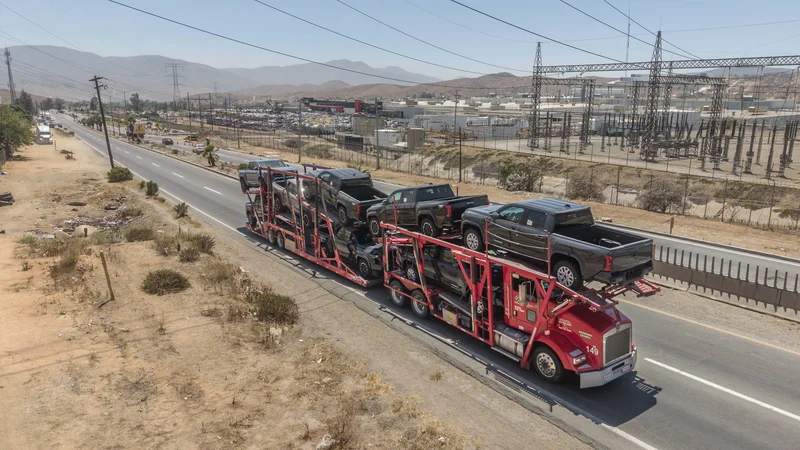
The government of Mexico has stepped up negotiations with the United States to contain the U.S. tightening of trade, especially in key sectors such as automotive and steel. Economy Secretary Marcelo Ebrard said on Thursday that the negotiating team reviewing the United States–Mexico–Canada Agreement (USMCA) has asked for a discount on the 25% tariff imposed by the Trump Administration on cars manufactured in Mexico and exported outside the alliance, and for greater flexibility in the duties applied to its steel sales.
Negotiations over the USMCA have entered a new phase of greater scrutiny in which every industrial sector on the table will be crucial to the economic performance of its members: Mexico, Canada and the United States. In July, Washington ruled out the possibility of swiftly renewing the agreement — which supports about $1.5 trillion in annual trade — for a further 16 years. Instead, the world’s largest economy has pushed its partners into a process of detailed, periodic bilateral meetings in which every trade issue is examined not only as a business matter but also through the Republicans’ political lens. In that context, Ebrard also disclosed that Mexico has requested a halt to the imposition of new tariffs while the treaty review is under way.
“I brought a study that says: you are charging 15% on a vehicle made in Japan, South Korea, Germany or Morocco, and you want to charge us 25% on the ones we make in Mexico. So give me a discount, because we buy more U.S. parts than the other countries I just mentioned,” the official told reporters.
The report on the negotiations was first published by The Wall Street Journal, which said that Claudia Sheinbaum’s government presented this counterproposal to the Trump Administration, which in turn is pushing to raise even further the rules vehicles must meet to qualify for the agreement’s preferential treatment for vehicles made in North America. According to the WSJ, the U.S. Trade Representative’s office has proposed amending the rules of origin to specify that only cars with 50% U.S. components would be covered by the USMCA.
The change would be significant both operationally and to the spirit of the agreement, shifting the advantage more strongly toward the United States, at least in the automotive sector, one of the pillars of trade among the three countries. Under the current USMCA rules, 75% of a vehicle’s content must originate in North America for it to qualify for preferential tariff rates. Outside that threshold, and under Section 232 provisions, the United States applies an additional 25% tariff on autos.
Ebrard confirmed that his delegation has been persistent in its demands, though he avoided revealing details about Washington’s requests or the progress of talks. The two sides will meet again in September. The executive branch had previously said its review strategy would focus on improving its stance in the automotive and steel sectors, without outlining a specific plan.
Currently, much of Mexico’s steel exports are also subject to U.S. Section 232 tariffs, a measure Washington justifies on national security grounds. Those tariffs were 25% and were later raised to 50% as of June 2025 for most products made from that raw material. “We have also raised the steel issue. Mexico runs a steel deficit with the United States. So: why do you put a 50% tariff on me?” Ebrard asked. Mexico argues that the steel tariffs lack commercial justification because the United States runs a surplus in bilateral trade. According to figures from the Mexican steel industry, that surplus exceeds $4 billion in finished products.
Trump has made the USMCA a recurring target of his attacks. He often threatens to tear up the free-trade framework he promoted during his first term in favor of a protectionist scheme to revive U.S. manufacturing. That strategy has fueled uncertainty in Mexico, whose value proposition as a manufacturing hub rests on preferential access to the world’s largest consumer market. In that context, the Mexican government is seeking to prevent the treaty review from becoming a pretext for new retaliatory measures against its factories. “We have proposed that, while talks on the free-trade agreement review continue, no further tariffs be imposed,” the secretary added. “We are the most persistent, persevering, patient and insistent delegation,” he stressed.
Despite the ups and downs, the Latin American country continues to benefit from a relatively stronger position than other exporters. Eighty percent of Mexico’s exports go to its northern neighbor and, of those, eight in 10 enter under USMCA preferential treatment. The agreement will remain in force at least until 2036, although it is subject to annual reviews. However, termination remains possible if any of the three partners notifies its withdrawal.
Canada and Mexico are confident that the economic benefits of integration will outweigh Trump’s pressures, who is approaching the halfway mark of his term. In that context, companies are watching the outcome of the negotiations closely because much of the conditions for producing and exporting from the Latin American country will depend on them.
“Prospects for foreign direct investment (FDI) in coming years will depend largely on the outcome of the USMCA review, tariffs and the international economic environment,” wrote wealth manager Skandia. “If the country maintains macroeconomic stability, strengthens the rule of law, improves energy and logistics infrastructure and keeps clear rules for investment, FDI will continue to grow,” the firm predicted.