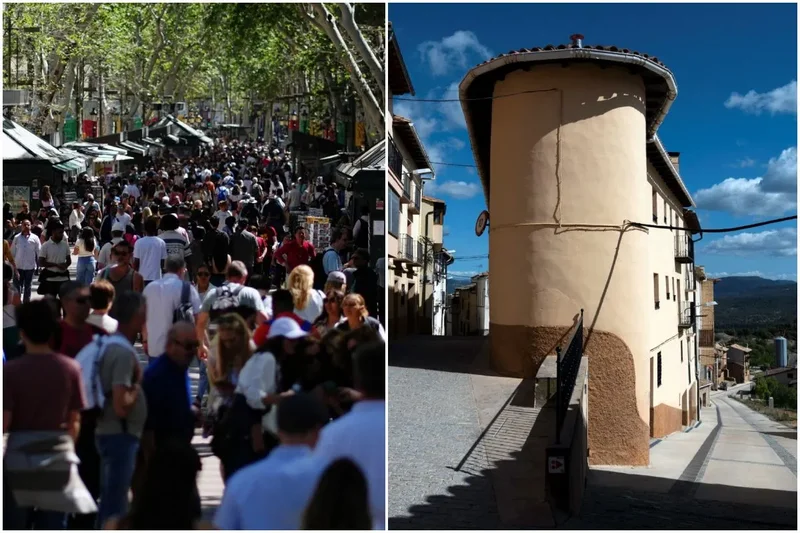
Spain often gets referred to as a land of contrasts due to its regional differences, varying landscapes, rich gastronomy and different languages.
But perhaps the most marked disparity is between its jam-packed, noisy cities and the emptiness of most of its interior.
Spain has an average population density of about 97 people per square kilometre, which hides the stark contrast between ciudades (cities) and pueblos (villages). For example, Barcelona has a population density of 16,000 people/km2, while the province of Soria has just 9 people/km2.
In fact, only around 12.7 percent of land in Spain is inhabited. This is only comparable to inhospitable areas of the Scandinavian Peninsula or the Alps.
It's no wonder a large swathe of northeastern Spain is known as 'Spanish Lapland' (La Laponia Española).
But what's dubbed 'Empty Spain' (La España Vaciada) is made up of far more than just that, including provinces such as Palencia, Zamora, Salamanca, Cáceres, Ávila, Segovia, Soria, Guadalajara, Cuenca and Teruel, covering a huge extension of the country's interior.
Spain is on the verge of reaching 50 million inhabitants, having seen a progressive rise in inhabitants despite dwindling birth rates, all thanks to an increase in immigration.
Despite the benefits these largely working-age migrants bring for the country's economy, welfare system and pension, they're heading to the same place as where most Spaniards live or move to - the overcrowded cities.
This was laid bare in a February 2026 article by leading Spanish daily El País called "La España apretada" (Cramped Spain), which highlighted how in the most populated and popular cities in the country, immigration together with mass tourism are putting pressure on housing, transport, transport and other public services that were designed to deal with far fewer people.
Meanwhile, in so-called 'Empty Spain', depopulation continues to worsen, and despite the abundance of cheaper albeit largely derelict housing, hardly anyone wants to move there.
READ ALSO: Seven in ten homes empty in Spain's villages in midst of national housing crisis
How did Spain get to this point? Why is its population density so uneven?
Weather
In a country like Spain, it’s easy to blame the climate and assume that people stick to areas with more temperate ones, without the extremes of unbearably hot summers and freezing cold winters.
This is partly true, although there are exceptions such as Andalusia and Madrid of course, which sits right bang in the centre of the Iberian Peninsula and is the third most populous region in Spain.
Nevertheless, climate has shaped 'Empty Spain' by making the interior high plateaus hard to farm. Scorching summers, freezing winters, and scarce rain have for decades pushed rural workers toward coastal cities and industrial hubs.
The Meseta Central, Spain’s huge central plateau acts like a high-altitude semi-desert. It gets extreme heat and biting cold.
There's also low rainfall and limited water, which make traditional rain-fed farming risky and low-yield.
Sudden frosts and intense dry spells regularly ruin olive and almond harvests, triggering local job losses.
Therefore, high temperatures, low rainfall, difficult terrain, poor soil, extreme winters have all paid a role in pushing people towards the coast and big cities.
History
According to the study ‘The Spatial Distribution of Population in Spain: an anomaly in European perspective’, Spain's unequal distribution of people dates all the way back to the so-called Reconquista or Reconquest of Spain, when Christian kingdoms were trying to recapture territory from Muslim rule.
READ ALSO: When did Spain become Spain?
During these times of conflict, a scarcity of materials and manpower made it impossible to guarantee the security of new settlements. It wasn't so safe to live in rural areas either, so the population was more concentrated in certain areas which were easier to defend and had ensured resources.
The Reconquista lasted for around 800 years, from around 718 at the Battle of Covadonga in Asturias to the creation of a unified Spain when the Catholic Monarchs Isabella I and Ferdinand II took back the last Moorish stronghold in Granada in 1492.
This cemented life in densely populated cities over hundreds of years. It continued long after the unification of the country, however, and by the 18th century the current marked population distribution could already be seen.
During the 20th century, the gap widened further, particularly from 1950 to 1991.
Historian believe the España Vaciada phenomenon was primarily created by a massive mid-20th-century rural exodus inspired by Dictator Francisco Franco, whose technocratic stabilization and industrialisation plans concentrated state investment, factories, and infrastructure in major urban centres like Madrid, Barcelona, and Valencia, leaving the agrarian interior impoverished, isolated, and largely abandoned.
If people wanted better jobs and greater earning potential, they had to move to the cities or coastal areas.
Lack of services and opportunities
Spain's population schism was further exacerbated during the 2008 financial crisis, which hit the country hard.
A study by the Bank of Spain titled ‘Recent Population Trends in Rural and Urban Areas of Spain’ specifically points out that an uneven spatial distribution of the population leads to an unequal distribution of income.
Cities concentrate the majority of jobs of overall (65 percent), in particular the more stable contract positions, whereas in the countryside there's a far higher rate of self-employment.
READ ALSO: How 'Empty Spain' is now a political party
This led to the ongoing migration of young people to the cities in search of better prospects.
That's not to say that there aren't jobs in the pueblos - many are desperate to fill vacancies - it's what comes with moving to rural Spain that keeps Spaniards living in the cities.
Fewer people has therefore resulted in a vicious circle of fewer services and jobs in 'Empty Spain'. Depopulated areas have increasingly lost access to basic services such as education, healthcare, leisure and transport, making them less attractive to families and working professionals.
For example, many banks have pulled out of rural regions making it even more difficult for people who can’t access it online or have access to cash.** **
Will Spain's population divide keep getting bigger?
Data from the National Institute of Statistics (INE) and demographic studies show that the gap between Spain's major urban centres/coastal areas and 'Empty spain' is just going to keep getting wider.
Although the Covid-19 pandemic saw more people moving to rural areas from which to work remotely more, and authorities in many regions are actively trying to encourage young families to move there through financial incentives, it's still not enough.
In truth, this hugely uneven population density is bad for both sides. People in the crowded coastal and urban areas fight for all available services, jobs and housing, while in the empty interior there are too few people for new or existing population centres to ever stand a chance of blossoming.
With additional reporting by Esme Fox