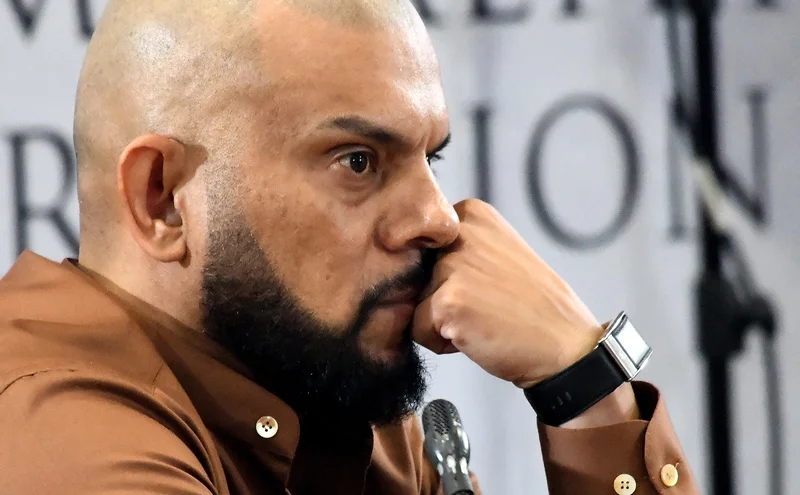
The Madlanga Commission will lay a criminal charge against its most recalcitrant witness, ANC member and multi-millionaire Suliman Carrim. He refused to submit himself to an independent medical assessment and again failed to appear before the Commission on Friday, 14 August.
Commission chairperson Justice Mbuyiseli Madlanga brought months of wrangling and multiple no-shows to an end: âThe commission is going to set the criminal process in motion. The commission will direct the commission secretary to lay criminal charges against Mr Carrim.â
Madlanga said allowing Carrimâs continued non-appearance to go unanswered would undermine the commission itself.
âIf the commission were not to do that, witnesses will decide willy-nilly not to appear before it. The commission will lay criminal charges against Mr Carrim.â
And with that, Madlanga declared: âThatâs the end of the road insofar as us having Mr Carrim before us.â
Carrim refuses independent medical assessment
The confrontation centres on Carrimâs continued reliance on medical reasons for not appearing before the commission, which ruled in July that Carrim should undergo an independent medical assessment.
Evidence leader Adila Hassim said the commission obtained the name of an independent specialist the following day. But Carrimâs lawyers did not agree to the assessment.
âOn August 3, we wrote and asked for a response by August 10 on whether Mr Carrim consented to an independent evaluation. No response was received,â said Hassim.
Instead, the commission received a further report from Carrimâs treating doctor on 12 August. But by then, there was another complication in Carrimâs medical case: Woolworths and Kauai.
While Carrim was said to be medically unable to appear before the commission, evidence had emerged that he was able to leave the facility where he was being treated and visit Woolworths and Kauai.
Madlanga was unimpressed by the attempt to characterise these differently: âFrom where I am sitting, they appear to have been outings even if you say they are not outings.â
Carrimâs advocate, Kameel Premhid, replied that even if they appeared to be outings, they were not. Hassim looked perplexed by this exchange.
More damaging for the commission was what happened to the treating doctorâs explanation once the Woolworths and Kauai visits became known.
Madlanga said the doctor had initially indicated that a patient could leave the facility only with his permission.
âA patient can only go out of the facility if I allow them to go (the doctor said). But once we got the Woolworths and Kauai visits, the doctor changes tack and says even nurses allow patients out.â
That apparent distancing of the doctor from the Woolworths and Kauai excursions â and from the suggestion that he had necessarily authorised them as part of Carrimâs treatment â fuelled the commissionâs insistence that it needed a second, independent medical opinion.
The latest report did little to settle the matter.
Hassim pointedly noted: âThe report is essentially an opinion by the same treating doctor, and it provides â notably, it says nothing about the daily outings by Mr Carrim. There is reference to Woolworths and Kauai and annoyance of why that was made public.â
For the commission, the question was becoming not simply whether Carrim was ill, but whether it could rely on the medical evidence explaining why a man apparently well enough for Woolworths and Kauai remained too unwell to appear before it. The commission has also struggled for months to get simple audited financial statements of Carrimâs companies from him, even though it had previously heard that he had continued operating his business by proxy.
Madlanga said an independent assessment was necessary precisely because the commission could no longer regard Carrimâs treating specialist as independent.
âTo counter the question of whether Mr Carrim is indeed unable to come to this commission, he needs to be independently assessed.â
He said the shifting explanations over the outings had undermined the commissionâs confidence in the doctor.
âThis is a doctor who has so aligned himself with Mr Carrim, Iâm not saying he is lying (but) we do want an independent assessment.â
Carrimâs lawyer puts up a fight
Premhid challenged whether the commission had the legal power to require Carrim to undergo an independent examination.
Madlanga said nobody was proposing physically compelling Carrim to see a doctor.
âThere is no compulsion. On the vires (power to do so) issue, there is no compulsion. If he chooses not to go, nobody will force him. Nothing stops me from dealing with it.â
He then gave the clearest indication that Carrimâs refusal had pushed the commission towards criminal action.
âThe commission is minded to refer Mr Carrim for criminal process. What the relevant authorities do is for them to decide. Whether to the SAPS to lay charges, or the NPA â that is their decision. That is what the commission is minded to do.â
Premhid rejected any suggestion that Carrim was avoiding accountability: âAny suggestion my client is running away from accountability needs to be responded to. Those mechanisms are there, and if we need to cooperate, we will.â
He pointed out that Carrimâs doctor had offered to appear before the commission in camera and be cross-examined.
Commissioner Sesi Baloyi reduced the dispute to its central issue: Carrim had again failed to appear when required.
âMr Carrim has not appeared as he was due today. He would be excused if we get an independent medical report. There is no basis for us to say he is properly excused from being here. The bottom line is that the conditions have not been complied with. Is it not that simple?â
Premhid conceded the factual point: âOn your narrow reading, I canât disagree with you because non-compliance has arisen.â
But he argued that criminal referral was unnecessarily punitive and that the commission had other ways to test Carrimâs medical evidence: âRather than a recommendation to obtain a punitive outcome â there are less intrusive means available rather than a criminal referral. If the commission does that, it brings that line of inquiry to an end and passes it to a different functionary.â
Madlanga rejected the characterisation: âLaying a charge is not recommending a charge â itâs for SAPS to decide whether or not to investigate.â
Commission âmust actâ
Hassim urged the commission to act, arguing that its authority was now at stake.
âItâs important the commission does now: it has a duty and the power to regulate its own processes.â
She said the dispute had to be viewed in the context of a possible breach of the Commissions Act.
âThatâs the context in which we find ourselves here. In my view and submission to the commission, it is urgent to do so.â
Madlanga agreed.
The commission would lay the criminal charge, leaving Carrim to argue his medical condition and the legality of the commissionâs directive in the criminal process.
âNothing can stop Mr Carrim from taking us on review.â
Carrim is likely to take the decision on review, further kicking into touch the serious allegations he faces, which include co-funding the police tender won by crime kingpin Cat Matlala, who is at the centre of this part of the commissionâs work. DM