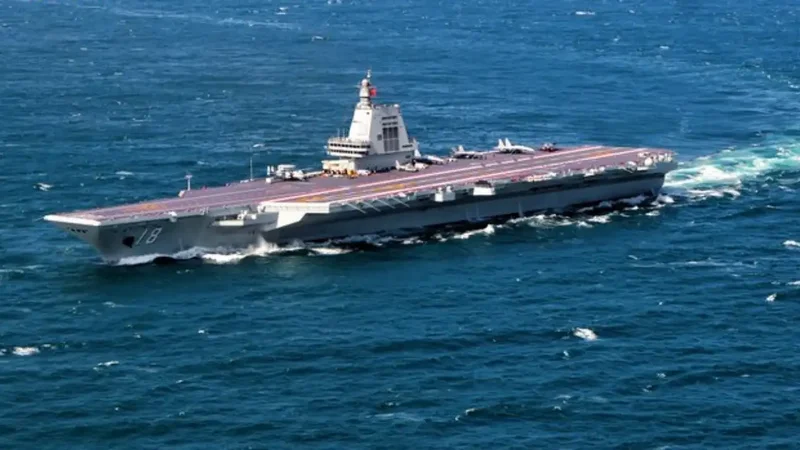
China has been on a shipbuilding spree, rolling out aircraft carriers at a pace that has alarmed capitals from New Delhi to Tokyo to Canberra. But for all the steel and swagger on display, Beijing's prized flat-tops, as aircraft carriers are known, could be sitting ducks the moment a hostile submarine slips into position, according to a fresh assessment. The warning comes from the Centre for Strategic and International Studies (CSIS), a Washington DC based think tank that has mapped out how the United States and its partners could, in theory, hold Chinese carrier groups at risk in a full-blown conflict in the Pacific.
China has invested heavily in building a blueâwater navy, with the Fujian carrier now undergoing sea trials and more carriers planned. These platforms are intended to project power far beyond Chinaâs shores, signalling Beijingâs ambition to rival the United States in maritime dominance. The report sketches a five-pronged "cost-imposition" playbook, that has in its sights China's aircraft carriers. The five prongs of this strategy as per the report are land-based missile networks, satellite-guided long-range air strikes, cyber and electronic warfare, drone swarms and submarine ambushes.
As per the CSIS report, Chinese carriers remain highly exposed to submarine attacks. In the undersea domain, China's adversaries such as the US, Japan and Australia maintain advanced submarine fleets capable of striking carrier groups without being detected.
They can manoeuvre close to carrier strike groups, launch torpedoes or cruise missiles with devastating effect. Even with layered defences, including destroyers, frigates and aircraft. The US Navy too is experiencing this vulnerability, as its carriers have long been considered prime targets for China's submarines and missiles.
The People's Liberation Army Navy (PLAN) has pulled ahead of rivals on paper with more hulls, bigger decks, newer aircraft, but the story changes when it comes to anti-submarine warfare. The report flags persistent gaps in China's ability to detect and track hostile submarines, particularly American attack boats prowling in the western Pacific.
That undersea blind spot matters more now than ever. According to the CSIS report, China wants to project power and is would move its carriers away from its shores as it builds capability. China is pushing these ships further out, past the first island chain and towards the second, in a bid to project power deep into the Pacific and beyond. Japan, for one, has already sounded the alarm over Beijing's expanding footprint and is improving its defensive capabilities.