'Mayfair means money': A walk through the Gulf elite's favourite part of London
It is 10am on Thursday, but the temperature on the streets of central London is already pushing beyond 30C, in what is set to be the UK’s hottest summer on record.
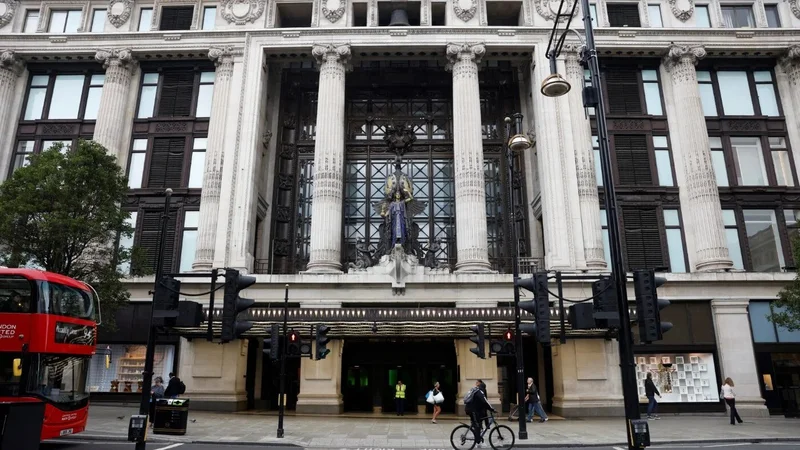
Outside Oxford Street’s Selfridges, the sun beats down on the pavement, a homeless man asks for change and a discarded free newspaper tells of yet more wildfires across the country.
Inside, the air conditioning runs smoothly and a concession selling Arabic coffee promotes Saudi Arabia, whose Public Investment Fund now owns 40 percent of the famous department store.
It was from Selfridges last weekend that Dubai’s ruler and the prime minister of the United Arab Emirates, Mohammed bin Rashid Al Maktoum, took a walk that saw him heckled on nearby North Audley Street over his country’s involvement in the Sudan war.
A member of the ruler's sizeable entourage went up to the Sudanese man - who had shouted “UAE is killing people in my country, stop killing my people” from across the street - and called him a “Black bitch”.
Mohammed bin Rashid remains in London, where he has met with UAE President Mohammed bin Zayed Al Nahyan and has been pictured in Chelsea, the now-affluent area once associated with London’s swinging 60s.
It is Mayfair, though, that has become a real home away from home for wealthy Gulf citizens. The area, which includes North Audley Street, where Mohammed bin Rashid and his group were shouted at, is one of the richest in the world - full of upscale restaurants, luxury car dealerships and grand hotels.
Inside Selfridges, 15-year-old Khaled and his uncle Mohammed, 53, are visiting from Dubai.
“We come to London because we have a lot of investments here and we like to help them out,” the noticeably confident Khaled says.
“Sudanese people are ignorant,” he tells Middle East Eye when asked about the incident with Dubai's ruler. “We are helping Sudan. We are sending humanitarian aid. It was disrespectful.”
“Yes, you can have freedom of speech, but you can’t say that to a leader; it’s not respectful,” says Mohammed, whose father was a soldier and who remembers a “simpler, harder life” in Dubai before oil transformed the city.
Today in the Emirates, he says, you can “get whatever you want within minutes. Someone will bring it to you. You don’t even have to get up”.
The family is staying in Mayfair for three weeks. It is a trip they make every August. They like the fact that London is awash with Emirati money, which helps the city feel familiar, as does the UAE’s historic connection to Britain and its empire, which they speak positively of.
Khaled is planning to go to university in London. Mohammed bin Rashid, Mohammed bin Zayed and other Emirati leaders were educated or received military training in the UK.
“I love it here. It’s not too hot,” says Khaled, on a day when even London at its hottest is still almost ten degrees cooler than Dubai, where life is air-conditioned.
But although the family visit Oxford and Hampshire, London for this teenager from Dubai begins and ends in the affluent parts of the centre.
'We come to London because we have a lot of investments here and we like to help them out'
-
Khaled, visiting London from Dubai
“We don’t go to the areas where there are roadmen and lots of migrants and stabbings,” he says, before getting out a map on his phone marked up with his favourite spots.
The list, which does not stray far beyond Mayfair, is described by Khaled as a map of "prime khaleeji hangouts". It includes the restaurants Cipriani, Ivy Asia, Sexy Fish, Supernova and Nobu.
Khaled’s fear of London outside its centre is echoed by one Saudi Arabian, who describes the reaction a teenager she knows has had to the British capital.
Despite not being a member of the Saudi elite, this 15-year-old has come to London to attend a residential summer school for teenagers from the kingdom. Every day, he escapes the school to go to Harrods, the famous department store now owned by the state of Qatar.
The boy has told the school he needs a bodyguard because “people here are so poor they will try and stab me for my Hermes”.
“There’s a lot of things that remind us of back home and we see a lot of people from back home,” say two sisters from Bahrain, aged 15 and 17, in Selfridges. Both have bumped into school friends from Bahrain in Mayfair, as well as other girls they did not know would be in London.
“When we go to Harrods we see people from the Gulf, we see friends and family… It’s not hot, it’s nothing compared to back home where we spend all the time with the AC on.”
While Mayfair feels familiar to the sisters, other elements of London feel more alien. “We don’t really have or use public transport in Bahrain. The underground here is very crowded and chaotic. The architecture is different here too.”
Influencers and jewellers
Across the road from Selfridges, on North Audley Street, the first pint of the day arrives at the Marlborough pub, named after a 17th-century ancestor of Winston Churchill. The temperature rises. A toddler sitting on a tricycle screams as his father scrolls on his phone.
Apart from the group drinking their pints, the street is almost entirely populated by visitors from the Gulf. Two Kuwaiti lifestyle and fashion influencers, Sarra and Elaf, are taking photos of each other. An elderly woman in pearls smiles as she steps around them. A Bugatti roars past.
“We mainly spend our time here in Mayfair,” Sarra says. “We come for the weather, the people, the shopping. In our country we can’t find a lot of the brands you have here… For us, it’s good weather. We also come in November because we love the cold, and we love the Christmas vibes.”
At Mayfair’s Grays Antique Market, which houses over 80 independent dealers, one jeweller tells MEE he never goes on holiday in August because that’s when wealthy visitors from the Gulf arrive. “They are an integral part of the business, especially in August; I can’t go away now.”
Members of the royal families of Saudi Arabia, Bahrain and the UAE have all been through the doors of the market. “A Thai princess came in last week,” the jeweller, who cannot be named, says. “She had 20 followers with her, which is less than her father the king, who has 100.”
“Mayfair is the mecca of the Arab world in a way,” the jeweller says. “They love fine things. The men come here to buy silver jewellery, the women come here because they know they can get brands like Cartier, Tiffany and Bulgari at a steep discount.
“Young girls from the Gulf will think nothing of spending £1,000 on a little charm. One lady from the Gulf didn’t blink when she bought something for £18,500. She knew she would have had to pay twice as much elsewhere.”
Before the Ukraine war, London was known as Londongrad because of the number of Russians and the vast sums of Russian money in the city. “I used to deal with a lot of Russians, but they’ve all left like rats from a sinking ship,” the jeweller says. “The Russians still here don’t have any money.”
'Mayfair means money'
Sitting in the heart of Mayfair, Grosvenor Square was home to the US diplomatic mission in Britain from 1785 until 2018. Now, the vast former embassy building is a luxury hotel containing a string of restaurants.
These include the Qatari-owned Qinwan Cafe, another focal point for wealthy visitors from the Gulf. Three small chicken sandwiches cost £20. The same Palestinian dates available back home can be bought by tourists visiting London.
Women in abayas and men in polo shirts scroll through their phones and post pictures of coffee on Instagram.
Outside, sitting in his van, delivery driver Hash, from south London, waits for his next job. “Mayfair means money,” he says, looking out into the baking heat.
There was a time six years ago, he says, when he could make £500 a day driving a delivery to Scotland and back. Now he says he is lucky to earn more than £100 a day.
Beyond Grosvenor Square, a queue of tourists from the Gulf gently envelops Marchesi, the patisserie founded in 1824, while the Ferrari dealership shines in the sun on Berkeley Square.
Inside Green Park Underground station, the temperature is approaching 40C. An announcement tells passengers that four lines are partially closed and that many more are experiencing severe delays.