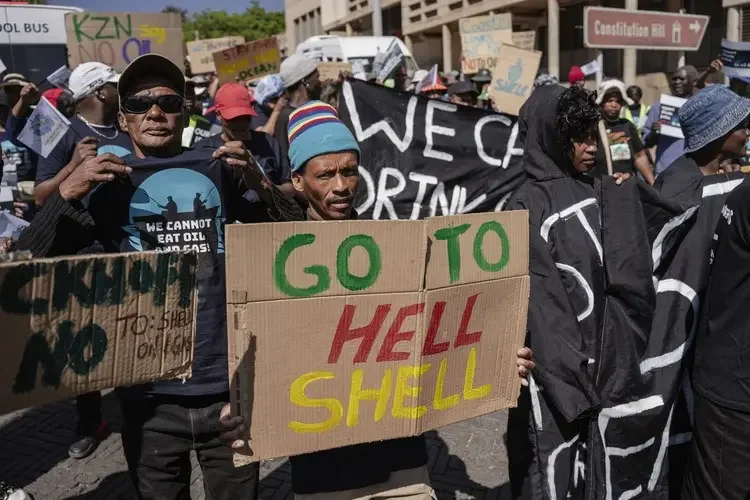
The Constitutional Court has set aside an exploration right held by__ Shell and Impact Africa off the __Wild Coast, finding that thousands of affected community members were excluded from decisions that could affect their livelihoods and cultural and spiritual practices.
In a judgment that goes beyond the fate of one exploration right, Justice Jody Kollapen placed the dispute in South Africa’s longer history of dispossession and the struggles of coastal communities to protect their land, marine resources and ways of life from extractive activities.
Kollapen said South Africa’s natural resources were shared commons of importance to present and future generations but remained vulnerable to economically driven development.
“The sea is of deep importance to coastal communities along the Wild Coast,” he said, noting their long-standing struggles to protect their land, marine resources and ways of life.
The judgment said the relationship between Wild Coast communities and the sea extended beyond nutrition and income, with the ocean central to livelihoods, ancestral practices, traditional healing and spiritual life.
At the centre of the case was whether an unlawful process that led to the exploration right could be repaired more than a decade later through further consultation during a renewal process.
The Constitutional Court said it could not.
The case dates from an exploration right granted to Impact Africa in 2014 and subsequently renewed. Shell acquired a 50% participating interest in the right in 2021.
The high court found the decisions to grant and renew the exploration right unlawful and procedurally unfair.
The Supreme Court of Appeal (SCA) upheld the findings but suspended the setting aside of the right pending the outcome of a third renewal application, during which further public participation could take place.
It was that remedy that the communities and environmental organisations challenged in the Constitutional Court.
Communities were not meaningfully consulted
The Constitutional Court highlighted serious failures in the original consultation process.
Impact Africa had not properly investigated who the affected parties were.
Notices were published in newspapers inaccessible to affected communities and only in English and Afrikaans, despite communities in the area being predominantly isiXhosa-speaking.
More significantly, Impact’s consultants had been told by traditional leaders that engagement with the broader affected communities was required but no steps were taken to engage directly with them.
“In these circumstances, Impact could not reasonably have believed that meaningful consultation had occurred,” Kollapen said.
The court said consultation was about more than giving people an opportunity to express an opinion. It was tied to the dignity and agency of affected communities and their status as participants in decisions affecting their land, culture and livelihoods.
Kollapen said thousands of community members had been excluded from the decision-making process and that telling them, more than a decade later, that they could now be consulted would not cure the original violation.
“Requiring a consultation to be conducted now does not vindicate the right to be consulted at the outset and does not vindicate the infringement of the applicant communities’ right to dignity.”
For Sinegugu Zukulu, the co-founder and director of Sustaining the Wild Coast, the judgment was a major victory after years of opposition to the exploration plans.
“We are excited about the judgement. We are feeling very emotional because this particular fight for us, this was not a personal fight. It was a fight for the health and for the well-being of the planet,” he said.
Zukulu said the struggle had been driven by concern for people most vulnerable to extractive activities, particularly poor rural communities whose livelihoods depended on their environment.
“When you are in a country where you could go to court and the judges could listen and be able to come with such a judgment, you feel very vindicated,” he said.
Melissa Groenink-Groves, an attorney and programme manager at Natural Justice, described the ruling as a “groundbreaking victory”.
“The judgment is a victory for coastal communities, it's a victory for our constitutional democracy and for the continued rigour of the judiciary and judicial processes,” she said.
Groenink said the court had recognised the deep connection coastal communities had with the ocean for their livelihoods, spirituality and culture.
“The protection of ecological systems is inseparable from the protection of rights to dignity, culture and livelihood,” she said.
A history of dispossession
Kollapen’s judgment places the case within the broader constitutional struggle over South Africa’s natural resources.
The dispute, he said, required consideration of the interconnectedness of people, their environment and developmental interests, including the constitutional right to a healthy environment, participation in decision-making, equality and transformation and sustainable development.
The court said the Wild Coast dispute had to be understood against the backdrop of “well-documented struggles” by coastal communities to protect their land, marine resources and ways of life from extractive activities.
Kollapen referred to resistance to proposed mining in Xolobeni and the importance of marine resources to customary practices and cultural identity in the Dwesa-Cwebe region.
“These histories reflect that environmental governance in coastal areas is often marked by deep contestation, in which the protection of ecological systems is inseparable from the protection of the rights to dignity, culture and livelihood,” he said.
The court also rejected the idea that economic development and community rights could simply be placed on opposite sides of a scale.
While job creation was a legitimate consideration, it could not be assumed to be inherently beneficial without asking who would receive the jobs, how secure they would be and what social, ecological and cultural costs affected communities would bear.
Zukulu said the judgment also spoke to a much longer history of communities being displaced or marginalised in the name of economic development.
“For so many centuries, we know that [through] colonialism, it has always been the norm for people to be pushed off their land in order to open the way for so-called economic growth and economic development,” he said.
The old application cannot simply be revived
The Constitutional Court rejected the SCA’s approach of sending the matter back for a further renewal process.
The original exploration application and environmental management programme dated from 2013. Since then, the legal and factual landscape had changed significantly, including the proposed operations, environmental impacts, scientific knowledge and the applicants’ financial and technical capacity.
“For a fresh and properly considered decision to be taken, a new application, including a fresh consultation process and a new EMPr [environmental management programme], would be required,” Kollapen said.
The majority also found that such a process could effectively sidestep the moratorium on new offshore applications, which was made in the public interest.
The judgment does not permanently bar the companies from applying for an exploration right in future. Any future application would have to be dealt with according to the legal and factual circumstances applicable at that time.
Nonhle Mbuthuma, the spokesperson for the Amadiba Crisis Committee, described the judgment as “a very clear victory for the ACC and the other Wild Coast communities – and a serious defeat for Shell and Impact Africa”.
She said the ruling did not necessarily mean oil and gas exploration off the Wild Coast was permanently prohibited but that “the existing route to the project has been closed”.
Mbuthuma said the judgment was particularly significant for the ACC's long-running struggle for communities to have a meaningful say over projects affecting their land, ocean and livelihoods.
“The judgment’s principles concerning meaningful consultation, human dignity and the rights of affected communities could also have implications far beyond this particular Shell case.”
Climate change and financial interests
The consultation failure was not the only defect in the original process. The judgment records that the high court had also found failures to properly consider relevant factors, including climate change, the Integrated Coastal Management Act and the precautionary principle.
The Constitutional Court therefore rejected the idea that simply conducting a new consultation process could cure all the defects in the original decision.
The court also considered the approximately R1.1 billion that Shell and Impact Africa said they had invested in the project. While this expenditure was a relevant consideration, Kollapen said the SCA had given it too much weight.
“Financial interests should not be unduly elevated to overrule other factors in the enquiry into what is just and equitable,” he said.
The majority also rejected Shell’s argument that it was an innocent party because it had not conducted the original consultation process.
When Shell acquired its 50% interest, Kollapen said, it also took on responsibility for the legal vulnerabilities associated with Impact’s actions.
The judgment noted that Shell continued to maintain that the consultation process had been “entirely reasonable”. Kollapen said that reflected a view that consultation was a secondary and procedural consideration that could be easily remedied, a position the court rejected.
Groenink said the court had, in setting aside the exploration right, “ultimately put people over profits” and confirmed that those complicit in an unlawful process could not gain an advantage from it.
In a statement, Shell said it had noted the Constitutional Court judgment and remained committed to “responsible offshore exploration, meaningful stakeholder engagement and environmental stewardship”.
“South Africa is currently reliant on energy imports for many of its energy needs,” the company said.
“Should viable resources be found offshore, this could significantly contribute to South Africa’s energy security and the Government’s economic development programmes.”
A different view
Rogers J, with Savage J concurring, disagreed with the majority on the remedy.
Rogers said it would be just and equitable to allow the relevant decision-maker to determine whether Impact Africa and Shell should receive a final three-year period for exploration, arguing that fresh consultation and consideration of relevant factors could adequately vindicate the affected communities’ rights.
The majority rejected that approach.
The Constitutional Court instead upheld the communities’ appeals, set aside the SCA’s order and restored the effect of the high court’s decision setting aside the exploration right and its renewals.
For Zukulu, the significance of the judgment extends beyond the fate of one exploration right.
He said the ruling was ultimately about “the future, sustainability and the wellbeing of the planet”.