I'm a communications professional who lost my powers of speech. Here's what aphasia taught me
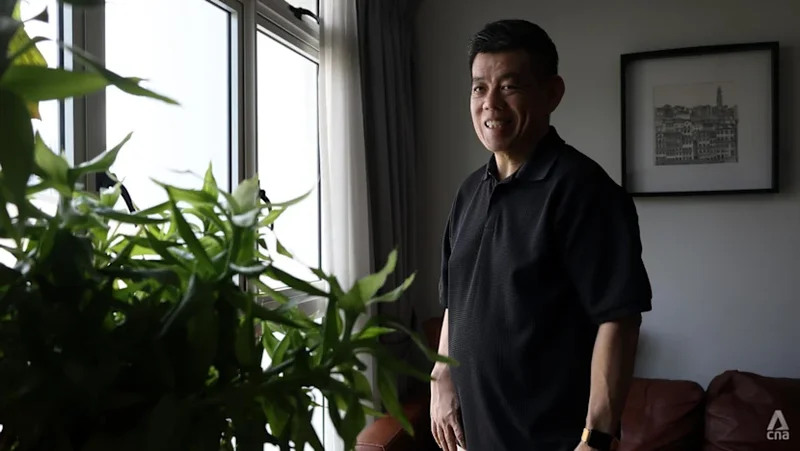
Mr Terence Ang spent nearly 30 years making a living from words. After a haemorrhagic stroke in 2020 took away his ability to speak fluently, he grappled with the loss and had to find new ways to communicate.
"Eee ... ooo ... eee ... ooo ..."
I stood before the mirror, repeatedly alternating between smiling at my reflection and blowing myself kisses while making these noises.
Anyone watching might have thought I had lost my mind. Really, I was following exercises prescribed by my speech therapist to help me regain control of the muscles in my face and mouth, and reconnect my brain with my speech abilities.
Communication had always been the foundation of my career. As someone who had spent his entire working life in communications, marketing and related fields, my professional skill set centred on my ability to present ideas, shape strategies and win support from others.
To do that, I needed words.
Words were not just tools. Words were my superpower; they gave me confidence and influence. They were a core part of my identity and how I measured my value.
Then, almost overnight, they were taken from me by a haemorrhagic stroke in August 2020.
My memories, thoughts and emotions were still there, but the words that once came so easily to express them no longer followed.
Sometimes, I could not retrieve a word; sometimes the wrong one emerged. I often got trapped halfway when forming a sentence. Reading and writing also became difficult.
The words flitted around restlessly in my mind, but my mouth could not release them.
THE INVISIBLE STRUGGLE OF APHASIA
Until my stroke, I had never heard the word "aphasia", a condition caused by damage to the brain that can affect a person's ability to speak, understand, read or write.
I had no idea what it could do to a person – or what it was about to do to me.
Aphasia robbed me of fluent speech and derailed my career, but it also dealt lasting blows to my dignity, confidence and self-worth.
My physical difficulties after the stroke were easier for others to recognise. People could see the significant weakness in the right side of my face and body, and the great effort required for me to walk and move around.
Aphasia was much less visible.
Every conversation became a test. Could I find the words? Would the other person wait? What if I said something completely different from what I intended?
Even now, years after my stroke, speaking requires a draining level of concentration.
The harder I try, the more tired I get. The more tired I am, the harder it becomes to retrieve the words.
All the while, a person interacting with me might not realise I'm struggling at all.
Every conversation became a test. Could I find the words? Would the other person wait? What if I said something completely different from what I intended?
Sometimes, people would jump in to complete my sentences, though the word they supplied was not always the one I wanted.
Conversations often moved on or concluded before I could take part. Follow-up questions were more likely to be directed to the person beside me.
Over time, these began to make me feel invisible. Eventually, I felt forced to hold my tongue more often than not.
It wasn't because I had nothing to say. Rather, it was just too hard to say anything at all.
LOSING MORE THAN MY VOICE
Sometimes, I wondered if this was the end of the line – maybe I had used up my lifetime "quota" of speech and must now use my reserves carefully.
My communication difficulties started to feel more like struggles to maintain my dignity as a human being.
It felt like people were mistaking my pauses for a lack of opinion, or my difficulty with speaking for a difficulty with thinking.
Some days, I grappled with depression as I struggled to understand and accept the distance between the person I used to be and the person I had become.
For a long time, I believed recovery meant reverting to the life I'd had before my stroke, as well as the person I'd been.
Close to five months after the stroke, I returned to work briefly, hoping to restore whatever vestiges of my former self that I could.
But it was a short-lived attempt. I was simply no longer able to communicate as quickly, comprehensively or compellingly as my work demanded.
I had to leave my career – the thing that had, for decades, given me purpose, fulfilment and belief in my very worth and value.
FINDING OTHER WAYS TO SPEAK
Gradually, I realised I could not rebuild my life anew if I insisted on clinging to my old one. You can't move forward if you keep trying to go back.
The truth was, I was stuck with aphasia – and I wasn’t about to convince myself it was a "gift" of sorts.
But I allowed myself to acknowledge yet another truth: I still had something meaningful to contribute.
I began writing, looking to place my fear, anger, confusion and loneliness somewhere outside my mind.
Writing was still difficult, but it gave me what conversation no longer did: time.
I could pause, search for a word and return later. With notes, text-to-speech tools and trusted support, I wrote myself a new pathway to the outside world.
I finished one book, which was published by a Singapore publisher. One book became six, each one exploring topics such as stroke, rehabilitation, identity and poetry.
For my latest book, Brokenness Becomes Beautiful, I produced an audiobook version using artificial intelligence (AI) tools and various recordings of me speaking in the years since my stroke, to create a digital version of my voice.
The first time I heard the AI recreation of my voice reading my poetry, I felt wonder, sadness and an odd sense of self-recognition. It was almost like reconnecting with a friend I’d known long ago.
AI did not cure my aphasia or restore my voice – it just gave me another way for my words to be heard.
It was not perfect, but perfection was never the purpose. And that's true for so much of my healing and rebuilding journey.
I STILL HAVE A VOICE
What is communication, really? What does it mean for us as human beings?
I once believed good communication was about speaking clearly, confidently and persuasively.
Aphasia has since taught me that good communication is also about listening.
We live in a world that rewards speed and closely associates competency with efficiency.
But speed is not intelligence. Efficiency does not necessarily mean better quality.
If you ever find yourself speaking with someone who has aphasia, give them time.
Speak naturally, address them directly and ask before completing their sentences. Don’t assume that when a person is having difficulty speaking, it means they’re having difficulty thinking.
This applies to anyone who may struggle to articulate their needs or thoughts, such as young children and seniors.
We tend to brush people aside when we feel like the conversation is going nowhere, but what makes communication with others worthwhile is not just being heard – it's also about listening, patiently and generously.
These days, my speech remains slower and less predictable than it used to be. I still struggle sometimes to turn a thought in my brain into words in my mouth.
The frustration remains, but I am no longer waiting for something that's long gone to return to me before I allow myself to live.
Rebuilding your life after it's been broken doesn't always mean making the difficulty disappear.
We are human beings, not jigsaw puzzles. Sometimes, putting the pieces of our lives back together will form a different picture than what it was before.
More importantly, finding your voice again does not mean recovering the one you had. You can find a new way to speak – what matters is that the words are still yours.
*Terence Ang is an author, stroke survivor and aphasia advocate. He previously spent nearly 30 years working in communications and marketing. *
If you have an experience to share or know someone who wishes to contribute to this series, write to voices [at] mediacorp.com.sg (voices[at]mediacorp[dot]com[dot]sg) with your full name, address and phone number.