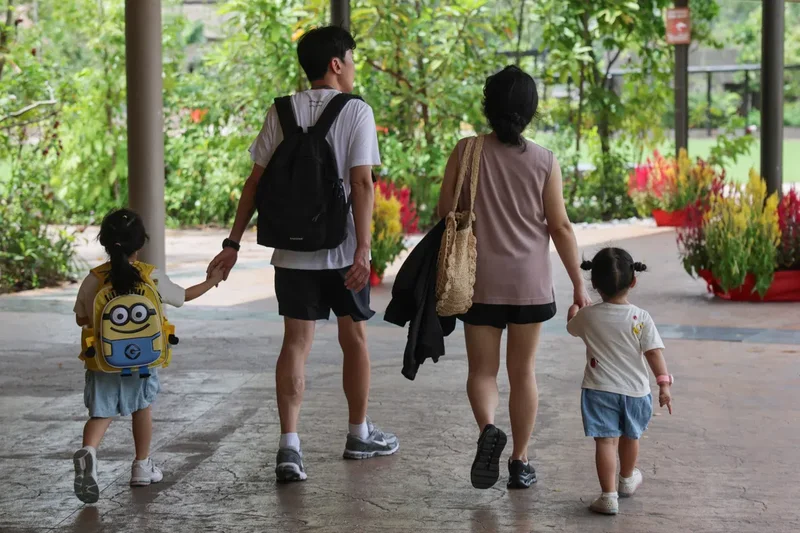
What parents want: More childcare leave, less pressure over maternity leave, and room for joy
AI generated
SINGAPORE – Whether parents of young children have one kid or three, like Kristen Kiong does, they have the same childcare leave entitlement: six days, dropping to two days when the children go to primary school.
“It cannot be that all these benefits are shared among all the kids, because then there’s no incentive to have more... The benefits reduce with every subsequent child,” said Kiong, who is mulling over having a fourth child.
Parents told The Straits Times they desire to spend more time supporting and nurturing their children. They also hope for more money or financial assistance for their young families.
These have been and continue to be top of mind for parents, who often have to weigh painful trade-offs between making time to be with their children and making money to better provide for them.
Parents spoke to ST about their challenges ahead of Prime Minister Lawrence Wong’s National Day Rally speech on Aug 23, when he will share the Government’s plans to help Singaporeans with the costs of raising children and to lighten the load on families.
In his National Day message on Aug 8, PM Wong said the Government is conducting a major review on how families are supported in Singapore across various life stages.
The review is a response to concerns from parents who feel stretched juggling competing demands, amid a record-low total fertility rate. In 2025, there were fewer than 30,000 births for the first time since Singapore’s independence.
Inadequate childcare leave is one of the perennial bugbears for parents, including Kiong.
Kiong, who has a one-year-old boy and two girls aged four and six, is currently on no-pay leave after maternity leave. She intends to return to her work as a part-time speech therapist in January, after her youngest child turns 18 months old. Kiong had moved from full-time to part-time work in mid-2024, as she was falling sick often and experienced burnout.
She said six days of childcare leave are easily wiped out once a child catches hand, foot and mouth disease. Taking time off from work to care for sick children tends to eat into parents’ annual leave, she added, citing how a friend had to take unpaid leave to bring his family on a holiday abroad.
And while she tries not to be one of those “tiger parents” who pack their children’s schedules with enrichment classes, she worries if her kids will miss out on opportunities.
So she hopes for more government subsidies for school-age children’s enrichment activities such as forest camps or educational camps during the school holidays. Her children do not go for enrichment activities currently.
Kiong also hopes funds from the Child Development Account can be used to pay student care centre fees.
Several parents told ST they hoped for additional support for inpatient and outpatient medical bills.
One mother, who declined to be named, said she racked up $13,000 in bills for a four-day stay in an A-class ward at KK Women’s and Children’s Hospital after giving birth by caesearan section.
She said a few of her relatives had babies who required care in the High Dependency Unit or the Neonatal Intensive Care Unit, and these increased the size of their hospitalisation bills, too.
More financial support in other ways could also reduce the unspoken pressure some working mothers may feel about taking maternity leave, as their colleagues have to cover their duties.
This is the view of Jeffrey Lau, a business owner and father of four. In his IT consultancy company comprising 13 employees, one of them went on maternity leave thrice in around 14 years.
He proposed for the Government to fully cover the cost of maternity leave, rather than subsidising the company with just half the salary of the leave incurred, and to provide tax relief for employers.
He also suggested for the colleague covering for the employee on maternity or paternity leave to receive an additional stipend of $1,000 a month from the Government.
Greater joy
Aidaroyani Adam, chief executive of PPIS, a non-profit organisation providing services for women and families, said more than one-third of Muslim women identified a lack of time, along with difficulties managing work commitments, as the single greatest challenge to fulfilling their family aspirations.
This was among the findings of PPIS’ 2022 study on the aspirations of Singapore Muslim women, which surveyed 1,000 Muslim women aged 21 to 62.
Aidaroyani said a parent dealing with an unexpected loss of income may worry about household expenses, caregiving arrangements and their children’s needs.
“When much of a parent’s attention is necessarily focused on meeting these immediate needs, it can also affect the time and emotional capacity they have for their children and relationships.
“Conversely, difficulties at home can make it harder for parents to remain consistently employed or pursue opportunities that could improve the family’s longer-term financial position,” she said.
While Aidaroyani lauded the raising of the income ceiling for the student care fee assistance from $4,500 to $6,500 from January 2027, she noted that the current maximum assistance subsidy of $290 per child per month has remained unchanged since 2020.
Beyond time and money, some parents are also calling for stronger emotional support for new parents and an environment where their children can find happiness. They hope the education system can have lower stakes and bring the joy of learning to kids, while preparing them for the workforce.
Roxanne Toh, who has a one-year-old boy and two girls aged seven and nine, said: “What would really help is subsidised mental wellness support like counselling for pre-marriage and postpartum or confinement support.”
She said she found it challenging to take care of a newborn all over again after her two elder children went to primary school. She and her husband also had to learn to manage sibling relations, for instance, how to ensure each child gets adequate attention.
Toh, who works at a restaurant owned by her husband, said she hopes hospital nurses can visit parents of newborns after their discharge.
The 42-year-old now fears for her children’s mental well-being and whether they will be allowed to thrive at their own pace, wondering: “Would they really be happy growing up in Singapore?”
“What would shape their memory of their country in the years to come? Would it just be a concrete jungle void of nature and memories of simple pleasures and joys?”
“What would shape their memory of their country in the years to come? Would it just be a concrete jungle void of nature and memories of simple pleasures and joys?”
Use other kinds of leave for childcare
Recently, Parliament has heard a number of proposals to help parents.
Earlier in August, Bishan-Toa Payoh GRC MP Elysa Chen suggested more government-paid childcare leave, extending childcare subsidies to stay-at-home mothers and increasing maternity leave to six months.
She also called for employees to be allowed to use their own medical leave to care for sick children or elderly parents. She asked for structured postpartum home visits and improved access to pre-school places, particularly in areas with higher demand.
Minister in the Prime Minister’s Office Indranee Rajah said the Marriage and Parenthood Reset Workgroup, which she chairs, is considering some of her suggestions.
Chen has also said many parents have shown support for universal childcare subsidies.
Such support would recognise the contributions of stay-at-home parents, or those with different working arrangements where they cannot clock 56 hours a month to qualify for the infant and childcare subsidy scheme, Chen told ST.
Chen, who is a parent herself and executive director of CampusImpact, a social service agency which supports young people, said with help from the Government, employers can have family-friendly policies to attract and retain staff, and create healthy workplaces.
Chen also proposed providing Government grants or tax credits to help companies hire temporary staff, or funding a direct relief allowance for colleagues who step up to take on extra duties.
She also recommended for parents to be allowed to use their own un-utilised sick leave entitlements to care for their ill children.
Jurong East-Bukit Batok GRC MP David Hoe proposed for parents to have six days of childcare leave until the child turns 12, and for parents to get six days for each child.
Hoe also suggested introducing “jumbo” BTO flats to encourage couples to have more children by offering larger, specially designed HDB units paired with extra housing subsidies.
Another of his proposals is to reduce or waive the minimum occupation period for families expecting more children so that they can apply for a larger flat, and also to give them priority in these applications.
Hoe said three- or four-room flats cannot accommodate families with one or two kids and a helper.
Support for young people
Jean Yeung, director of social sciences at A*STAR Institute for Human Development and Potential, said the most important reason for the low fertility rate in Singapore is the low marriage rate.
“Overall, young people need to feel hopeful that they are supported and can build a meaningful and healthy family life in order for them to pursue marriage or parenthood.”
Yeung, who is also a professor in the Department of Paediatrics at the National University of Singapore Yong Loo Yin School of Medicine, hopes there will be more incentives provided to employers to create a more gender-equal and family-friendly work environment.
These include measures that reduce the opportunity costs of marriage and having children, such as equal opportunities for promotion for women, flexible work arrangements, providing daycare near work, and allowing men to take paternity leave and childcare leave, she said.
Tan Poh Lin, senior research fellow at the Institute of Policy Studies, said: “Perhaps the most important factor for family well-being is a greater sense of economic security”, both now and in the future, believing that their children will have bright economic prospects.
She said current anxieties over the possibility that they could fall behind lead youth to prioritise jobs and financial stability over marriage and parenthood.
More people will be open to the “risky enterprise” of having children in a volatile climate if they can sense that there are guardrails in place and they can expect income and training support in the event of a shock, she said.
Tan noted that introducing more parenthood-linked leave provisions can end up causing discrimination against parents at the workplace.
“Hence, it would be ideal to simultaneously broaden access to family leave for non-parent workers, to increase quality time with family and normalise caregiving as a part of family life.”
Said Elysa Chen: “We want to make room for families by addressing the constant sense of having to make trade-offs. We need to create the breathing room for families to experience the everyday joys of raising children.”