- See more This is Money on Google - save us as a Preferred Source
How many times can the Government move the electric car goalposts? I've genuinely lost count.
I've seen learner drivers spend less time shunting backwards and forwards while attempting a parallel park than ministers have dithering over when to completely ban the sale of new cars with combustion engines.
With Labour announcing today it is consulting on yet another delay to the switch to EVs, we are once again left in the dark.
Trying to tell you how much longer you'll be able to buy a new petrol car has become guesswork.
And the consequence of all this indecision is far more serious for Britain's motor industry.
Carmakers are already grappling with soaring energy costs, increased export tariffs and relentless competition from China.
Constantly shifting the deadline only makes it harder for them to plan, invest and compete.
The Department for Transport has announced a new consultation to water down electric car sales targets between now and the end of the decade. Isn't this all becoming a little ridiculous?
Frankly, I'm amazed manufacturers haven't threatened to walk away from the UK altogether until ministers finally make up their minds.
The uncertainty is also wreaking havoc for chargepoint operators, who are being forced back to the drawing board time and time again as they try to not overwhelm the delivery of eggs before there are enough chickens.
The Department for Transport's defence is that it's reviewing the 'pathway' to zero emission driving 'in the context of challenging and complex global economic conditions, including supply chain disruption and tariff and trade uncertainty'.
This is to 'ensure they remain pro-business and grounded in the real-world'.
But after nearly a decade of arbitrary deadlines and political U-turns like this latest one, Britain doesn't need another consultation or another delay. It needs certainty. Pick a date. Commit to it. And, for once, stick to it.
A sixth major change
I've had to rake through the embers of my memory to recall way back in July 2017 when Michael Gove, then Secretary of State for Environment, Food and Rural Affairs, first drew a line in the sand for axing new petrol and diesel car sales.
His Air Quality Plan recommended they should be outlawed from 2040.
In November 2020, Prime Minister Boris Johnson, in typical blasé Boris fashion, accelerated the date by a whole decade to 2030 as part of his ten point plan for a Green Industrial Revolution.
But by 2023, Rishi Sunak was frantically pumping the brakes.
He cited the cost-of-living squeeze as justification for a five-year delay to the deadline.
He said the 'upfront cost' of EVs was 'still too high, especially for families struggling financially' in response to voter concern.
Yet in a curious contradiction, it was Sunak who, having just argued that Britons simply weren't ready or financially positioned to switch to EVs, introduced the Zero Emission Vehicle (ZEV) Mandate – the Government's enforced timeline for manufacturers to scale back sales of fossil-fuelled cars.
Sensing an opportunity to win over climate-conscious voters and position the Labour Party as committed to green energy and net-zero goals ahead of the 2024 General Election, Keir Starmer pledged to reinstate the 2030 ban.
But as early as April last year, Labour was already diluting its position, adding fresh flexibilities and loopholes to help manufacturers hit targets and avoid punitive fines.
Now, just 16 months later, Andy Burnham wants to tinker with the policy again...
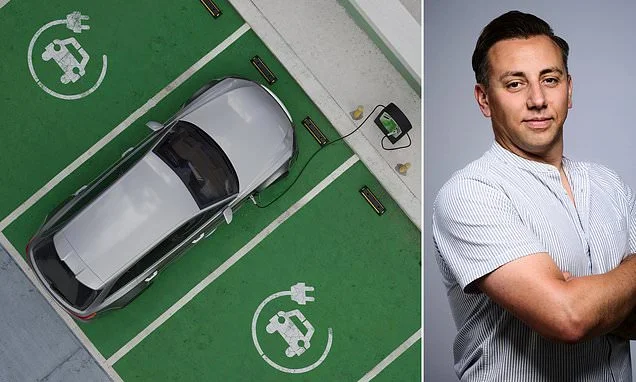
Motoring editor Rob Hull says he's seen learner drivers spend less time shunting backwards and forwards attempting to parallel park than ministers have dithering over EV sales targets
What's changing now?
The new PM isn't about to scrap the 2030 petrol and diesel ban. Instead, Mr No10 of the North is preparing to take a sledgehammer to the key policy designed to make it happen – the ZEV mandate.
The divisive policy requires manufacturers to sell an ever-increasing proportion of electric cars each year.
The target started at 22 per cent of all sales being EV in 2024 and rose to 28 per cent last year. For 2026, it stands at 33 per cent.
Under the mandate's current trajectory, by 2030, 80 per cent of new cars sold in Britain must be electric. But Labour now thinks this is a stretch too far.
Today's consultation asks whether that target between 2027 and 2030 should be slashed, with ministers floating dramatically lower end-of-decade thresholds of 70, 60 or even just 50 per cent.
More flexibilities are being considered for the next three years and DfT also wants to reconsider the role of plug-in hybrid electric vehicles (PHEVs) in the legislation and how it could 'further incentivise their use in electric mode'.
Transport Secretary, Heidi Alexander said: 'The end goal hasn't changed – but we need to take business with us on the journey, and that’s exactly what we’re doing today, by making sure industry has the chance to shape how we get there.'
For carmakers struggling to hit EV sales targets, it would be a significant reprieve. For critics, it's yet another sign that policy is being rewritten on the fly.
Who's lobbied this?
Yet it's the carmakers themselves, through industry lobby group the Society of Motor Manufacturers and Traders, who have been leading the calls for change.
For months, the SMMT has insisted reform of the ZEV mandate is 'vital'.
But why, when electric car sales are rising month after month? The trade body's answer is simple: those gains have come at an unsustainable cost.
According to the SMMT, manufacturers have pumped billions of pounds into discounts and incentives to persuade motorists to go electric.
And while that strategy is boosting demand, the trade body says it cannot continue indefinitely.
But before you start taking pity on the $2.75trillion automotive industry, remember that you, the taxpayer, are also fronting £2billion worth of grants reducing the price of new models between now and 2029-30.
It was also revealed in April that a powerful coalition of car companies and parts producers had urged ministers to rethink the UK's EV transition timetable – this time behind closed doors.
A letter obtained by The Fast Charge newsletter through a Freedom of Information request outlined how BMW, Ford, Nissan and Toyota, alongside automotive giant Bosch, had lobbied the Government for a policy rethink.
The manufacturers called for what they dubbed an 'open technology approach', allowing a wider mix of low-emission technologies to remain on sale beyond 2035.
The proposal closely mirrors demands already being made in Brussels, where automotive powerhouses last year successfully pushed EU lawmakers to avoid an EV-only future.
In their letter, the companies argued there should still be a place for highly efficient combustion engines, hybrids, plug-in hybrids and range-extender models, particularly when paired with sustainable fuels and greener manufacturing processes.
Dr Andy Palmer, former chief exec at Aston Martin and the man who steered the launch of the first mainstream EV – the Leaf – during his tenure at Nissan over a decade ago, says it is 'automakers that have been slow to move to EVs' that are making all the noise.
In an interview with Times Radio at the weekend, he accused these manufacturers of 'lobbying hard to get a delay so that they can catch up' at the expense of those who have 'moved more quickly'.
Dr Andy Palmer, the former boss at Nissan and Aston Martin, says it is automakers that have been slow to move to EVs that are making all the noise about watering down targets
Who wants the Government to stick to their guns?
Many car manufacturers and businesses have already staked their future on the EV revolution, pumping billions into development on the proviso that ministers will stand by their commitments.
Delvin Lane, chief executive of InstaVolt, says his company has already invested hundreds of millions of pounds building the UK's biggest ultra-rapid public charging network based on the 'clear runway' set out by the ZEV mandate. He warns today's sudden policy change could undermine confidence.
'Softening the mandate at this stage risks spooking exactly the private capital that's been building the infrastructure this transition depends on,' he says.
Octopus Electric Vehicles chief executive Gurjeet Grewal is equally blunt.
'The ZEV mandate is working,' he tells us. He says the current thresholds are 'giving manufacturers confidence to invest and drivers confidence to switch'.
He added: 'Weakening it now would send exactly the wrong signal, just as EVs are becoming some of the best-value cars on the road.'
Grewal says estimates by Carbon Brief suggest shifting the goalposts yet again could cost drivers £3bn a year in expensive petrol between now and 2030.
'We should be accelerating the transition [to EVs], not creating another policy that leaves drivers, businesses and the UK economy paying the price.'
Are car makers missing existing EV sales targets?
At first glance, yes.
Just one in five new cars registered so far in 2026 is fully electric, well short of the headline target of one in three.
But the reality is far more complicated.
That's because the ZEV mandate includes a raft of flexibilities and allowances built into the rules from day one.
Those mechanisms effectively lower the target many manufacturers need to hit.
As a result, most major brands remain on track to comply this year.
Stuart Masson, editorial director of The Car Expert, compares it to income tax. 'You might officially pay tax at 20 per cent or 40 per cent, but allowances and reliefs reduce what you actually pay. The ZEV mandate works in exactly the same way.'
He says that existing flexibilities mean manufacturers - generally speaking - need to achieve closer to a 25 per cent EV sales mix this year. That's a figure the industry is already reaching.
And the biggest question nobody can answer...
For all the U-turning on petrol car bans, EV sales mandates and Net Zero targets, we're all still in the dark over one crucial issue: what models will actually be in showrooms between 2030 and 2035?
The fate of pure petrol and diesel cars is effectively sealed. Manufacturers know it. Dealers know it. And drivers should know it too.
Hybrids, however, have secured a five-year stay of execution. But which ones?
'Mild hybrids' look very unlikely to make the cut. They use a small battery and electric motor, but can't drive on electric power alone.
Self-charging hybrids, such as the Toyota Prius, are harder to call. They don't need plugging in, but their electric-only capability is minimal, raising questions about whether they fit the Government's Net Zero ambitions.
Plug-in hybrids currently look the strongest candidates for survival, especially with the DfT looking to gauge feedback on their green credentials in the new consultation.
The newest models, particularly some arriving from China, can travel more than 90 miles using electricity alone before the engine needs to kick in. In these cases, they're effectively short-range EVs. But only if owners remember to plug them in.
The truth is, nobody seems certain.
And perhaps most worrying of all, it is not entirely clear the Government is either.