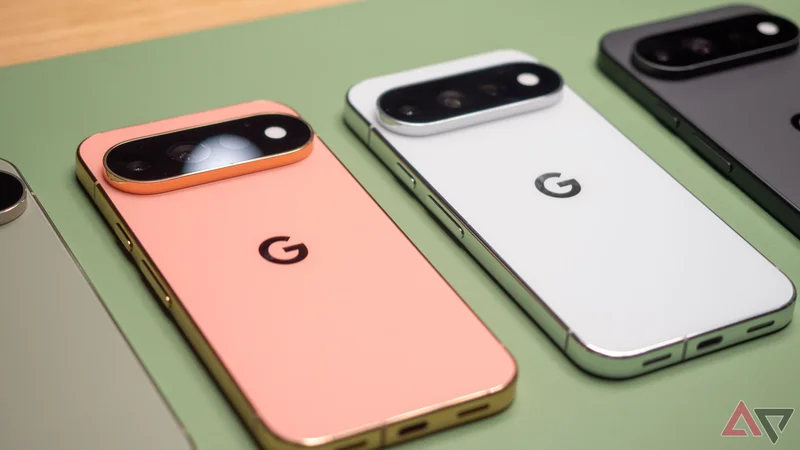
Made by Google 2026 just wrapped, and as expected, it was chock-full of fun new product announcements, including the Google Pixel 11 lineup and the Pixel 11 Pro Fold.
It was also an event that felt predictable, polished, and a bit sterile — devoid of the whimsy that once heralded Google's announcements.
Don't get me wrong. Google's latest phones look fantastic; they're boring in the very best way possible. The new family once again mirrors Apple's staid iPhone lineup, and it's hard to argue with mainstream market share.
However, they also make me nostalgic for the halcyon days when Google phones had character.
The era of gloriously pure Google
A blank canvas for enthusiasts
I cut my teeth on the Nexus One. While I'd played around with the HTC Dream and the Motorola Milestone before that, they didn't really do it for me.
However, when Google announced the Nexus One in 2010, I was hitting the order button almost as soon as it came to Canada.
The software was on the bleeding edge back then. I eagerly awaited the arrival of Froyo 2.2 to unlock things like USB tethering, Wi-Fi hotspot, and microSD card storage for apps.
But the best part was that the Nexus One was a playground for experimentation. The glowing trackball felt like a game-changer, and there was no carrier cruft to contend with.
I still have fond memories of grabbing Light Flow to make the trackball glow like a rainbow, with unique colors for everything from texts and emails to Facebook comments and tweets.
This was Android as it should be: pure, unadulterated, and fun.
I stuck with Nexus phones through the Samsung era (Nexus S, Galaxy Nexus) and into the first LG-made Nexus 4, with its sparkly glass back. I even had a Nexus Q on my desk.
They were all delightfully whimsical and unapologetically nerdy. Enthusiast phones through and through.
The peak fun Pixel years
Google's early hardware embraced the weirdness
When Google decided to start building its own phones in 2016, it didn't just continue the fun — it doubled down.
The original Pixel through the Pixel 4 was an era of experimentation. A time when Google threw everything at the wall to see what would stick.
The first Pixel broke new ground with a subtly wedge-shaped design that let it avoid a camera bump. It was a simple but elegant way for Google to signal that it could outdo its recent Nexus partnerships.
Then we got Active Edge on the Pixel 2 and Pixel 3, letting you squeeze the phone to talk to Google Assistant. It was the most satisfying tactile experience I've ever had on a smartphone.
Google also wasn't afraid to go big or go home. The "bathtub notch" of the Pixel 3 XL took a feature that Apple had been pilloried for the year before — and dialed it up to 11.
However, the peak of Google's sandbox arguably came in 2019 with the Pixel 4 and the rise of Project Soli from the ashes.
A millimeter-wave radar chip in the top bezel let you silence alarms, skip tracks, or pet an interactive Pokémon wallpaper. It felt like a Jedi mind trick.
It wasn't only the features. Google leaned hard into its quirky side with colors like "Really Blue," "Sorta Sage," and "Oh So Orange."
The Pixel phones of 2016 to 2020 had personality. But, deep down, I knew it was too good to last.
The pivot to premium slabs
Did Google lose its hardware soul?
As I write this, I still have a Pixel 6 sitting on my desk. It was a fantastic phone in so many ways. It broke new ground with Google's first Tensor G1 chip and introduced the now-iconic camera bar.
However, the Pixel 6 also marked a shift into an entirely new era for Google. It was the beginning of the end. And the prices began rising to match.
In the years that followed, fun, two-tone colorways like "Kinda Coral" and "Sorta Sunny" would gradually give way to "Obsidian" and "Porcelain."
Subsequent models became more refined as Google ironed out the kinks.
The notorious fingerprint scanner of the Pixel 6 was replaced by fast and reliable ultrasonic sensors. Google also aggressively improved its Tensor silicon to run cooler and more efficiently.
As we marched forward from the Pixel 7 to the Pixel 10, the design was refined with flattened screens, thinner bezels, and brighter displays.
The result was a set of premium phones with near-museum-piece aesthetics, but also a more sterile feel.
It was an era when Google decided it was time to take on Samsung and Apple. There's no question that strategy has been a massive success, but it's arguably followed the iPhone playbook a bit too closely.
A better phone, a boring legacy
Phones don't need to be fun to be good — but it helps
The Pixel 11 and Pixel 11 Pro are almost certainly the best and most refined phones that Google has ever made.
A Tensor G6 chip lets them run advanced on-device AI models, and the camera features continue to lead the pack by a healthy margin.
Google has also added a callback to the good old days with HiLight, but it's a shadow of what it once was.
Compared to the glorious trackball LED of the Nexus One, HiLight feels like a locked-down cage. You only get five colors, and it only works for calls and Gemini — not third-party apps.
It's a stark comparison to Nothing, which has elevated notification LEDs into a pure art form. It's one of the few Android makers that's still embracing its fun side.
The most ironic part is that I'm not even sure Nothing has really "leveled up" notification LEDs. It's just stepped into the sandbox that Google abandoned.
However, the real tragedy here may be how much the enthusiast playground is shrinking.
I can't blame Google for focusing on mainstream market share, and even OnePlus — perhaps the best-known enthusiast brand of this decade — is pulling out of North America.
The Pixel 11 lineup is the latest signpost that the world of smartphones has become truly commoditized. Google may have finally built an iPhone killer, but in doing so, it feels like it forgot how to be Google.
As much as I enjoy seeing a perfectly polished $1,100 premium phone, I'm not sure if it was worth trading away the quirky soul that made me fall in love with Google's hardware in the first place.