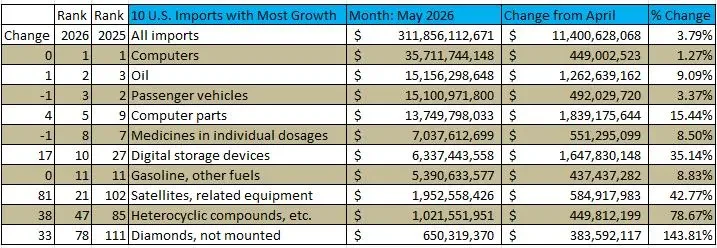
Three import categories increased more than $1 billion in May, when compared to the previous month, playing a role in the United States' increasing trade deficit.
WorldCity analysis of U.S. Census Bureau data
The $103.65 billion U.S. trade deficit in May was the second-highest since March of last year, the second month in a row with an increase.
The deficit surged last March as companies the world over front-loaded shipments to avoid President Trump’s April 2 “Liberation Day” tariffs, since declared illegal by the Supreme Court. The only other month higher than the current figure was the $117.13 billion total last July.
The May increase is potentially troubling to a president who, like many of his predecessors, does not like trade deficits. The difference is that Trump has raised or attempted to raise tariffs to a rate not seen since the Great Depression, though not all have survived legal challenges.
Within the last couple of weeks, he has threatened cutting off all trade with Spain, 50% tariffs on Canada, 25% tariffs on Brazil, 100% tariffs on generic drugs where the manufacturer is not investing in the United States, and threatening to roll out a section of the 1930 Smoot-Hawley Trade Act that has never been used. (The United States has a trade surplus with Brazil.) Most have “carve outs,” which would lessen any impact, or will soon be abandoned, if past pronouncements provide any guidance.
The United States registered a greater deficit than in May in pm;y one month since President Trump's announcement of "Liberation Day" tariffs on April 2, 2025.
WorldCity analysis of U.S. Census Bureau data
The May increase to $103.65 billion comes on top of a monthly increase in April to $82.46 billion, after three months of relatively low trade deficits. The February deficit was $58.42 billion.
In fact, through the first quarter, the U.S. trade deficit was the lowest it had been since the first quarter of 2020. After two months of increasing deficits, it remains down on a year-to-date basis, but only lower than the total through the first quarter of 2021.
What changed in May?
U.S. exports, which are up 15.09% on a year-to-date basis, fell 4.49% in the month of May when compared to April and 5.96% when compared to March, according to my analysis of the latest U.S. Census Bureau data.
Meanwhile, U.S. imports, which are down 4.08% year-to-date, increased in May when compared to April to the highest level since March of 2025 – the month prior to the Liberation Day tariffs were announced – up 3.79% when compared to one month ago and slightly less, 3.17%, when compared to March, two months ago.
On the export side, four outbound shipments cooled significantly from March and April into May.
The first was gold, which fell $5.93 billion, a decline of 25.19% from April and 67.74% from March.
At the moment, gold appears to be coming down from the party that was 2025. In 2025, gold had its best year since 1979, with its price appreciating to $5,500 an ounce at one point, and with the category briefly ranking as the most valuable U.S. export – both reactions to skittishness in the financial markets tied not only to the disruptive trade war with the world but ongoing wars in Ukraine and Gaza.
Most gold exports fly from JFK International Airport to Switzerland, where gold is processed, and the United Kingdom, home to one of the world’s three largest financial markets, London.
The second and third important exports to this story, computers and computer parts, also rose rapidly in 2025 in an attempt to meet the demand of the companies building AI data centers across the country. U.S. computer parts, in particular, are part of the USMCA supply chain – and come back as servers. But computers also play into this as well, with the majority of U.S. exports also headed to Mexico.
On the import side, three inbound shipments increased more than $1 billion in May when compared to the previous month.
The largest increase was in computer parts, which increased $1.84 billion. That was 15.44% greater than the April total and the largest monthly total for at least two years. It’s a safe bet most of those parts are replacement or add-on parts for some of the server farms.
The second-largest increase was in digital storage devices, a jump of $1.65 billion, which was equal to 35.14% and, as with computer parts, the largest total in two years. I will again guess this has something to do with the AI industry, whose largest players are investing billions to forge ahead of each other, the Chinese startups, and others springing up around the world.
The third-largest increase, and the only other one with an increase in excess of $1 billion when compared to the previous month, was oil. The value of oil exports increased $1.26 billion, an increase of 9.09% and the highest total since July of 2024. Oil prices have fluctuated but overall increased after the United States started the war with Iran four months ago.
And yes, despite Trump’s efforts in his first term to collar the deficit with steep tariffs on China, despite former President Joe Biden’s decision to largely leaving those tariffs in place, despite China’s trade deficit falling more than 60% from its 2018 peak, and despite Trump’s renewed efforts in his second term, the U.S. trade deficit has set a record seven of the last nine years, topping $1 trillion the last five.
May’s sharp increase is less an anomaly than a reminder. Trade flows can be distorted in the short term by policy shocks, front-loading and geopolitical tension, but over time they tend to revert to underlying economic fundamentals.
Unless those fundamentals change, the trade deficit is likely to remain not just persistent, but historically large — regardless of who occupies the White House or how aggressively tariffs are deployed.