For the legendary Swiss folk hero William Tell, shooting an apple off his son’s head was the punishment for an act of rebellion. So when John Stewart’s father places an apple on his young son’s head in the opening scene of HBO’s Lanterns, it feels like that tall tale has been twisted into an act of child abuse. Then he pulls the trigger, shoots the apple cleanly, and reveals the act for what it really is: a cruel ritual designed to condition John’s fearlessness.
John had just watched the Green Lantern, aka Hal Jordan (Kyle Chandler), explain his own fearlessness during a 1996 television interview. Every child’s greatest fear is losing a parent, Hal explains, but his test-pilot father died when Hal was eight. The worst thing he could imagine had already happened. So when a Green Lantern ring chose him and asked whether he was afraid, the honest answer was no.
That juxtaposition between Hal and John establishes the central tension of Lanterns, an exceptional eight-episode superhero detective drama created by Chris Mundy (Ozark), Damon Lindelof (Watchmen), and award-winning comics writer Tom King. Hal’s fearlessness emerged from catastrophic loss; John’s family manufactured his. Their respective traumas turned them into radically different men — and immediately combustible partners.
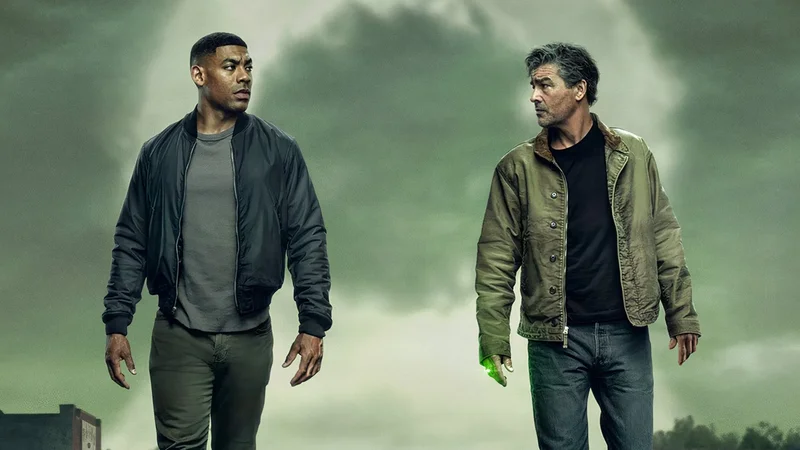
After deftly establishing their dueling visions of fearlessness, the series pairs Hal with John’s imposing adult self (Aaron Pierre) to investigate a mass shooting with potential extraterrestrial connections in the small town of Rushville, Nebraska. What they find draws them into a conspiracy with far-reaching implications.
‘True Detective with superheroes’ works better than it should
Describing Lanterns as “True Detective with superheroes” always sounded reductive, even if that easy comparison haunted the series for years. Having seen the first seven episodes, I can confidently say it’s also accurate. Hal and John are odd-couple investigators circling a rural menace with potentially cosmic stakes. Like True Detective’s Rust Cohle and Marty Hart, they immediately generate friction: Hal drives up to meet his new trainee with music blaring and somewhat proudly proclaims, “I’m late!” You can practically feel John bristling.
Hal is a disheveled, frequently hungover wiseass who relies on gut feelings and treats authority as an obstacle. John is a disciplined soldier who follows orders to a T, but he’s also thoughtful, creative, and far more measured than his new mentor. John has been training with Hal for two months when the story begins, and Hal still has no interest in accepting that he might need backup.
At times, Lanterns also feels like the first superhero drama precision-engineered for Yellowstone fans. In Rushville, weathered men trade barbs beside pickup trucks, a powerful family lords over the surrounding community, and dudes wear seriously big hats while riding horses with big guns. That neo-Western atmosphere grounds the cosmic mythologyl so the series never feels bogged down by Green Lantern’s weirder comic-book elements. (If you're looking for Mogo, the massive living planet who's also a member of the Green Lantern Corps, this isn't the TV show for you.)
The central mystery in Lanterns is compelling in its own right. Rushville’s smalltown quaintness grows increasingly unnerving as Hal and John uncover evidence that something potentially sinister is happening beneath the surface (previous trailers have name-dropped a race of aliens called Manhunters). Lanterns withholds its biggest answers just long enough without becoming frustrating, and many of the mysteries add new dimensions to the characters rather than manufacture twists for the sake of some kind of mystery box. The investigation moves at a steady clip, with each revelation adding weight to Hal and John’s partnership and the forces that brought them together.
The show exercises similar restraint with its superhero spectacle. A muted palette makes the emerald glow of a Green Lantern ring feel genuinely otherworldly whenever it’s used, accompanied by an uncanny warble. But the grounded setting never really avoids everything strange and interesting about Green Lantern. The series gives the cosmic mythology a more human scale without abandoning the alien technology or big ideas about courage and willpower.
Most importantly, Lanterns understands that friction between two people can be frustrating, but it doesn’t necessarily mean it’ll lead to hatred. Hal and John don’t need to like each other to respect one another. They butt heads constantly. But their conflict never feels manufactured, and neither does the connection that keeps them together. Like Rust and Marty in True Detective, they recognize that the annoying man sitting beside them in the car is who they want by their side when everything goes wrong.
Truly, if you like shows like True Detective, Watchmen, and Yellowstone and have even a passing interest in Green Lantern, there’s a lot to love about Lanterns.
Aaron Pierre and Kyle Chandler redefine Green Lantern
Chandler’s casting initially seemed like an odd fit to me. Hal is often depicted as a clean-cut test pilot in the prime of his life. In Lanterns, Chandler walks with a slight hunch and carries the weariness of a man who's spent decades battling the worst things in the universe. He couldn’t be more different from Ryan Reynolds’ vigorous version of the character in the 2011 movie.
Chandler sells Hal’s charm, exhaustion, and arrogant swagger in equal measure. His outward sloppiness conceals a legitimate hero clever enough to use other people’s low expectations of him against them. He may look like he spent the night drinking — and he probably did — but his obnoxious “gut feelings” have an irritating tendency to be right. When someone is in danger, the disheveled facade drops away and Hal acts without hesitation, suit or no suit.
John’s internal conflict anchors the series, even if Hal is the more immediately engaging character. Pierre is a revelation throughout Lanterns and emerges as its true star. John has spent his life carrying other people’s expectations for him, and Pierre conveys the layers to the character that this burden creates.
When the adult John first appears, he’s hammering away at a punching bag, immediately establishing him as physically imposing and precise. Pierre reflects the character’s traumatic upbringing with astonishing control. John’s posture, focus, and sheer presence suggest a dangerous man who learned too young that every movement matters. His strikingly light eyes make him appear Lantern-like without the ring, as if he has spent his life growing into an image someone else created for him.
In the best possible way, Lanterns also recalls the thematic heft of HBO’s Watchmen, which Lindelof developed. Both series use superhero mythology to examine the Black experience in America, especially the inherited trauma and the institutions that decide who gets to wield power. Lanterns doesn’t interrogate those subjects as deeply as Watchmen, but its ideas about fear and heroism remain inseparable from John Stewart’s identity as a Black man.
Hal’s loss convinces him that nothing worse can happen. John is raised to navigate a frightening world that routinely overlooks Black people while carrying the expectations of a family determined to ensure he will never be overlooked again. Lanterns finds both love and cruelty in the way his family prepares him for that future. Pierre then finds the person beneath that preparation: a thoughtful, emotionally guarded man trying to determine which parts of his identity actually belong to him.
That inner conflict gives Lanterns a great deal of emotional force. Fearlessness is usually treated as an uncomplicated qualification for joining the Corps, but Lanterns presents it as something closer to a psychological wound. Hal and John are both extraordinarily courageous, but they both had to lose something profound to become that way.
Even as early as the opening scene, Hal Jordan and John Stewart can truthfully answer the same question: “Are you afraid?” No. The most interesting thing Lanterns does is to never question or compromise that answer. Instead, the drama comes from reflecting on what they’ve lost to achieve that. Sure, being a superhero is cool, but is it really worth it?
Lanterns* premieres Aug. 16 on HBO and HBO Max. *